Friday, April 29, 2022

Becoming Boethius: The Medieval Mind of C.S. Lewis


Church Life Journal has a fascinating essay by Jason Baxter about C.S. Lewis as a medievalist. (And Chesterton gets mentioned!) 

"Perhaps to our surprise, this third Lewis, the medievalist, emerges in the 1962 list that he shared with The Christian Century. When Lewis replied to the editors, he mentioned ten books that shaped his sense of vocation and his philosophy of life, some of which we would expect: 1) George MacDonald’s Phantastes; 2) G.K. Chesterton’s Everlasting Man; 3) Virgil’s Aeneid; 4) The Temple, by George Herbert; 5) William Wordsworth’s Prelude; 6) Rudolf Otto’s The Idea of the Holy; 7) Boethius’s Consolation of Philosophy; 8) The Life of Samuel Johnson, by James Boswell; 9) Descent into Hell, by Charles Williams; and 10) Arthur James Balfour, Theism and Humanism. Some of these books, even if they have been largely forgotten by us, make sense in light of Lewis’s interest in apologetics. ..."

The essay is an adaptation of the introductory chapter of The Medieval Mind of C.S. Lewis: How the Great Book Shaped a Great Mind.

You can read the full essay here.


Monday, April 11, 2022

A Scottish Connection


In his autobiography, GKC explained that his mother came of “Scottish people, who were Keiths of Aberdeen” - hence his middle name. He noted that “partly because of a certain vividness in any infusion of Scots blood or patriotism, this northern affiliation appealed strongly to my affections; and made a sort of Scottish romance of my childhood”

He did not dwell on his Scottish roots - he viewed himself as English - though he did have a fondness for Robert Louis Stevenson. And he did discuss Mary, Queen of Scots, including an essay (reprinted in the Ignatius edition of Lepanto) called "If Don Juan of Austria Had Married Mary Queen of Scots." I'll deal with that essay in a later post..

In All Things Considered, he did include an essay dealing with Scotland, declaring in it “I am quite certain that Scotland is a nation; I am quite certain that nationality is the key of Scotland.” 

Here is the essay:

Edward VII. and Scotland


IHAVE received a serious, and to me, at any rate, an impressive remonstrance from the Scottish Patriotic Association. It appears that I recently referred to Edward VII. of Great Britain and Ireland, King, Defender of the Faith, under the horrible description of the King of England. The Scottish Patriotic Association draws my attention to the fact that by the provisions of the Act of Union, and the tradition of nationality, the monarch should be referred to as the King of Britain. The blow thus struck at me is particularly wounding because it is particularly unjust. I believe in the reality of the independent nationalities under the British Crown much more passionately and positively than any other educated Englishman of my acquaintance believes in it. I am quite certain that Scotland is a nation; I am quite certain that nationality is the key of Scotland; I am quite certain that all our success with Scotland has been due to the fact that we have in spirit treated it as a nation. I am quite certain that Ireland is a nation; I am quite certain that nationality is the key to Ireland; I am quite certain that all our failure in Ireland arose from the fact that we would not in spirit treat it as a nation. It would be difficult to find, even among the innumerable examples that exist, a stronger example of the immensely superior importance of sentiment to what is called practicality than this case of the two sister nations. It is not that we have encouraged a Scotchman to be rich; it is not that we have encouraged a Scotchman to be active; it is not that we have encouraged a Scotchman to be free. It is that we have quite definitely encouraged a Scotchman to be Scotch.

A vague, but vivid impression was received from all our writers of history, philosophy, and rhetoric that the Scottish element was something really valuable in itself, was something which even Englishmen were forced to recognise and respect. If we ever admitted the beauty of Ireland, it was as something which might be loved by an Englishman but which could hardly be respected even by an Irishman. A Scotchman might be proud of Scotland; it was enough for an Irishman that he could be fond of Ireland. Our success with the two nations has been exactly proportioned to our encouragement of their independent national emotion; the one that we would not treat nationally has alone produced Nationalists. The one nation that we would not recognise as a nation in theory is the one that we have been forced to recognise as a nation in arms. The Scottish Patriotic Association has no need to draw my attention to the importance of the separate national sentiment or the need of keeping the Border as a sacred line. The case is quite sufficiently proved by the positive history of Scotland. The place of Scottish loyalty to England has been taken by English admiration of Scotland. They do not need to envy us our titular leadership, when we seem to envy them their separation.

I wish to make very clear my entire sympathy with the national sentiment of the Scottish Patriotic Association. But I wish also to make clear this very enlightening comparison between the fate of Scotch and of Irish patriotism. In life it is always the little facts that express the large emotions, and if the English once respected Ireland as they respect Scotland, it would come out in a hundred small ways. For instance, there are crack regiments in the British Army which wear the kilt—the kilt which, as Macaulay says with perfect truth, was regarded by nine Scotchmen out of ten as the dress of a thief. The Highland officers carry a silver-hilted version of the old barbarous Gaelic broadsword with a basket-hilt, which split the skulls of so many English soldiers at Killiecrankie and Prestonpans. When you have a regiment of men in the British Army carrying ornamental silver shillelaghs you will have done the same thing for Ireland, and not before—or when you mention Brian Boru with the same intonation as Bruce.

Let me be considered therefore to have made quite clear that I believe with a quite special intensity in the independent consideration of Scotland and Ireland as apart from England. I believe that, in the proper sense of the words, Scotland is an independent nation, even if Edward VII. is the King of Scotland. I believe that, in the proper sense of words, Ireland is an independent nation, even if Edward VII. is King of Ireland. But the fact is that I have an even bolder and wilder belief than either of these. I believe that England is an independent nation. I believe that England also has its independent colour and history, and meaning. I believe that England could produce costumes quite as queer as the kilt; I believe that England has heroes fully as untranslateable as Brian Boru, and consequently I believe that Edward VII. is, among his innumerable other functions, really King of England. If my Scotch friends insist, let us call it one of his quite obscure, unpopular, and minor titles; one of his relaxations. A little while ago he was Duke of Cornwall; but for a family accident he might still have been King of Hanover. Nor do I think that we should blame the simple Cornishmen if they spoke of him in a rhetorical moment by his Cornish title, nor the well-meaning Hanoverians if they classed him with Hanoverian Princes.

Now it so happens that in the passage complained of I said the King of England merely because I meant the King of England. I was speaking strictly and especially of English Kings, of Kings in the tradition of the old Kings of England. I wrote as an English nationalist keenly conscious of the sacred boundary of the Tweed that keeps (or used to keep) our ancient enemies at bay. I wrote as an English nationalist resolved for one wild moment to throw off the tyranny of the Scotch and Irish who govern and oppress my country. I felt that England was at least spiritually guarded against these surrounding nationalities. I dreamed that the Tweed was guarded by the ghosts of Scropes and Percys; I dreamed that St. George's Channel was guarded by St. George. And in this insular security I spoke deliberately and specifically of the King of England, of the representative of the Tudors and Plantagenets. It is true that the two Kings of England, of whom I especially spoke, Charles II. and George III., had both an alien origin, not very recent and not very remote. Charles II. came of a family originally Scotch. George III. came of a family originally German. But the same, so far as that goes, could be said of the English royal houses when England stood quite alone. The Plantagenets were originally a French family. The Tudors were originally a Welsh family. But I was not talking of the amount of English sentiment in the English Kings. I was talking of the amount of English sentiment in the English treatment and popularity of the English Kings. With that Ireland and Scotland have nothing whatever to do.

Charles II. may, for all I know, have not only been King of Scotland; he may, by virtue of his temper and ancestry, have been a Scotch King of Scotland. There was something Scotch about his combination of clear-headedness with sensuality. There was something Scotch about his combination of doing what he liked with knowing what he was doing. But I was not talking of the personality of Charles, which may have been Scotch. I was talking of the popularity of Charles, which was certainly English. One thing is quite certain: whether or no he ever ceased to be a Scotch man, he ceased as soon as he conveniently could to be a Scotch King. He had actually tried the experiment of being a national ruler north of the Tweed, and his people liked him as little as he liked them. Of Presbyterianism, of the Scottish religion, he left on record the exquisitely English judgment that it was "no religion for a gentleman." His popularity then was purely English; his royalty was purely English; and I was using the words with the utmost narrowness and deliberation when I spoke of this particular popularity and royalty as the popularity and royalty of a King of England. I said of the English people specially that they like to pick up the King's crown when he has dropped it. I do not feel at all sure that this does apply to the Scotch or the Irish. I think that the Irish would knock his crown off for him. I think that the Scotch would keep it for him after they had picked it up.

For my part, I should be inclined to adopt quite the opposite method of asserting nationality. Why should good Scotch nationalists call Edward VII. the King of Britain? They ought to call him King Edward I. of Scotland. What is Britain? Where is Britain? There is no such place. There never was a nation of Britain; there never was a King of Britain; unless perhaps Vortigern or Uther Pendragon had a taste for the title. If we are to develop our Monarchy, I should be altogether in favour of developing it along the line of local patriotism and of local proprietorship in the King. I think that the Londoners ought to call him the King of London, and the Liverpudlians ought to call him the King of Liverpool. I do not go so far as to say that the people of Birmingham ought to call Edward VII. the King of Birmingham; for that would be high treason to a holier and more established power. But I think we might read in the papers: "The King of Brighton left Brighton at half-past two this afternoon," and then immediately afterwards, "The King of Worthing entered Worthing at ten minutes past three." Or, "The people of Margate bade a reluctant farewell to the popular King of Margate this morning," and then, "His Majesty the King of Ramsgate returned to his country and capital this afternoon after his long sojourn in strange lands." It might be pointed out that by a curious coincidence the departure of the King of Oxford occurred a very short time before the triumphal arrival of the King of Reading. I cannot imagine any method which would more increase the kindly and normal relations between the Sovereign and his people. Nor do I think that such a method would be in any sense a depreciation of the royal dignity; for, as a matter of fact, it would put the King upon the same platform with the gods. The saints, the most exalted of human figures, were also the most local. It was exactly the men whom we most easily connected with heaven whom we also most easily connected with earth. 
Friday, April 01, 2022

Be Alive As You Die


“A dead thing can go with the stream, but only a living thing can go against it.”
    - G. K. Chesterton


We’ve had a small late March snowstorm a couple of days ago. In Western New York, this is not unusual. I’ve experienced April snow here. 


There was enough snow I had to do a little shoveling of the driveway. 


I like shoveling snow. It’s a physical activity, albeit, a short-lived one. But it makes me feel …  virtuous. And there’s a sense of accomplishment as I clear a path for the cars. And it gives me time to think, to pray, to mull over my latest writing project or what I should have said (or might say).


When the snowfall is heavier, as it was earlier this year, I’ve even had to get out the small electric snowblower my daughters kindly gave me one Christmas. I like to shovel, but I’m not a masochist.


My wife, however, frets any time I go out to clear snow off the driveway. She is certain I will at some point have a heart attack and drop dead. Shovel in hand. She keeps bringing up the idea of hiring someone to plow.


When she brings this up, I usually respond I don’t want to hire a plowing service. And if I do drop dead, it’s actually one of the ways I wouldn’t mind going into the great beyond. It would be sudden; no lingering. 


Another way I wouldn’t mind going is mowing the lawn. It’s also an activity I enjoy for many of the same reasons I enjoy shoveling the driveway. And it’s another activity my wife frets about and repeatedly calls for hiring an outsider to battle the grass.


So far, I’ve held off giving in to her.


There’s also a romantic side to me, so if I had to go I wouldn’t mind if it was in some heroic way. I’m too old to be a soldier, a police officer, or a firefighter, so I wouldn’t go into the heavenly realms doing my job. But dying while saving someone during some kind of disaster - natural or man-made - would be a fine way to step into the light.


Another romantic way to go would be as a martyr. Yes, that might be slow and/or painful, but dying for my faith in such a way would make up for some (too many) sins in my past, and would (I hope) punch my ticket into heaven. 


I’ve joked that when my time comes, family members should just drive me deep into the Canadian woods, open the car door, and let me out to sit under a tree to welcome Brother Death. Of course, the fact that I might also have to deal with Brother Bear or Brother Wolf makes me reject this option. 


When I look at the ways I wouldn’t mind dying, I think of Dylan Thomas’s admonition not to go gentle into that good night. Go down fighting. Don’t go with the current like a dead thing, as Chesterton noted, go against it like a living thing. Confront the forces of nature. Go against the currents of evil or the secular secular culture. Be alive, even as you die.


What I would not like is a slow, lingering slide into that good night. I’ve watched too many loved ones suffer in that way. My father, who in his youth had been a star athlete and even a heavyweight boxer, suffered a massive stroke and spent his last 13 years gradually losing his abilities to walk and to take care of himself. He ended up in a nursing home. He was aware of his decline, and it deeply troubled him.


That’s not for me.


Just give me a shovel and let it snow, let it snow, let it snow.


Thursday, March 24, 2022

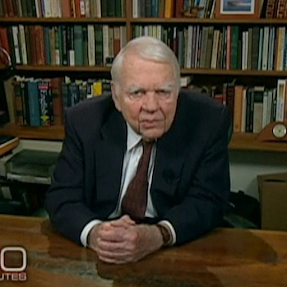
A Reflection on Andy Rooney and Chesterton


I’ve been reading a collection of short essays by the late Andy Rooney. Anyone familiar with his short commentaries for years on 60 Minutes will find these essays true to form.

I always enjoyed his commentaries. Yes, he was frequently cranky and a bit of a curmudgeon, but so am I.

When I think of the two men, I can imagine Rooney yelling at the kids to get off his lawn, while Chesterton would amble out and join in whatever game the young folks were playing.


As I read, I was suddenly reminded of the essays of G.K. Chesterton. No, not that Chesteron was cranky or a curmudgeon. He was passionate about issues and ideas, but he never showed in his writing the suggestion of anger that underlies some of Rooney’s. And their writing styles are very different. Colloquial language has changed over the years, and Rooney’s writing appeals more to a contemporary American audience demanding short sentences and simplified language. Rooney’s essays are also short when compared with Chesterton’’s. Again, shortness is more the style of contemporary Americans who are more used to sound bytes than sound explanations. Indeed, some of Rooney’s essays seem to end abruptly, almost at a point where Chesterton would just be warming up. And consequently, Rooney’s essays, while they often make valid points, don’t go far enough, certainly not to the depth of thought and insight a Chesterton essay offers..

But there were some things in Rooney’s essays that did remind me of Cheterton’s.

Rooney, like Chesterton, viewed himself as primarily a journalist.

While Rooney could be cranky with an edge of anger, he never seemed mean-spirited, even in criticizing others. In that, he was like Chesterton, who often made good friends of his foes.

The essays also tend to be very personal in nature - much as were so many of Chesterton’s. In the middle of a discussion of some international subject Rooney will suddenly insert a personal experience or memory inspired by the subject at hand.

But what struck me as most similar is that Rooney, like Chesterton, writes about everything, even commonplace seemingly trivial things. He does not necessarily celebrate them as Chesterton does, but he certainly is aware of them in a way most of us are too busy or oblivious to do so. In this particular collection, Rooney expounds on going to the dump, cookies, music, the Super Bowl, newspapers, cooking, semicolons, baseball, cars, and more. I don’t know if he ever wrote about things he found in his pocket, but you never know.

And as he writes about all these seemingly trivial things he often uses them as starting points to ruminate about the world and human nature. Indeed, as happens in some Chesterton essays, when you get to the end you have almost forgotten what he was originally talking about.

Of course, unlike Chesterton, he tended to focus on the negative, If, for example, both men ate a breakfast cereal, Chesterton would probably celebrate the creativity that went into making that cereal and use that as a jumping off point to expound on human creativity in general, while Rooney would more likely wonder about the chemicals and additives in the cereal and the possible negative effects of eating that cereal on his waistline.

I like both writers. I enjoy reading both. But I also recognize that while the essays of Rooney are of their time, the essays of Chesterton are timeless.

Tuesday, March 15, 2022

G.K. Chesterton Became Catholic 100 Years Ago, Drawn in by Jerusalem and Our Lady


"On July 30, 1922, at the Railway Hotel, in Beaconsfield, England, G.K. Chesterton became a Catholic. In the absence of a local Catholic church, the Railway Hotel’s Irish landlady had allowed the ballroom to be converted into a makeshift chapel. It was there, beneath a corrugated-iron roof and surrounded by bare wooden walls, the 48-year-old writer entered into full communion with the Church.

What were the reasons for Chesterton taking this step?

And, given his thought and writings on Christianity for many years, why had it taken him so long? ..."

Monday, March 14, 2022

Tom Baker Clerihew


As an actor, Tom Baker
was more of a character than a heart-breaker.
But I think his Doctor is worthy of a clerihew,
even though at mention of his name some folks just say, Who?"

Robert Burns Clerihew


Robert Burns
hid behind some ferns.
He feared that he might be shot
by the husband of an auld acquaintance he forgot.

Thursday, March 03, 2022

Judgment for Planned Parenthood


 “God Himself will not help us ignore evil, but only to defy and to defeat it.” 

I was recently watching Judgment at Nuremberg. If you have never seen it, it's a powerful film with some fine performance. Indeed, Maximilian Schell won the Academy Award for Best Actor. Interestingly, after finishing this move he portrayed Saint Joseph of Cupertino in The Reluctant Saint. Saint Joseph was not a bright light - and I couldn't help but wonder if Schell was inspired in any way by the nominated (as Best Supporting Actor) portrayal of a developmentally limited man by Montgomery Clift in Judgment at Nuremberg.

The movie raises  number of moral issues, including the culpability of government officials who did nothing to oppose the growing evil - and indeed were often complicit in it. The four judges on trial in the movie all had "rational" explanations for their crimes, including that they were willing to sacrifice people for the good of the nation.

The movie also addressed the issue of people who say they did not know the evil that was going on.

That ignorance may have been due to a number of causes.

Some people might  have been genuinely ill-informed, isolated, impoverished, caught up in mere survival, or mentally challenged that they really did not know. I have sympathy for them.

Others are harder to excuse.

Some people were lazy and relied on others to keep them "informed."

Some people deliberately tried to avoid becoming informed.

Some people were aware - partly, or wholly - but chose denial.

Some people were aware - partly or wholly - but chose to lie.

Some people were aware - partly or wholly - but were too afraid of potential repercussions to do anything. 

Some people simply didn't care.

The degree of quilt varied. Certainly the men on trial in the movie deserved to be sentence to prison. But the people of Germany - indeed, of the world - who allowed this evil to occur were not exempt from blame. 

As the Chesterton quotation that begins this post suggests, God is not on the side of those who ignore evil - for whatever reason. We are called to recognize and reject evil, not to wallow in ignorance. Indeed, as he observed, “We cannot be vague about what we believe in, what we are willing to fight for, and to die for.”

The movie and the cooperation with evil of so many people reminded me of the evil of abortion in our country. Some people have been directly involved in the killing of more than 60 million babies. Some allowed it to continue through elections, their refusal to acknowledge what organizations like Planned Parenthood really do, and by their failure to act to change the culture and the laws.

Too often they plead that they did not or do not know. Too often, they do nothing to become informed. And they allow the supporters of abortion to justify it because it is supposedly better in some way for individuals, society, the economy, and so on. Some call it a right, or a good thing.

It's like a 1984 twisting of language. 

We are seeing what Chesterton noted: “Men do not differ much about what things they will call evils; they differ enormously about what evils they will call excusable.”

Although some involved with abortion have faced charges for related crimes, it is unlikely that others will face a tribunal like that depicted in the movie for the crime of abortion itself. After all, as those accused in the film could legitimately contend about what they did, while it may be a crime against humanity, it is legal. 

And those who plead ignorance will not be confronted with the evil they tried to ignore.

At least not in this life.

For in the end, there will be a Final Tribunal that with render a Final Judgment. 


Monday, February 28, 2022

Yikes


On social media - a swamp I advise others to tread in cautiously - I've seen repeated debates over certain Catholic issues.

Usually, they are started by one side in the debates.

There are those who hate Pope Francis no matter what he says or does.

There are those who contend the only valid way to celebrate Mass is the Traditional Latin Mass.

There are those say only traditional hymns played on organ or sung by choirs are proper for Mass.

Tired of the endless stream of criticism - again, largely from one side - I posted:

All the squabbles over TLM vs. NO, contemporary (guitar) music vs. traditional organ hymns, Pope Francis vs. "Pope X" deemed more "orthodox," I think of The Screwtape Letters. C.S. Lewis uses Screwtape to point out that the devil uses such squabbles to help undermine faith.

I added two quotations from Screwtape:

“Provided that any of those neighbors sing out of tune or have boots that squeak, or double chins, or odd clothes, the patient will quite easily believe that their religion must therefore be somehow ridiculous.” 

“Surely you know that if a man can’t be cured of churchgoing, the next best thing is to send him all over the neighborhood looking for the church that “suits” him until he becomes a taster or connoisseur of churches.”

The response was as if I stepped on a wasp nest.

Oh, there were those who agreed with me - but even more who attacked not only me and my position, but Novus Ordo and Vatican II in general.

So many claimed that with NO the liturgical abuses are the norm, not the exception.

I pointed out that I regularly attend NO Masses that are reverent and liturgically correct.

One person suggested that I must attend a "magical unicorn parish."

Sigh.

I know that the TLM folks have a beef because of some recent statements and guidelines out of the Vatican. Though I think a few brought it on the whole because of the way they talk and act - as some of the responses to my postings show.

I know that most TLM folks - especially the ones I know - are faithful, devout people who don't run around pontificating with chips on their shoulders. 

As a musician, I know a lot of contemporary music is flawed. But there are also some wonderful new hymns out there - including some played on guitars. And I've been to churches where traditional hymns are played on an organ - and it sounds as if I'm at a circus. Musicianship is important!

I engage in debates with pro-choicers on a regular basis. To be honest, I find those debates less painful than these liturgical/Church ones. The pro-choicers are like the kid down the street who calls you a name. It may bother you - but not as much as when a relative or someone you considered a friend calls you the same thing.  

The Church is universal, and I think we need to accept that as long as people are following the rubrics, various forms are worship are equally valid, so we need to be careful how and when we criticize. If something is being done incorrectly, speak up. otherwise, we need to accept that we are not all the same.

There are more important spiritual issues that need our attention than what language one uses or what  musical instrument one plays.

As Screwtape notes, when we do this we play into his hands:

“The game is to have them all running about with fire extinguishers when there is a flood, and all crowding to that side of the boat, which is already nearly gunwale under.”

Friday, February 04, 2022

Patriotism and Sport (and the Olympics)


The Beijing Olympics have begun. I’m not a big fan of the Winter Olympics in general, but I have in the past tuned in for some events.
 
There’s something about curling.
 
But this year I am boycotting the Olympics over China’s human rights abuses. Just to cite two of China’s many offenses, the treatment (genocide) of the Uyghurs and forced abortion, merit condemnation. I am saddened that the U.S. and other nations still sent athletes.
 
In 1908, Chesterton commented on nationalism and athletics – the kind of misplaced national pride we too often see with the Olympics.
 
Patriotism and Sport
 
I notice that some papers, especially papers that call themselves patriotic, have fallen into quite a panic over the fact that we have been twice beaten in the world of sport, that a Frenchman has beaten us at golf, and that Belgians have beaten us at rowing. I suppose that the incidents are important to any people who ever believed in the self-satisfied English legend on this subject. I suppose that there are men who vaguely believe that we could never be beaten by a Frenchman, despite the fact that we have often been beaten by Frenchmen, and once by a Frenchwoman. In the old pictures in Punch you will find a recurring piece of satire. The English caricaturists always assumed that a Frenchman could not ride to hounds or enjoy English hunting. It did not seem to occur to them that all the people who founded English hunting were Frenchmen. All the Kings and nobles who originally rode to hounds spoke French. Large numbers of those Englishmen who still ride to hounds have French names. I suppose that the thing is important to any one who is ignorant of such evident matters as these. I suppose that if a man has ever believed that we English have some sacred and separate right to be athletic, such reverses do appear quite enormous and shocking. They feel as if, while the proper sun was rising in the east, some other and unexpected sun had begun to rise in the north-north-west by north. For the benefit, the moral and intellectual benefit of such people, it may be worth while to point out that the Anglo-Saxon has in these cases been defeated precisely by those competitors whom he has always regarded as being out of the running; by Latins, and by Latins of the most easy and unstrenuous type; not only by Frenchman, but by Belgians. All this, I say, is worth telling to any intelligent person who believes in the haughty theory of Anglo-Saxon superiority. But, then, no intelligent person does believe in the haughty theory of Anglo-Saxon superiority. No quite genuine Englishman ever did believe in it. And the genuine Englishman these defeats will in no respect dismay.
 
The genuine English patriot will know that the strength of England has never depended upon any of these things; that the glory of England has never had anything to do with them, except in the opinion of a large section of the rich and a loose section of the poor which copies the idleness of the rich. These people will, of course, think too much of our failure, just as they thought too much of our success. The typical Jingoes who have admired their countrymen too much for being conquerors will, doubtless, despise their countrymen too much for being conquered. But the Englishman with any feeling for England will know that athletic failures do not prove that England is weak, any more than athletic successes proved that England was strong. The truth is that athletics, like all other things, especially modern, are insanely individualistic. The Englishmen who win sporting prizes are exceptional among Englishmen, for the simple reason that they are exceptional even among men. English athletes represent England just about as much as Mr. Barnum's freaks represent America. There are so few of such people in the whole world that it is almost a toss-up whether they are found in this or that country.
If any one wants a simple proof of this, it is easy to find. When the great English athletes are not exceptional Englishmen they are generally not Englishmen at all. Nay, they are often representatives of races of which the average tone is specially incompatible with athletics. For instance, the English are supposed to rule the natives of India in virtue of their superior hardiness, superior activity, superior health of body and mind. The Hindus are supposed to be our subjects because they are less fond of action, less fond of openness and the open air. In a word, less fond of cricket. And, substantially, this is probably true, that the Indians are less fond of cricket. All the same, if you ask among Englishmen for the very best cricket-player, you will find that he is an Indian. Or, to take another case: it is, broadly speaking, true that the Jews are, as a race, pacific, intellectual, indifferent to war, like the Indians, or, perhaps, contemptuous of war, like the Chinese: nevertheless, of the very good prize-fighters, one or two have been Jews.
 
This is one of the strongest instances of the particular kind of evil that arises from our English form of the worship of athletics. It concentrates too much upon the success of individuals. It began, quite naturally and rightly, with wanting England to win. The second stage was that it wanted some Englishmen to win. The third stage was (in the ecstasy and agony of some special competition) that it wanted one particular Englishman to win. And the fourth stage was that when he had won, it discovered that he was not even an Englishman.
 
This is one of the points, I think, on which something might really be said for Lord Roberts and his rather vague ideas which vary between rifle clubs and conscription. Whatever may be the advantages or disadvantages otherwise of the idea, it is at least an idea of procuring equality and a sort of average in the athletic capacity of the people; it might conceivably act as a corrective to our mere tendency to see ourselves in certain exceptional athletes. As it is, there are millions of Englishmen who really think that they are a muscular race because C.B. Fry is an Englishman. And there are many of them who think vaguely that athletics must belong to England because Ranjitsinhji is an Indian.
 
But the real historic strength of England, physical and moral, has never had anything to do with this athletic specialism; it has been rather hindered by it. Somebody said that the Battle of Waterloo was won on Eton playing-fields. It was a particularly unfortunate remark, for the English contribution to the victory of Waterloo depended very much more than is common in victories upon the steadiness of the rank and file in an almost desperate situation. The Battle of Waterloo was won by the stubbornness of the common soldier--that is to say, it was won by the man who had never been to Eton. It was absurd to say that Waterloo was won on Eton cricket-fields. But it might have been fairly said that Waterloo was won on the village green, where clumsy boys played a very clumsy cricket. In a word, it was the average of the nation that was strong, and athletic glories do not indicate much about the average of a nation. Waterloo was not won by good cricket-players. But Waterloo was won by bad cricket-players, by a mass of men who had some minimum of athletic instincts and habits.
 
It is a good sign in a nation when such things are done badly. It shows that all the people are doing them. And it is a bad sign in a nation when such things are done very well, for it shows that only a few experts and eccentrics are doing them, and that the nation is merely looking on. Suppose that whenever we heard of walking in England it always meant walking forty-five miles a day without fatigue. We should be perfectly certain that only a few men were walking at all, and that all the other British subjects were being wheeled about in Bath-chairs. But if when we hear of walking it means slow walking, painful walking, and frequent fatigue, then we know that the mass of the nation still is walking. We know that England is still literally on its feet.
 
The difficulty is therefore that the actual raising of the standard of athletics has probably been bad for national athleticism. Instead of the tournament being a healthy melee into which any ordinary man would rush and take his chance, it has become a fenced and guarded tilting-yard for the collision of particular champions against whom no ordinary man would pit himself or even be permitted to pit himself. If Waterloo was won on Eton cricket-fields it was because Eton cricket was probably much more careless then than it is now. As long as the game was a game, everybody wanted to join in it. When it becomes an art, every one wants to look at it. When it was frivolous it may have won Waterloo: when it was serious and efficient it lost Magersfontein.
 
In the Waterloo period there was a general rough-and-tumble athleticism among average Englishmen. It cannot be re-created by cricket, or by conscription, or by any artificial means. It was a thing of the soul. It came out of laughter, religion, and the spirit of the place. But it was like the modern French duel in this--that it might happen to anybody. If I were a French journalist it might really happen that Monsieur Clemenceau might challenge me to meet him with pistols. But I do not think that it is at all likely that Mr. C. B. Fry will ever challenge me to meet him with cricket-bats.
 

Thursday, January 27, 2022

G.K. Chesterton and the Meaning of Education


Joseph Pearce is on a roll. 

G.K. Chesterton and the Meaning of Education| National Catholic Register: The tragedy of modern education is that it has left us perilously ignorant of who we are, where we are, where we have come from and where we are going.

“It is typical of our time,” Chesterton wrote, “that the more doubtful we are about the value of philosophy, the more certain we are about the value of education. That is to say, the more doubtful we are about whether we have any truth, the more certain we are (apparently) that we can teach it to children. The smaller our faith in doctrine, the larger our faith in doctors ...”

Thursday, January 20, 2022

Tolkien, and Father Christmas


Since I have Tolkien on my mind (having seen the movie now), I stopped by the library and picked up a copy of  The Father Christmas Letters (edited by Baillie Tolkien). I had read a few of them before, and wanted to read them all, in part because they are Tolkien, and in part because I'm writing my own "Santa" book and wanted to see how he dealt with Kris Kringle.


Tolkien had written (and illustrated) a letter a year to his children beginning in 1920. This particular collection has the letter from 1920, but then skps to 1925 -though there is a stamp for 1924 and an undated note. I wonder if there is a more complete collection?

I was amused to see we actually have a couple of common ideas - problems with goblins, caves beneath the North Pole, heavy snow, fireworks mishaps, and melting ice and snow. He has a polar bear who means well but causes problems; I have some goofy elves and a human friend who flies a mail plane.


Alas, I don't have his drawing abilities.

Overall, it's an enjoyable read.

Wednesday, January 19, 2022

Tolkien (the movie)


I finally got to see the 2019 movie Tolkien. 

At the time it came out it got mixed reviews, but some Catholic commentators noted that at least it did not attack his faith or distort his life with contemporary obsessions.

I agree that as a film it's, frankly, not that good. "Dull" is the word that comes to mind. 

It's not bad, but the pacing is slow, and the structure is flawed, making it kind of confusing. I also found the attempts to link his life with elements in his fiction clumsy.

It did not attack his faith, and one of the strong positive characters is a priest. But given how deep Tolkien's faith was the movie needed to address Catholicism in more detail. 

I'm glad I saw it. For fans of Tolkien it's worth watching, though the definitive movie about him is yet to be made. But for non-fans, it's probably not the best introduction to Tolkien. Watch The Lord of the Rings Trilogy instead!


Wednesday, December 29, 2021

Mass is Tiresome?


Eating, Drinking and Praying — G.K. Chesterton and Christmas


Joseph Pearce in the National Catholic Register -


Eating, Drinking and Praying — G.K. Chesterton and Christmas| National Catholic Register: Chesterton had the good sense to treat Christmas as if it were the very center of history

The author most associated with the joy and glow of Christmas is obviously Charles Dickens. Apart from the perennially popular A Christmas Carol, Dickens wrote several other Christmas-themed novellas, most notably The Chimes and The Cricket and the Hearth. In his book on Dickens, in a chapter entitled “Dickens and Christmas,” G. K. Chesterton lauded “Dickens’s great defence of Christmas”: ...

Thursday, December 23, 2021

The Man Who Love Christmas


(I have been writing a book called Santa's Diary. One of the entries deals with a familiar fellow.) 

The question I dealt with yesterday about retirement is often linked with another question (sometimes stated, often not): If I ever stopped being Santa Claus, who could take my place?

Mind you, I am Santa only by the will and grace of God. The Lord could just as easily choose someone else to play my role.

When I look back at history, I see so many people who could play the role. Francis of Assisi, for example. There was a man who had the Christmas spirit. (Though that dear little man would have a hard time fitting in my suit!) And, of course, Charles Dickens is often credited with helping to save Christmas. I fear he might have failed the "saint" test, though. 

But If I had to pick just one person, it would be Gilbert Keith Chesterton.

Ho! There’s a man who could fill my suit! In fact, they’d have to let it out!

But beyond his physical size, he was a man who truly loved Christmas.

He wrote essays about it. He cited the feast again and again in his works. He wrote poetry about it.

And he appreciated me. Rather, he appreciated what I represent.

In writing about the loss of a sense of faith in one essay he said, “Father Christmas was with us when the fairies departed; and please God he will still be with us when the gods return.”

Yes, in all modesty, I must admit that all the stories that have grown up around me help to keep alive the sense of wonder and magic, the belief in something that can’t be explained, even in a time when faith is treated as something embarrassing.

In one of his books he wrote, "Father Christmas is not an allegory of snow and holly; he is not merely the stuff called snow afterwards artificially given a human form, like a snow man. He is something that gives a new meaning to the white world and the evergreens, so that the snow itself seems to be warm rather than cold.”

Perhaps that is part of the magic. Not my magic, of course, but the magic of belief.

As for those who don’t believe, he wrote in one essay, “Personally, of course, I believe in Santa Claus; but it is a season of forgiveness, and I will forgive others for not doing so.”

How like the man. That spirit was one reason why even the people he debated respected and loved him. That is part of what would have made him a good Santa.

We met a couple of time. In one essay he described one of our conversations, though, of course, he changed some things around to suit his purpose. He had us meet in a toy shop and had me lamenting the modern world. The conversation actually took place during a meal in a tavern. And I seem to recall some of the lamenting was on his part.

I remember fondly the first time I met him as an adult.

I was in his home delivering gifts (some items for his toy theater), when he walked into the room. I sank back into the shadows, and he did not see me. Even if I hadn’t sunk into the shadows, I’m not sure he would have seen me anyway. As usual, he was lost in thought.

He stopped in the middle of the room, and said loudly, questioningly, “Slipper.”

I looked at his feet. Sure enough, he had only one slipper on.

“Slipper,” he said again.

Then suddenly he walked over to a tall bookcase and reached up to the top.

He brought down a slipper, and a book that had been under it, propped open.

He looked at the book, reading a little from the open page. He chuckled, and then walked out of the room, slipper and book in hand.

I reminded him of the moment years later. He did not remember it.

But he did remember the toy theater items I brought.

Yes, Chesterton would have made a fine Santa.

Of course, given his absent-minded ways, who knows what gifts would have ended up where. Why, if he was bringing a book to someone, he might have just sat down to read it, and when the children rushed down to open their gifts on Christmas morning they might have found him still sitting there, reading, and laughing out loud.

Very Santa-like image, I’d say.

Saturday, December 18, 2021

Rereading


C.S. Lewis observed in - Of Other Worlds: Essays and Stories:

“An unliterary man may be defined as one who reads books once only. . . . We do not enjoy a story fully at the first reading. Not till the curiosity, the sheer narrative lust, has been given its sop and laid asleep, are we at leisure to savour the real beauties. Till then, it is like wasting great wine on a ravenous natural thirst which merely wants cold wetness.”

When I was a teacher, there were indeed certain books/plays that I read again and again because I was teaching them. Among those books were To Kill a Mockingbird by Harper Lee, The Great Gatsby by F. Scott Fitzgerald, several of Shakespeare's plays (Romeo and Juliet, The Merchant of Venice, Hamlet, MacBeth), Pride and Prejudice by Jane Austen. and Jane Eyre by Charlotte Bronte. 

But outside of teaching, there are only a few works I have read more than one. The Lord of the Rings Trilogy and The Chronicles of Narnia come to mind. Chesterton's Orthodoxy and The Everlasting Man are works that I have also reread.

But now that I'm retired, I have more time to read, and I've begun to reread some of the works I read at some time in the past - sometimes as much as 50 years ago. I recently reread The Bridge of San Luis Rey by Thornton Wilder, and a series of dystopian novels like Brave New World by Aldous Huxley, 1984 by George Orwell, and Fahrenheit 451 by Ray Bradbury. There are a few others I have read in the last year and a half, but right now I'm more focused on some of the great works I would like to reread in the future. Among them are: 

The Brothers Karamazov and Crime and Punishment by Fyodor Dostoyevsky
A Tale of Two Cities and Bleak House by Charles Dickens
The Man Who Was Thursday by G.K. Chesterton
Utopia by St. Thomas More
The Republic by Plato 
The Confessions by St. Augustine
The Divine Comedy by Dante

I'm sure there will be more title that will occur to me. I will mix them in as I also read works i've never read before. I hoep to find among those new books more that I will want to reread.

After all, I don't want to be an "unliterary" man.


Friday, December 10, 2021

Chesterton: Advent waiting is a gift


Freelance writer Shemaiah Gonzalez has a wonderful take on Advent, using Chesterton as a focus ("Chesterton: Advent waiting is a gift"):   

Writer G.K. Chesterton appreciated how waiting could be a gift. To Chesterton, waiting opened possibility:

“Around every corner is another gift waiting to surprise us, and it will surprise us if we can achieve control over our natural tendencies to make comparisons (to things that are better rather than things that are worse), to take things for granted … and to feel entitled!”

To see her full essay, go to Chesterton: Advent waiting is a gift


Friday, December 03, 2021

Dr. Seuss Clerihew


Dr. Seuss
was fond of tippling fermented mulberry juice.
This helps to explain a thing or thing two,
such as that cat's hat and Horton's who.