Thursday, August 28, 2025

Maybe Somebody Should Have Put Baby In A Corner


A Grace
by G. K. Chesterton

You say grace before meals.
All right.
But I say grace before the play and the opera,
And grace before the concert and pantomime,
And grace before I open a book,
And grace before sketching, painting,
Swimming, fencing, boxing, walking, playing, dancing;
And grace before I dip the pen in the ink.

Chesterton apparently had nothing against dancing per se, especially when it is part of celebrating. It is a natural human expression of joy and worship.

We see dancing in the context of worship and celebrating in the Bible as well. ("Let them praise His name with dancing; let them sing praises to Him with timbrel and lyre." - Psalm 49: 3 and "A time to weep and a time to laugh; a time to mourn and a time to dance." Ecclesiastes 3: 4 to cite two examples.)

And don't forget Snoopy's joyful dance!

But, of course, dancing has its limits, especially when it strays from celebration - such as David before the Ark - to sensuality - as with Salome before Herod.

Indeed, dance in Western civilizations too often strays into the realm of sensual and erotic. That is why the Catholic Church prohibits it in Masses (except when the Mass is for a cultural group that has dance as part of its worship):

" Here dancing is tied with love, with diversion, with profaneness, with unbridling of the senses. . . . For that reason it cannot be introduced into liturgical celebrations of any kind whatever: That would be to inject into the liturgy one of the most desacralized and desacralizing elements, and so it would be equivalent to creating an atmosphere of profaneness which would easily recall to those present and to the participants in the celebration worldly places and situations." - Congregation for the Sacraments and Divine Worship, Dance in the Liturgy (1975)

One Saint who clearly did not like dance was St. Jean Vianney, The Cure of Ars. In the collection of his sermons (The Sermons of the Cure of Ars, translated by Una Morrissy), he decried dancing again and again.

Is there any place, any time, any occasion wherein so many sins of impurity are committed at the dancehalls and their sequels? Is it not in these gatherings that people are most violently prompted against the holy virtue of purity? Where else but there are the senses so strongly urged towards pleasurable excitement? If we go a little more closely into this, should we not almost die of horror at the sight of so many crimes which are committed? Is it not at these gatherings that the Devil so furiously kindles the fire of impurity in the hearts of the young people in order to annihilate in them the grace of Baptism? Is it not there that Hell enslaves as many souls as it wishes? If, in spite of the absence of occasions and the aids of prayer, a Christian has so much difficulty in preserving purity of heart, how could he possibly preserve that virtue in the midst of so many sources which are capable of breaking it down?

Did the Holy Fathers of the Church say too much about it? St. Ephraim tells us that dancing is the perdition of girls and women, the blinding of men, the grief of angels, and the joy of the devils. Dear God, can anyone really have their eyes bewitched to such an extent that they will still want to believe that there is no harm in it, while all the time it is the rope by which the Devil pulls the most souls into Hell?

St. Augustine tells us that those who go to dances truly renounce Jesus Christ in order to give themselves to the Devil.


And he says even more. Yikes.

We do need to be aware of the context of his condemnation. When he was stationed in Ars, the parish had been without a priest for a while. The population had seriously lapsed when it came to church teachings and practices, and to morality. So he was trying to shock them to break them of bad - and sinful - habits. Dancing was in some ways an entry-level activity for some of those habits.

Now it is true that there are forms of dance that do indeed cross the line. And they may indeed lead into sin. (Why did they call that movie Dirty Dancing?)

Personally, I think, like Chesterton, that dancing can be a good thing in the right forms and the right circumstances. I like that in the poem he calls for saying grace before dancing.

On the other hand, he did advise us not to dismiss the wisdom of the saints: "It is better to speak wisdom foolishly like the saints than to speak folly wisely like the deans."

St. John did have a point. And we know how foolish deans can be.

Speaking of foolishness, reading his sermons did inspire a clerihew (of course).

St. Jean Vianney
went to the hootenanny
but left in horror when he happened to glance
some people starting to dance.

Thursday, August 21, 2025

On Vacation, So Quotations!


I'm on vacation this week, with wife and dog at a cottage as a base from which to venture forth to see the sights. So just a few quotations from Gilbert!

"The traveler sees what he sees, the tourist sees what he has come to see."

"An adventure is only an inconvenience rightly considered. An inconvenience is only an adventure wrongly considered."

"They say travel broadens the mind, but you must have the mind."

"The whole object of travel is not to set foot on foreign land; it is at last to set foot on one's own country as a foreign land."

Thursday, August 14, 2025

What Tolkien Can Teach Us About the Creative Life


"Beyond his much-beloved books, The Hobbit, The Lord of the Rings, and The Silmarillion, J. R. R. Tolkien was a poet, philologist, translator, and inventor of languages. His letters, collected in The Letters of J. R. R. Tolkien, are particularly illuminating, as they offer a glimpse of Tolkien as a writer—one who was often in need of precious, uninterrupted time to write. And though few of these letters are directed to other writers about writing, they reveal some important truths about the craft."  

Thus begins an article by Lindsey Weishar over at Word on Fire. 

She goes on to note: 

"For those of us who write, Tolkien offers a realistic approach to the writing life. Very few of us will be completely free to write as much as we wish. We have families who need us, day jobs to attend to, and obligations to ourselves and others that come with living life. There is beauty in picking up our joys (be that writing or another form of creativity) in the odd hours; so too, there is beauty in the call to the sometimes sacrifice of pouring ourselves out in other ways. Indeed, perhaps that is what makes works like Tolkien’s so rich: The stories lived in him so long and accompanied him throughout his life."

She further says:

"Though writing is often a solitary art, Tolkien’s life demonstrates that our ideas can come to full fruition only when we allow others to enter into them. The Hobbit and The Lord of the Rings appeared before the Inklings, and Tolkien speaks of the debt of gratitude he owed to C. S. Lewis for his encouragement. The Hobbit became a long-form story Tolkien told his children, and he relied on his children, and the son of his publisher, Rayner Unwin, then a young boy, to offer their feedback on The Hobbit. During World War II, he sent parts of Lord of the Rings to his son, Christopher Tolkien, both to comfort Christopher and because Tolkien valued his opinion."

The rest of the article is a good read - especially for those who would be writers!


Friday, August 08, 2025

Saint Tolkien


August 8, 2025

Perhaps I may say also now (as I have meant to do for some time) that though I only briefly thanked Austin [one of the correspondents] for his booklet on the Rosary (I hope I did!), I have now had it by me for a long time, and have derived profit and encouragement from it. I was late in finding the Rosary, and it has been in addition a great delight to know that others whose virtue and learning is far above mine are companions. I began to use it only after hearing Knox [Mgr. Ronald Knox, Tolkien’s chaplain at Oxford] (on a private occasion) say: ‘Personally I do not like the Rosary, but I have a suspicion that Our Lady does.’ Very Knox. But obedience to one’s Mother is only a beginning! It can be greatly rewarded.

J.R.R. Tolkien (letter 242a)


Over on Substack - which seems to a growing place for online writing, including blogs - there is a site called Saint Tolkien run by Kaleb Hammond. He describes himself as:  I am a Roman Catholic, an aspiring writer of both fiction and nonfiction and a graduate student at Holy Apostles College & Seminary pursuing an MA in Theology. My special topics of interest are St. Thomas Aquinas and J.R.R. Tolkien.


He offers a Tolkien Quote of the Day, and a Saint Tolkien Weekly Roundup in which he links to Tolkien-related posts by others, as well as links to other posts of interest to fans of the Inklings and Tolkien. 


August 7, 2025 

I shall miss you v. much at Christmas, though I know it cannot be helped. But I am cheered by the thought that I shall see you again before 1956 is very old. You know that I shall be thinking of you with love, and I know the same of you. I am not attempting to send any Christmas present, since I think it would be much nicer to find something when you are here. I enclose a cheque for £1, in the hope that you may find a chance to say two masses for me. One I should particularly like you to say, for my mother Mabel Tolkien; the other a mass in honour of Our Lady in thanksgiving, you could ‘send back’, if you are (as may well be) overburdened.

J.R.R. Tolkien (letter 179a, to his son, Fr. John, who could rarely come home for Christmas due to the busy parish season)

Thursday, July 31, 2025

In the News (Two Clerihews)


Two people in the news lately inspired clerihews, Ozzy Osbourne and Syndey Sweeney..

Ozzy Osbourne
was by water borne
to the Alamo
where he was heard to mumble, "When ya gotta go, ya gotta go."


(Ozzy died July 22. Back in 1982, a drunken Osbourne publicly urinated in Alamo Plaza on the Alamo Cenotaph, a 60-foot monument commemorating the men and women who defended the Alamo in 1836.

He was arrested and paid a fine, and was banned from performing in San Antonio for 10 years. He apologized, and was eventually allowed to perform in that city again.

Then, in 2015, 33 years after the incident, he was finally welcomed back to the Alamo for a segment of the History Channel's series, Ozzy & Jack’s World Detour.

After his death, the Alamo, on its Instagram account, issued a statement:

We at the Alamo are saddened to hear of the passing of legendary musician Ozzy Osbourne. His relationship with the Alamo was marked initially by a deeply disrespectful incident in 1982. This act profoundly and rightfully upset many who hold this site sacred.

However, redemption and reconciliation eventually became part of his history as well. In 1992, Ozzy personally apologized to then-Mayor Nelson Wolff and expressed genuine remorse for his actions. Decades later, in 2015, he revisited the Alamo grounds to learn and appreciate the site's profound history, openly demonstrating humility and understanding.

At the Alamo, we honor history in all its complexities. Today, we acknowledge Ozzy Osbourne's journey from regret to reconciliation at the historic site, and we extend our condolences to his family, friends, and fans around the world. May he rest in peace.)

Sydney Sweeney,
noting that her costume for the next scene seemed especially teeny,
asked the director, "Is this all there is to it?"
Leering, he replied, "You can just leave it off if it doesn't fit."

(Sweeney has been in the news lately because of a fake controversy over her American Eagle Jeans ads. She earlier gained notoriety for her nude scenes in an HBO series.)

Thursday, July 24, 2025

Carter vs Scranton Joe (Clerihew)


Good Jimmy Carter,
when it comes to presidents was one of the smarter.
Historians rank his presidency pretty low,
but it’s looking better these days thanks to “Scranton Joe.”

Joe Biden and his issues have been in the news lately. So naturally I thought of Jimmy Carter.

For years, Carter has been held out as an unsuccessful President, but as one of the best former Presidents because of all his international and national humanitarian efforts, earning him the 2002 Nobel Peace Prize.

Carter was elected in 1976, the first presidential election in which I was able to vote. I did not vote for him. I had the sense that despite him being a good man, he did not have what it took to be an effective President.  I was right. But he also faced a number of national and international crises that helped to drag down his presidency - the Iranian Revolution and the American hostages, the Soviet invasion of Afghanistan, the oil crisis, and more. 

For years, conservative pundits have been arguing that Joe Biden was an even worse President than Carter. Now even mainstream commentators and historians are beginning to agree. His policies harmed the nation, his obvious mental decline is finally being acknowledged, and his lack of honesty and allegations of corruption are overshadowing his legacy. 

Oh, by the way, I didn't vote for Biden either, because I foresaw his shortcomings! 

Anyway, inspired by all the revelations about Biden coming out, I penned the above clerihew the other day. 

Thursday, July 17, 2025

More Housekeeping


Four weeks ago I looked at the Blogs to which this blog linked. I found that many of them are no longer active.

Today I checked the other linked pages. Some of them are still active, but some have ceased to exist. 

All the Wikipedia Pages links still work: 

Muggeridge @ Wikipedia
H.G. Wells @ Wikipedia
Owen Barfield @ Wikipedia
Hilaire Belloc @ Wikipedia
Maurice Baring @ Wikipedia

Of the Chesterton Friendly links, only the American Chesterton Society is still active, though it is now The Society of G. K. Chesterton. If you want Gilbert Magazine,  you need to go there (and join the Society - if you haven't, why not?!). The Chesterton Quote of the Day link also no longer works.

The link to the Malcolm Muggeridge Society is no longer active. Ditto for the Dawson Collection at St. Thomas University, The Vision of Christopher Dawson, James V. Schall @ Ignatius Insight, and Joseph Pearce @ Ignatius Insight.

The Oscar Wilde Homepage still works. The same holds true for the Ronald Knox Society of North America, the Ronald Knox Bio, The Bernard Shaw Society, The Tolkien Society, and the Into the Wardrobe: Lewis Site.

The link to What About Charles Williams? does work, but it's a Touchstone and you need a subscription to gain access to the online content. It's aa great magazine, but I'm only a print subscriber to it, so I can't get to the articles. Sigh.   

Since I'm the most junior member of this blog's team - though apparently I'm the only still-active one - I have hesitated to make changes beyond my weekly posts. But I may do some cleaning up of the links, eliminating the ones where the links no longer work, and perhaps adding some new ones. 

I've started by changing American Chesterton Society to The Society of G. K. Chesterton. 

Thursday, July 10, 2025

Peter Maurin, G. K. Chesterton, and Hilaire Belloc


Peter Aristide Maurin (1877-1949 ...

Peter Maurin was a social activist and theologian, and a co-founder (with Dorothy Day) of the Catholic Worker movement. In his thinking he was influenced by Chesterton and Belloc, particularly when it came to economics. He specifically cited the distributism espoused by Chesterton and Belloc as part of the antidote to communism. 

Maurin, who was born in France and moved to the United States, summed up his thinking in poems called "Easy Essays." In those essays he cited Chesterton multiple times, and especially Chesterton's observation, “The Christian ideal has not been tried and found wanting; it has been found difficult and left untried.” He sometimes quoted this observation directly, but more often paraphrased it. 

Over the years the Easy Essays were printed in the Catholic Worker newspaper. He used many of the essays repeatedly, changing them slightly, or adding or removing portions of them. Here is a version of one known as "Not Practical." 

1. Chesterton says
     "The Christian ideal 
     has not been tried 
     and found wanting. 
2. It has been found difficult 
     and left untried." 
3. Christianity has not been tried 
     because people thought 
     it was impractical. 
4. And men have tried everything 
     except Christianity. 
5. And everything 
     that men have tried 
     has failed.
6. And to fail
     in everything
     that one tries
     is not to be practical
7. Men will be practical
     when they try to practice
     the Christianity
     they profess
     to believe in.

When he recommended books to read he included two by Chesterton: The Outline of Sanity and St. Francis of Assisi.

He cited Belloc less often, but he is there. He also liked his book The Servile State. 

One Easy Essay where Belloc appears is called "The Trouble Has Been."

Hilaire Belloc says:
1. The modern proletarian
     works less hours
     and does far less
     than his father.
2. He is not even
     primarily in revolt
     against insecurity.
3. The trouble has been 
     that the masses
     of our town
     lived under
     unbearable conditions.
4. The contracts
     they were asked to fulfill
     were not contracts
     that were suitable
     to the dignity of man.
5. There was no personal relation
     between the man
     who  was exploited
     and the man
     who exploited him.
6. Wealth has lost
     its sense of responsibility.

Given his appreciation of Chesterton and Belloc, and of distributism, I think it's safe to say Maurin could be counted as a "Friend."

Thursday, July 03, 2025

Joining Some Inklings Fan Groups


I was continuing my look at some of the blogs and pages to which this blog is linked when I came across ones about C. S. Lewis and the Inklings (Lewis, J. R. R. Tolkien, Charles Williams, Christopher Tolkien, Owen Barfield, Hugo Dyson, Warren Lewis, etc.). That led me in turn to Lewis and Inkling Facebook groups.

Yes, not only do I blog, I am on Facebook. I guess I am old!

Anyway, being easily distracted, I joined a few of them. One of them required that I list first some of the Inkling books I have read and/or taught.

So I compiled a list of ones I'd read in the five years since I retired.

Tolkien related:

Tolkien’s Faith: A Spiritual Biography by Holly Ordway

The Hobbit by J. R. R. Tolkien

Tolkien: A Biography by Humphrey Carpenter

The Father Christmas Letters by J. R. R. Tolkien

The Return of the King by J. R. R. Tolkien

The Two Towers by J. R. R Tolkien

The Fellowship of the Ring by J. R. R. Tolkien


C. S. Lewis related:

Mere Christianity by C. S. Lewis

The Great Divorce by C. S. Lewis

Out of the Silent Planet by C.S. Lewis

Perelandra by C. S, Lewis
That Hideous Strength by C.S. Lewis
The Silver Chair by C. S. Lewis

The Last Battle by C. S. Lewis

The Screwtape Letters (with Screwtape Proposes a Toast) by C. S. Lewis


And one by Charles Williams:

Descent Into Hell by Charles Williams

I have not read the works of some of the other Inklings. To be honest, I looked, but they are hard to find in our local libraries, or even for purchase (plus I'm trying to downsize anyway, so I don't want to buy more books at this time).

I was accepted by the Facebook pages, by the way.

Since this is a Chesterton blog, I also compiled a list of works that are Chesterton-related, or written by his circle of friends, that I've read in the last five years.

The Poet and the Lunatics by G. K. Chesterton
The Surprise by G. K. Chesterton
The Judgement of Dr. Johnson by G. K. Chesterton
Heretics by G. K. Chesterton

The Flying Inn by G. K. Chesterton

The Ball and the Cross by G. K. Chesterton

Saint Thomas Aquinas by G. K. Chesterton

The Secret of Father Brown by G. K. Chesterton

The Incredulity of Father Brown by G. K. Chesterton

The Innocence of Father Brown by G. K, Chesterton

“The Donnington Affair” by G. K. Chesterton

“The Vampire of the Village” by G. K. Chesterton

The Ballad of the White Horse by G.K. Chesterton 

Lepanto: With Explanatory Notes and Commentary by G. K. Chesterton

Orthodoxy by G. K. Chesterton

Knight of the Holy Ghost by Dale Ahlquist


The Path to Rome by Hilaire Belloc


The Children’s Crusade by Frances Chesterton

Sir Cleges by Frances Chesterton

Piers Plowman’s Pilgrimage by Frances Chesterton


The Golden Key and Other Fairy Tales by George MacDonald

Phantastes by George MacDonald

The Princess and the Goblin by George MacDonald

Trent’s Last Case by E. C. Bentley


The Unpleasantness at the Bellona Club by Dorothy L. Sayers

Have His Carcase by Dorothy L. Sayers

Gaudy Night by Dorothy L. Sayers

Strong Poison by Dorothy L. Sayers

Busman’s Honeymoon by Dorothy L. Sayers

The Five Red Herrings by Dorothy Sayers

Murder Must Advertise by Dorothy L. Sayers

The Nine Tailors by Dorothy L. Sayers

Whose Body? by Dorothy L. Sayers

Clouds of Witness by Dorothy L. Sayers


Okay, enough of that. Back to looking at the linked pages.


Friday, June 27, 2025

Did He, Or Didn't He?


A page on Facebook posted the following meme:


Being a trusting sort, I reposted it. Yikes. I got jumped on by multiple people claiming he never said that, that Billy Sunday said it.

Knowing that there are all sorts of memes out there falsely attributing quotations to various people, I went off into the interuniverse searching for the source of the quotation.

I found multiple attributions to Chesterton, but also multiple attributions (or variations of it) to Billy Sunday. So then I tried digging deeper to see if indeed Chesterton said it where he said it. Alas, he was regularly quoted as saying it, but no documentation was offered where he supposedly said it. 

So, any Chesterton experts out there know if he did indeed say this, and where he said it?

Thursday, June 19, 2025

Blogging Buddies Go Bye-Bye


Back when I started contributing to this blog there was a team that posted multiple times a week. There were also a number of other blogs about Chesterton and his compatriots.

Blogging has declined as people have turned to other outlets.

The team behind this blog faded away, so I am the only member still posting here. I suspect the other members of the team found more meaningful things to do!

As for the other blogs, I noted that their posts became sporadic, or basically ceased. Here's a look at few of them.

Discover the Wit & Wisdom of Gilbert Keith Chesterton - one post in 2024, one in 2012, and 16 back in 2020.

Old World Swine - Says the last post was seven years ago, but it seems to have moved to a new platform as well. I was not allowed to enter!

GKC's Favourite - Last entry ten years ago

THE BLOG OF THE AMERICAN CHESTERTON SOCIETY - there was one post in 2017, but then you have to go back to 2010 to find another one.

The New Distributist League - They announced back in 2010 they were moving. The last entries in the new site were from 2018.

The ChesterBelloc Mandate - The same crew as the Distributist League, same results.

The Distributist Review - Ditto!

The Flying-Ins (i.e. The Chesterteens) - Last entry in 2010.

The Blue Boar - Is now only open to invited people. I was not invited. I don't know if they still continue.

That's it for those listed as blogs. There are links to other sites related to Chesterton and his compatriots, but I have not checked them yet.

So - seems this is the only still active Chesterton-related blog of the ones we knew in the good old days. Maybe there are others out there, but I do not know them.

Meanwhile, I continue posting. This one is the 27th post of 2025. 

Thursday, June 12, 2025

Three Clerihews


Three of my clerihews made it in to the latest issue of Gilbert:

T. S. Eliot
was not appreciated by the proletariat.
"Those new-fangled poems kinda bore us.
He writes like he's sittin' with an open thesaurus."

St. Paul,
by modern standards wasn’t tall,
but he did go from guarding the coats
to being one of the Church’s GOATs.

Alfred Hitchcock
developed a bad case of writer's block
despite his use of a bran muffin
as the MacGuffin.

Thursday, June 05, 2025

Ballade to Our Lady of Czestochowa - and Tolkien


A tidbit gleaned from Holly Ordway's Tolkien's Faith: A Spiritual Biography. 

In 1960, Tolkien was contacted about about writing out a version of Hilaire Belloc's poem, "Ballade to Our Lady of Czestochowa". Belloc had written the poem long before World War II and had made a pilgrimage to the Shrine of Our Lady of Czestochowa where a framed copy of the poem was hung on the chapel wall. But during the war, the framed copy disappeared. "Known for his beautiful calligraphy," Tolkien was asked to make a copy to replace the missing one. Although, according to Ordway, he "had misgivings about the literary merit of Belloc's poem," he approved the devotional act and did produce a calligraphic copy. It was hung in the chapel in 1961.


Ballade to Our Lady of Czestochowa

By Hilaire Belloc

I

Lady and Queen and Mystery manifold
And very Regent of the untroubled sky,
Whom in a dream St. Hilda did behold
And heard a woodland music passing by:
You shall receive me when the clouds are high
With evening and the sheep attain the fold.
This is the faith that I have held and hold,
And this is that in which I mean to die.

II

Steep are the seas and savaging and cold
In broken waters terrible to try;
And vast against the winter night the wold,
And harbourless for any sail to lie.
But you shall lead me to the lights, and I
Shall hymn you in a harbour story told.
This is the faith that I have held and hold,
And this is that in which I mean to die.

III

Help of the half-defeated, House of gold,
Shrine of the Sword, and Tower of Ivory;
Splendour apart, supreme and aureoled,
The Battler's vision and the World's reply.
You shall restore me, O my last Ally,
To vengence and the glories of the bold.
This is the faith that I have held and hold,
And this is that in which I mean to die.

Envoi

Prince of the degradations, bought and sold,
These verses, written in your crumbling sty,
Proclaim the faith that I have held and hold
And publish that in which I mean to die.

Thursday, May 29, 2025

Tolkien and Anti-Semitism


The sin of anti-Semitism has been in the news lately.

It was also a prominent issue during the life of J.R. R. Tolkien as he watched with horror the rise of Hitler and Nazism, the Holocaust, and World War II.


According to Holly Ordway in her book, Tolkien's Faith: A Spiritual Biography, Tolkien loathed anti-Semitism. 

In 1938, for example, a German publisher producing a translated version of The Hobbit asked Tolkien to supply a declaration that he was Aryan, not Jewish. Tolkien told his own publisher that in light of that request he was willing to let the German edition "go hang" if need be. He declared, "I have many Jewish friends, and should regret giving any colour to the notion that I subscribed to the wholly pernicious and unscientific race-doctrine." He responded to the German publisher refusing to make any such declaration. 

Ordway contends that Tolkien believed that Jews and Christians "could enjoy companionship and mutual respect." He even brings that to life in The Lord of the Rings.

Tolkien repeatedly noted that the Dwarves in the epic and his legendarium parallel the Jewish people. He also displays in the trilogy the Elvish racism against Dwarves. Ordway points out that Tolkien addressed that issue through Gimli's friendship with the elf Legolas. "Writing in a time when overt racism and anti-Semitism were commonplace, Tolkien shows two characters of different races, whose cultures have a history of conflict, overcoming stereotyped assumptions and becoming the best of friends."


In a draft of his response to that German publisher, Tolkien wrote, “If am to understand that you are enquiring whether I am of Jewish origin, I can only reply that I regret that I appear to have no ancestors of that gifted people .…”

According to Ordway, the actual response was even more strongly worded.

That tends to make his position clear.

Tolkien respected the Jewish people, and hated anti-Semitism.

Thursday, May 22, 2025

Shadowlands


Every month, our parish has a movie night. Our pastor, who is a film buff, shows a movie that has moral/religious themes. We view the movie, he gives us some details about it and the actors, then we have a discussion afterwards. 

Last night, the movie was Shadowlands, a movie about the courtship and marriage of C. S. Lewis and Joy Davidman, her death due to cancer, and how Lewis deals with that death.  Anthony Hopkins played Lewis, and Debra Winger played Davidman.

Lewis later wrote a book about dealing with her death, A Grief Observed. The movie - and the play from which it was adapted - was based on that book.

I had seen the movie decades ago when it was in the theaters. I also read A Grief Observed.

I highly recommend both.

Father is usually ready to answer any questions during the after-movie discussion, but a few stumped him last night.

In the movie, Joy had one son Douglas, with her from her previous marriage (in real life, she had two sons). When she dies, Lewis took in the boy. Someone in the audience asked what happened to the boy as Lewis himself would die just three years after Davidman. Father did not know.

Lewis had adopted both Douglas and his older brother David. At the time of Lewis's death, Douglas had just turned 18, so he was no longer a child. David at that point was 19. Douglas later became an actor, voice actor, producer, and more, and he and his wife had five children. He also shared in Lewis's estate after Lewis's older brother, Warnie, died. 

Two question rose about Warnie that Father could not answer. There was a hint in the movie that he had a drinking problem and someone wondered if he did have that problem.

Turns out he was indeed an alcoholic. But he apparently somewhat controlled his drinking with his brother's help, though not always successfully. I don't know what happened after Lewis died in terms of his drinking; Warnie survived him by 10 years, and was involved with helping to edit his bother's works, so perhaps he was able to keep his drinking under control. But I don't know for certain. 

Someone also wondered if after Lewis's death if he raised Douglas and David, his step-nephews. But they were 18 and 19, so no longer children, per se. He did maintain contact with them, however. He had inherited his brother's estate, and when he died in 1973 it all went to Douglas and David.

Some added notes: Douglas remained a Christian, but David reverted to his family's Orthodox Jewish faith. Lewis while he was alive tried to make sure there was kosher food provided for him.

Sadly, David had mental issues, and he and Douglas were estranged. David later died in a mental institution in 2014. 

Douglas is apparently still alive. 

Thursday, May 15, 2025

Saint Tolkien?


I know there has been discussion of the G. K. Chesterton's canonization - though that seems to have stalled for now.

But now I'm seeing some folks raise the idea of canonizing J. R. R. Tolkien.

I don't see it - in either case.

Now first let me note that all those who reach heaven are saints, so if Chesterton and Tolkien are there - and I strongly suspect they are or will be - then they are indeed saints.  

I won't get into Chesterton's case, though I do view him as a good and holy man.

As for Tolkien, his Catholic faith clearly played a significant role in his life. He talked about his own struggles, particularly after the horrors of World War I, but he became solid and devout in his faith. It influenced how he raised his family - one of his sons, John, later became a priest, through there was a shadow over him later on - in his teaching, and in his writing. Scholars have noted the very Catholic nature of The Lord of the Rings. 

But to be canonized by the Church there has to be evidence of extraordinary sanctity. I've read a few biographies of him, and while I see evidence of his strong Catholic faith, I haven't seen anything that rises to the level of "extraordinary sanctity."

Now it may be there, and if there ever is a cause perhaps wiser minds than mine might find evidence of such sanctity.

As far as I know, there has been no formal cause started.

I do have a copy of this book. 

Maybe it's time to read it!

Thursday, May 08, 2025

The Surprise


I just finished reading Chesterton's The Surprise. 

It was his final play, written in 1932, but it was not published or performed during his lifetime.  His secretary, Dorothy Collins, edited the manuscript and it was published in 1952.

I had read Magic before, but none of his other plays.

The Surprise was clever, entertaining, and I found the dialogue witty. Shaw was correct to suggest Chesterton should write plays. Too bad he did not write more.

I won't discuss the plot, other than to say it does include a couple of surprises.

One surprise is that Chesterton looks at some deeper issues such as free will, obedience, and omnipotence.

There was a production of it done by the Chesterton folks for EWTN.


Quite enjoyable!


Thursday, May 01, 2025

A C. S. Lewis Poem


I have long been a fan of C. S. Lewis. I read his fiction, his fantasies, his essays, his theological works, his talks, and others his prose writings.  But I had read little of his poetry. 

Then I recently stumbled across this poem by C. S. Lewis. As I, an oldster, am increasingly dealing with various aches and pains, it spoke to me! 

As One Oldster to Another

Well, yes the old bones ache. There were easier 
Beds thirty years back. Sleep, then importunate, 
Now with reserve doles out her favours;
Food disagrees; there are droughts in houses. 

Headlong, the down night train rushes on with us,
Screams through the stations…how many more? Is it
Time soon to think of taking down one’s 
Case from the rack? Are we nearly there now?

Yet neither loss of friends, nor an emptying 
Future, nor England tamed and the ruin of 
Long-builded hopes thus far have taught my 
Obstinate heart a sedate deportment. 

Still beauty calls as once in the mazes of 
Boyhood. The bird-like soul quivers. Into her 
Flash darts of unfulfill’d desire and 
Pierce with a bright, unabated anguish. 

Armed thus with anguish, joy meets us even in
Youth--who forgets? This side of the terminus, 
Then, now, and always, thus, and only
Thus, were the doors of delight set open.

Thursday, April 24, 2025

Come Rack! Come Rope!


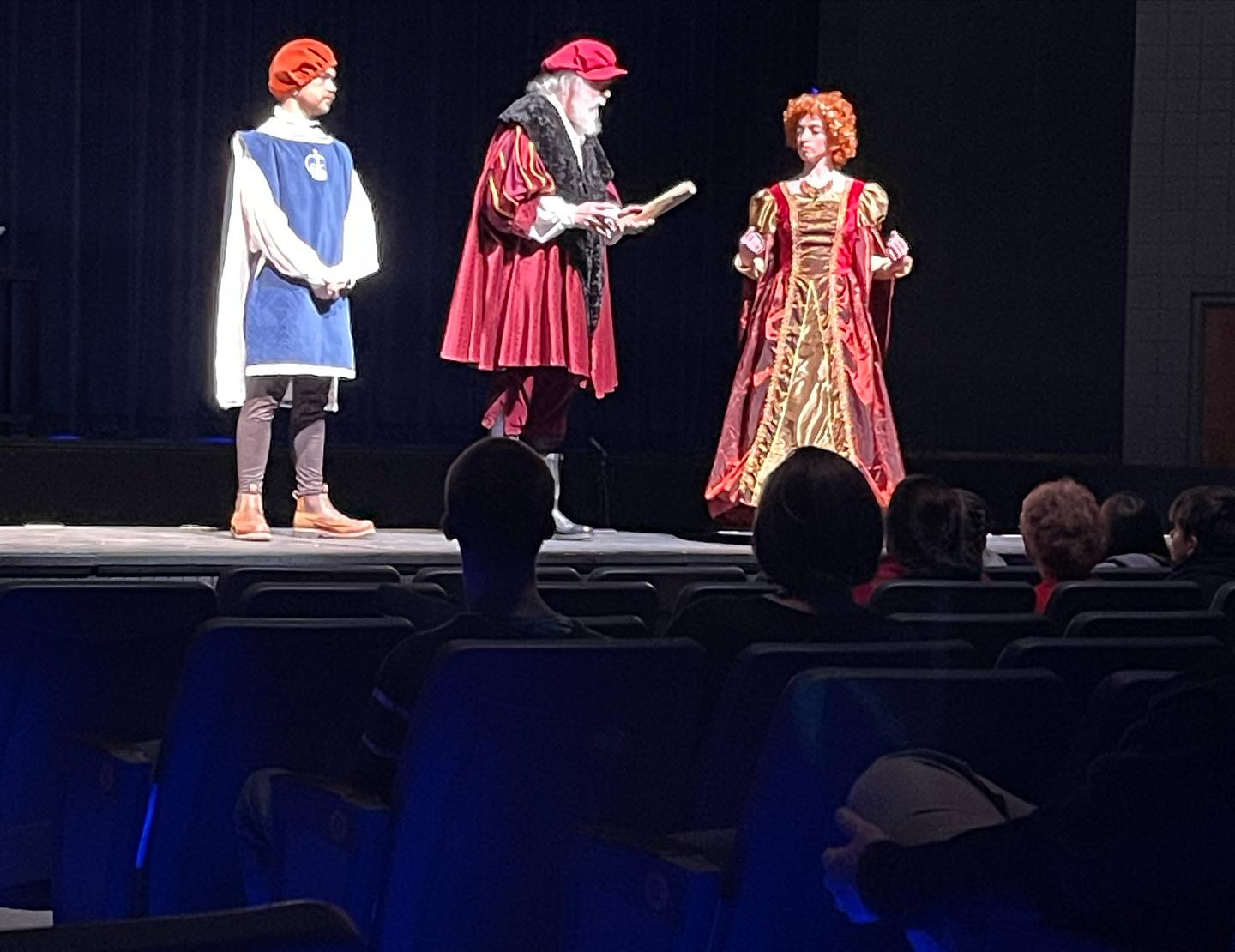
Our local Chesterton Academy did a production of  Come Rack! Come Rope! The play is an adaptation by Dale Ahlquist and Adrian Ahlquist of the novel by Robert Hugh Benson.


In the novel, Queen Elizabeth only appears once in a scene in which she processes through London. In  the adaptation, they added a scene about William Cecil, Lord Burleigh convincing Elizabeth to execute Mary, Queen of Scots.

The directors asked two teachers and one former teacher - me! - to play the roles of Elizabeth, Burleigh (again, me), and Robert Dudley, Earl of Leicester. 

Part of the pleasure for me was that I was in this production with some of my former students, some of whom I had directed in plays.