Forgive the delay in my normal entry. My grandmoter passed away, and as the nearest living relative, I have been taking care of all the arrangements.
The funeral is Saturday.
I will post as soon as I can.


IN OCTOBER
6 years ago
Cyril Clemens interviewed George Bernard Shaw in 1934 on the subject of the playwright's views of Mark Twain. Shaw who, the interviewer noticed, had a copy of G.K.'s Weekly on his desk, endorsed Chesterton's view of Twain: "Chesterton has hit the nail on the head," he told Clemens. "The exaggeration of Mark Twain is his most salient characteristic." The series of interviews Clemens conducted for the International Mark Twain Society also included an interview with Chesterton and was published in book form to celebrate the centennial of Twain's birth. [Mark Twain and Mussolini, 1934, pp. 10-12. The interview with Chesterton also appears in Clemens' Chesterton as Seen by His Contemporaries.]
At times like this, of course, one can only bellow "Shaw!" and shake one's fist.An obscure short play by George Bernard Shaw directly influenced the handling of Britain's abdication crisis, research shows.
The playlet, written 70 years ago, is said to have been brought to the attention of Edward VIII by Winston Churchill who suggested the King emulate the actions of Shaw's fictitious monarch.
In Shaw's drama The King, the Constitution and the Lady, a king takes on the twin establishments of church and polity to marry his twice-divorced American mistress Daisy Bell.
The playlet is based on The Apple Cart, an earlier Shaw comedy, in which King Magnus is pressured by his mistress to marry her but faces opposition from his prime minister on constitutional grounds.
[It continues in some detail]
 For those of you that are really into top notch liturgical hoe downs, I have some news for you. The wild and wooly men in the dark hooded robes have done it again. They have just released their third CD a sure number one hit climbing the charts with a bullet. The moment I received my advance copy it was in the machine and yes - let me tell you - this is no ordinary boy band.
Albert, the Swabian, rightly called the Great, was the founder of modern science. He did more than any other man to prepare that process, which has turned the alchemist into the chemist, and the astrologer into the astronomer. It is odd that, having been in his time, in this sense almost the first astronomer, he now lingers in legend almost as the last astrologer. Serious historians are abandoning the absurd notion that the mediaeval Church persecuted all scientists as wizards. It is very nearly the opposite of the truth. The world sometimes persecuted them as wizards, and sometimes ran after them as wizards; the sort of pursuing that is the reverse of persecuting. The Church alone regarded them really and solely as scientists. Many an enquiring cleric was charged with mere magic in making his lenses and mirrors; he was charged by his rude and rustic neighbours; and would probably have been charged in exactly the same way if they had been Pagan neighbours or Puritan neighbours or Seventh-Day Adventist neighbours. But even then he stood a better chance when judged by the Papacy, than if he had been merely lynched by the laity. The Catholic Pontiff did not denounce Albertus Magnus as a magician. It was the half-heathen tribes of the north who admired him as a magician. It is the half-heathen tribes of the industrial towns today, the readers of cheap dream-books, and quack pamphlets, and newspaper prophets, who still admire him as an astrologer. It is admitted that the range of his recorded knowledge, of strictly material and mechanical facts, was amazing in a man of his time. It is true that, in most other cases, there was a certain limitation to the data of medieval science; but this certainly had nothing to do with medieval religion. For the data of Aristotle, and the great Greek civilisation, were in many ways more limited still. But it is not really so much a question of access to the facts, as of attitude to the facts. Most of the Schoolmen, if informed by the only informants they had that a unicorn has one horn or a salamander lives in the fire, still used it more as an illustration of logic than an incident of life. What they really said was, "If a Unicorn has one horn, two unicorns have as many horns as one cow." And that has not one inch the less a fact because the unicorn is a fable. But with Albertus in medieval times, as with Aristotle in ancient times, there did begin something like the idea of emphasising the question: "But does the unicorn only have one horn or the salamander a fire instead of a fireside?" Doubtless when the social and geographical limits of medieval life began to allow them to search the fire for salamanders or the desert for unicorns, they had to modify many of their scientific ideas. A fact which will expose them to the very proper scorn of a generation of scientists which has just discovered that Newton is nonsense, that space is limited, and that there is no such thing as an atom.
This great German, known in his most famous period as a professor in Paris, was previously for some time professor at Cologne. In that beautiful Roman city, there gathered round him in thousands the lovers of that extraordinary life; the student life of the Middle Ages. They came together in great groups called Nations; and the fact illustrates very well the difference between medieval nationalism and modern nationalism. For although there might any morning be a brawl between the Spanish students and the Scottish students, or between the Flemish and the French, and swords flash or stones fly on the most purely patriotic principles, the fact remains that they had all come to the same school to learn the same philosophy. And though that might not prevent the starting of a quarrel, it might have a great deal to do with the ending of it. Before these motley groups of men from the ends of the earth, the father of science unrolled his scroll of strange wisdom; of sun and comet, of fish and bird. He was an Aristotelian developing, as it were, the one experimental hint of Aristotle; and in this he was entirely original. He cared less to be original about the deeper matters of men and morals; about which he was content to hand on a decent and Christianised Aristotelianism; he was even in a sense ready to compromise upon the merely metaphysical issue of the Nominalists and the Realists. He would never have maintained alone the great war that was coming, for a balanced and humanised Christianity; but when it came, he was entirely on its side. He was called the Universal Doctor, because of the range of his scientific studies; yet he was in truth a specialist. The popular legend is never quite wrong; if a man of science is a magician, he was a magician. And the man of science has always been much more of a magician than the priest; since he would "control the elements" rather than submit to the Spirit who is more elementary than the elements.
The media maven Marshall McLuhan was a GKC friend. In June of 1932, the twenty-year-old Marshall McLuhan wrote his parents back in
A Chestertonian points out to me, though, that McLuhan was quite wrong. Chesterton's Short History contains seven dates: 878, 1397, 1399, 1750, 1832, 1850, and 1914.
For 45 years, she was a Roman Catholic nun. Now she considers herself a Catholic bishop.
Patricia Fresen of South Africa says she was ordained a priest in 2003 and a bishop last year — though the church recognizes neither.
The 65-year-old Fresen, part of a movement that began four years ago called Roman Catholic Womenpriests, will be speaking in the Puget Sound area over the next few days. She's one of about 40 members who consider themselves priests or deacons and one of four who consider themselves bishops.
Given our status as a superpower, our material wealth and the continuous advancements in our technology, it seems safe to say that the president of the United States has more power and responsibility than any person in history.I mean, it's not like there were ever Emperors or Kings (or Popes, hey!) or anything who held literal life and death power over anyone, right? No, their power was more abstract, being rooted in the necessity of literally fending off usurpers rather than some vague constitutional notion. No, their responsibilities were fewer, given the frequent necessity of actually fighting wars with their own hands rather than handing out directives from behind a desk. With regard to America's status as a "president-booster," in terms of that gentleman's power and responsibility, I would suggest that the world is not less American than America than the world was less Roman than Rome. That is, if we want to talk about "status as superpower," "material wealth," and "continuous advancements," let's not talk about a world in which the superpower in question trails other countries in the fields of electronics, automotives and so on.
Believing that God has delivered you unto the presidency really seems to entail the belief that you cannot make any catastrophic mistakes while in office.This statement is so monstrously simplistic that I can't even bring myself to address it. You're all clever people, though; you'll figure it out.
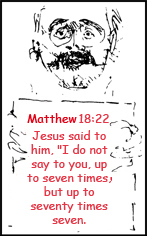 Although most media outlets have stopped talking about the Nickel Mines slaughter it is still on my mind. Not the incident but the aftermath. The idea, the concept, the reality and power of Forgiveness is what still swims around in my head. In my last post I hinted at a wheel barrel of trouble that was dumped on to my front stoop. Much of which I am still dealing with and can not talk about yet but this load includes everything from a new lump on my mother’s lung to the brutal murder of my friend’s 24 year old son. This boy had the nerve to be home when some addict wanted to rob his house.
Best story of the day, if you want to bury your head in your hands and cry:
Separating anatomy from what it means to be a man or a woman, New York City is moving forward with a plan to let people alter the sex on their birth certificate even if they have not had sex-change surgery.
Under the rule being considered by the city’s Board of Health, which is likely to be adopted soon, people born in the city would be able to change the documented sex on their birth certificates by providing affidavits from a doctor and a mental health professional laying out why their patients should be considered members of the opposite sex, and asserting that their proposed change would be permanent. . . .
The change would lead to many intriguing questions: For example, would a man who becomes a woman be able to marry another man? (Probably.) Would an adoption agency be able to uncover the original sex of a proposed parent? (Not without a court order.) Would a woman who becomes a man be able to fight in combat, or play in the National Football League? (These areas have yet to be explored.)
Great stuff. I just want to know what most guys want to know: Can we declare ourselves a women and hang out in the ladies’ bathroom?
The best part of the story is at the end:
Joann Prinzivalli, 52, a lawyer for the New York Transgender Rights Organization, a man who has lived as a woman since 2000, without surgery, said the changes amount to progress, a move away from American culture’s misguided fixation on genitals as the basis for one’s gender identity.
“It’s based on an arbitrary distinction that says there are two and only two sexes,” she said. “In reality the diversity of nature is such that there are more than just two, and people who seem to belong to one of the designated sexes may really belong to the other.”
Chesterton said some things can’t be argued with. They simply must be stomped out with one’s heel. This is one of them. You can’t argue. You simply have to call them “freaks” and get on with your day.
Belloc's wonderful book, The Four Men, describes a walk he took in the English county of Sussex, from October 29 till All Souls' Day, 1902. As the four walkers reach the end of their walk, the old man, who, like the other three walkers, is Belloc himself, makes the following memorable farewell reflection:There is nothing at all that remains: not any house; nor any castle, however strong; nor any love, however tender and sound; not any comradeship among men, however hardy. Nothing remains but the things of which I will not speak, because we have spoken enough of them already during these four days. But I who am old will give you advice, which is this: to consider chiefly from now onward those permanent things which are, as it were, the shores of this age and the harbours of our glittering and pleasant but dangerous and wholly changeful sea. When he had said this (by which he meant Death), the other two, looking sadly at me, stood silent also for about the time in which a man can say good-bye with reverenceI have always been moved by this haunting passage--nothing at all remains, the glittering and pleasant but dangerous and wholly changeful sea, the time in which a man can say good-bye with reverence.
The four men finally find an old inn "brilliantly lighted".... The four men heard singing from within. They knocked and were let into the inn. They found a pleasant bar with a large room in which fifteen or twenty men were drinking and singing. All were hearty and some old. These men had finished their meal, but the four men ordered theirs,
which was of such excellence in the way of eggs and bacon, as we had none of us until that morning thought possible upon this side of the grave. The cheese also ... was put before us, and the new cottage loaves, so that this feast, unlike any other feast that yet was since the beginning of the world, exactly answered to all that the heart had expected of a it, and we were contented and were filled (Hilaire Belloc, The Four Men, 147)The four then called for their pipes and drink, Belloc for the black current port (not that Portuguese concoction that is "but elderberry liquorice and boiled wine"), Grizzlebeard for brandy, the Poet, at "the Sailor's expense", for beer, and the Sailor for claret.
[James V. Schall, S. J., Sundry Schall Quotations]