A friend who deserves more attention:
"Today Belloc remains a writer who has not been tried and found wanting, but who has simply not been tried at all."
Frederick Wilhelmson, Hilaire Belloc: No Alienated Man


IN OCTOBER
6 years ago
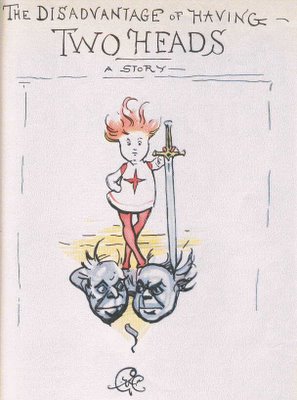

A little boy once looked over the garden fence and saw four knights with enormous crests riding by. As he is now married to a princess and moves in rather good society, he has desired me not to mention his name: so we will call him Redlegs. Being interested in such things he climbed over the fence and ran after the knights to see where they were going. They came to a very old man, who was sitting on the very sharp point of a rock, balancing himself. The knights, seeing by his sugar-loaf hat and white beard that he was a Magician, asked him where they could find the Princess Japonica (for so the Princess, who is a relative of mine, desires to be described). "The Princess Japonica," replied the Magician, "lives in the Castle beyond the Last Wood in the World, in the place where it is always sunset. She cannot come and visit anyone, and no one can visit her, because there are only two roads to it: and the right hand road is held by a Giant with One Head, and the left hand road is held by a Giant with Two Heads." Then the first knight said with great excitement (he was Bromley Smunk on the mother's side, and you know what they are), "I will soon clear the giant out of the way. But I think I will confine myself to the giant with one head. For I am a humane man and desire to cut off as few heads as possible."

So the first knight set out along the road to the One-Headed Giant. And a little while after the second knight set out & then the third & then the fourth, all the same way. The little boy stopped behind and talked to the Magician about the Fiscal Question. Scarcely had they dismissed this brief topic, then they saw a sad string of people coming along the road from the One-Headed Giant. They were the four knights & and I am sorry to say that they were rather smashed. Then Redlegs said suddenly, "I should very much like to see a Two-Headed Giant. Lend me a sword." Then they all roared with laughter and told him how silly he was to think that he could kill the Two-Headed Giant when they couldn't kill even the One-Headed Giant. But he went off all the same, with his head in the air & he found the Two-Headed Giant on the great hills where it is always sunset. And then he found out a funny thing. The Two-Headed Giant did not rush at him and tear him to pieces as he had expected.
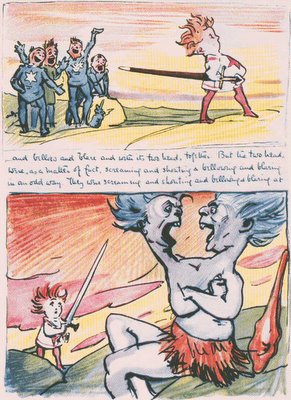
It did certainly scream & shout and bellow and blare and with its two heads together. But the two heads were, as a matter of fact, screaming and shouting & bellowing and blaring in an odd way. They were screaming and shouting and bellowing & blaring at each other. One head said, "You are a Pro-Boer": the other said, with bitter humour, "You're another"; in fact, the argument might have gone on for ever, growing more savage & brilliant every moment, but it was cut short by Redlegs, who took out the great sword he had borrowed from one of the knights & poked it sharpley into the giant & killed him. The huge creature sprawled & writhed for a moment in death & said "You are beneath my notice." Then it died happily.

Redlegs went on along the road that had been guarded by the Two-Headed Giant, until he came to the Castle of the Princess. After a few words of explanation, I need hardly say they were married - and lived happily ever after. The Magician, who gave the bride away, said after the conclusion of the ceremony the following cabalistic and totally unintelligible words: "My son, the Giant who had one head was stronger than the Giant who had two. When you grow up there will come to you other magicians who will say, '[Something in Greek; I don't have the font for it, and don't know what it says anyway]. Examine your soul, wretched kid. Cultivate a sense of the differentiations possible in a single psychology. Have nineteen religions suitable to different moods.' My son, these will be wicked magicians; they will want to turn you into a two-headed giant." Redlegs did not know what this meant and nor do I.

===
That's that. I'm not sure what we'll get next time, but there's still a great deal to address. We might, for a lark, take a look at the illustrated demonology he constructed at the age of 17.
If imitation is the sincerest form of flattery, what is plagiarism? The least sincere form? A genuine crime? Or merely the work of someone with less-than-complete mastery of quotation marks who is in too great a hurry to come up with words and ideas of his own?Read the full article by Joseph Epstein at The Weekly Standard (03/06/2006, Volume 011, Issue 24).
Over many decades of scribbling, I have on a few occasions been told that some writer, even less original than I, had lifted a phrase or an idea of mine without attribution. I generally took this as a mild compliment. Now, though, at long last, someone has plagiarized me, straight out and without doubt. The theft is from an article of mine about Max Beerbohm, the English comic writer, written in the pages of the august journal you are now reading.
The man did it from a great distance--from India, in fact, in a publication calling itself "India's Number One English Hindi news source"; the name of the plagiarist is being withheld to protect the guilty. I learned about it from an email sent to me by a generous reader.
...
In the realm of plagiarism, my view is, better a lender than a borrower be. (You can quote me on that.) The man who reported the plagiarism to me noted that he wrote to the plagiarist about it but had no response. At first I thought I might write to him myself, remarking that I much enjoyed his piece on Max Beerbohm and wondering where he found that perfectly apposite G.K. Chesterton quotation. Or I could directly accuse him, in my best high moral dudgeon, of stealing my words and then close by writing--no attribution here to Rudyard Kipling, of course--"Gunga Din, I'm a better man than you." Or I could turn the case over, on a contingency basis, to a hungry young Indian lawyer, and watch him fight it out in the courts of Bombay or Calcutta, which is likely to produce a story that would make Bleak House look like Goodnight Moon.

“News is old things happening to new people.”read the entire article by Jim Hillibish in the Canton Repository (February 18, 2006)
Newspaperman Malcolm Muggeridge penned this warning to self-assured newsmakers who ignore history and believe they are unique for their times.
A friend of mine offered evidence of this in a flat box of yellowed newsprint she found in her grandfather’s attic, proof there’s nothing new on our favorite planet.
Inside were Puck tabloids, named for Shakespeare’s meddling sprite in “A Midsummer Night’s Dream.” Joseph Keppler in 1871 converted mischief into cartoons and stories in his national weekly, inventing the first political humor magazine.
I realized the genius of Muggeridge while working my way through this pile of musty mirth. They had terrorist bombers, assassins, religious and political fanatics and legions of officious folks trying to tell everybody how to think, disguised as special interests.
Politicians were bought with “campaign contributions,” responded to accusations with “lies of convenience” and created political parties threatening “free thinking among an endangered species — the voter.”
Americans were worried sick about their jobs going overseas. Instead of Microsoft and Wal-Mart, the monopolists of the telegraph and railroads were the fat cats draining us poor citizens of scarce dollars. So were usurious credit companies. So was religion.
“Kissing pastors who make love to the funds of the church have palled upon our taste.”
Sound familiar?
The only difference was the Democrats were conservative leg draggers and the Republicans were liberal buffoons, roles reversed today. Puck lambasted both sides with words mightier than swords.
"All healthy men, ancient and modern, know there is a certain fury in sex that we cannot afford to inflame, and that a certain mystery and awe must ever surround it if we are to remain sane.”
When author G.K. Chesterton wrote these words nearly a century ago, he couldn’t have comprehended the fury pornography had yet to unleash on society.
A $57-billion worldwide industry, pornography is no secret pastime. It’s an epidemic infecting far more than the sole viewer, according to experts who say spouses, children, health, employment and good standing in society are often contaminated too.
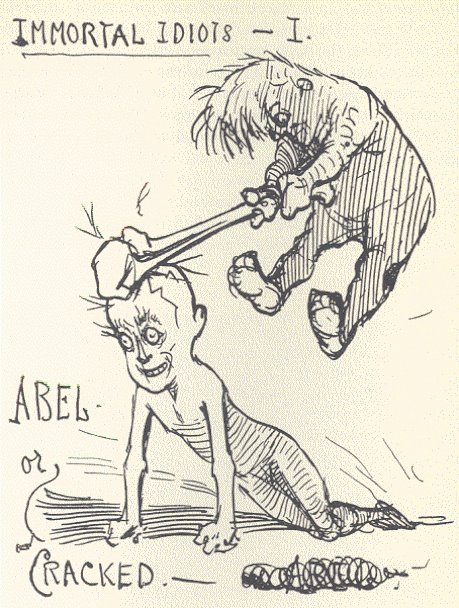
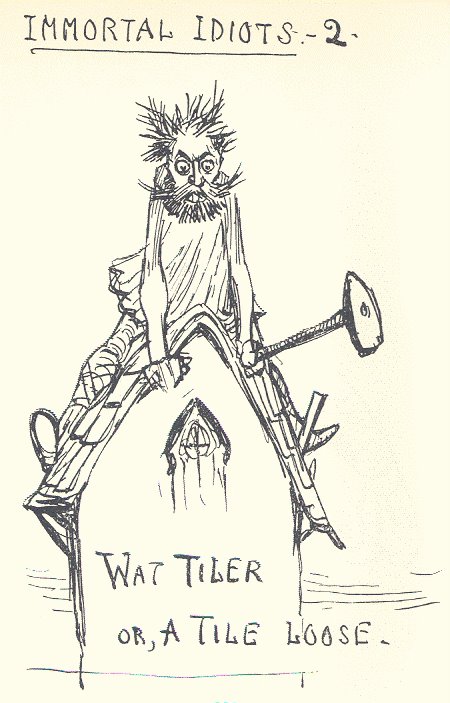
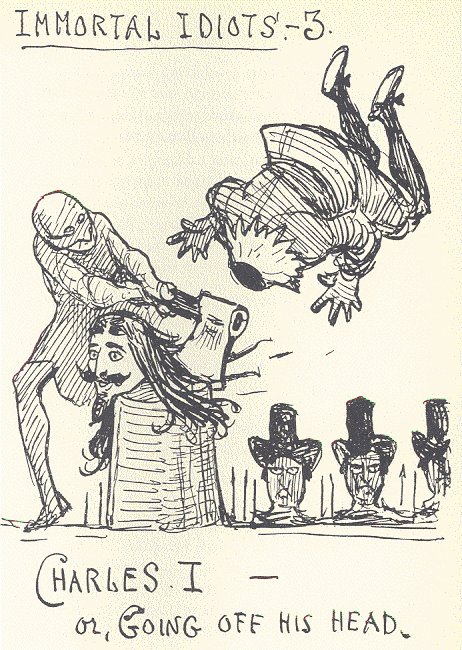
 Of the four, Charles II is my favourite artistically, and Abel thematically. Also, for those of you unfamiliar with Wat Tiler, he was, along with Jack Straw, the leader of a peasant rebellion against Richard II in 1381. The rebellion faltered when the army was overcome by Richard II's charm. Tiler himself was killed in a fight with the mayor of London soon after. The Nelson one, regrettably, leaves me kind of flat, but that's mostly due to my radical bias in favour of the man.
G. K. Chesterton once wrote that the reason Christianity was declining was ‘not because it has been tried and found wanting, but because it has been found difficult and therefore not tried’. So too with time management. There is no magic formula and circumstances – and interruptions – often seem to conspire to prevent best intentions from working out. Some people, perhaps failing to achieve what they want, despair and give up.You can read the entire article Get Tougher With Time here.


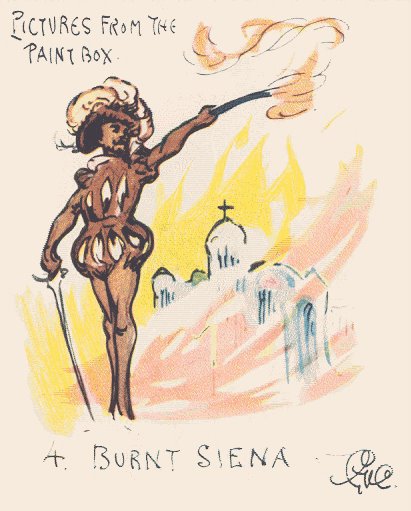
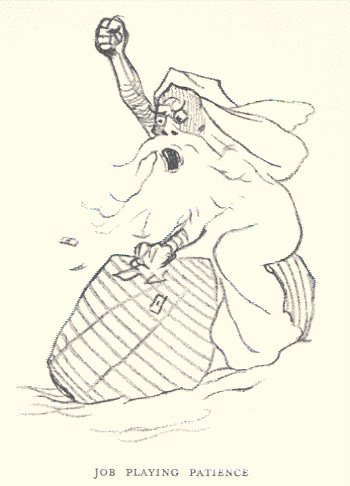 Next time there will be some more text from the book, as well as a caricature series entitled "Immortal Idiots" in which such characters as Abel, Charles I, and Horatio Nelson meet their doom.
Siegfried Sassoon was a septuagenarian when he was received into the Catholic Church in 1957. An early and lasting admiration for Belloc and a late friendship with Ronald Knox were both significant factors in his spiritual journey, but most important was his own introspective mysticism. His final acceptance of Christianity was the culmination of a lifetime’s search, traceable through his poetry back to his youth.
A Prayer in Old Age
Being no expectance of heaven unearned
No hunger for beatitude to be
Until the lesson of my life is learned
Through what Thou didst for me.
Bring no assurance of redeemed rest
No intimation of awarded grace
Only contrition, cleavingly confessed
To Thy forgiving face.
I ask one world of everlasting loss
In all I am, that other world to win.
My nothingness must kneel below Thy Cross.
There let new life begin.

"...a man preaching what he thinks is a platitude is far more intolerant than a man preaching what he admits is a paradox. It was exactly because it seemed self-evident, to Moslems as to Bolshevists, that their simple creed was suited to everybody, that they wished in that particular sweeping fashion to impose it on everybody. It was because Islam was broad that Moslems were narrow. And because it was not a hard religion it was a heavy rule. Because it was without a self-correcting complexity, it allowed of those simple and masculine but mostly rather dangerous appetites that show themselves in a chieftain or a lord. As it had the simplest sort of religion, monotheism, so it had the simplest sort of government, monarchy. There was exactly the same direct spirit in its despotism as in its deism. The Code, the Common Law, the give and take of charters and chivalric vows, did not grow in that golden desert. The great sun was in the sky and the great Saladin was in his tent, and he must be obeyed unless he were assassinated. Those who complain of our creeds as elaborate often forget that the elaborate Western creeds have produced the elaborate Western constitutions; and that they are elaborate because they are emancipated." ("The Fall of Chivalry," The New Jerusalem)
"There is in Islam a paradox which is perhaps a permanent menace. The great creed born in the desert creates a kind of ecstasy out of the very emptiness of its own land, and even, one may say, out of the emptiness of its own theology. It affirms, with no little sublimity, something that is not merely the singleness but rather the solitude of God. There is the same extreme simplification in the solitary figure of the Prophet; and yet this isolation perpetually reacts into its own opposite. A void is made in the heart of Islam which has to be filled up again and again by a mere repetition of the revolution that founded it. There are no sacraments; the only thing that can happen is a sort of apocalypse, as unique as the end of the world; so the apocalypse can only be repeated and the world end again and again. There are no priests; and yet this equality can only breed a multitude of lawless prophets almost as numerous as priests. The very dogma that there is only one Mahomet produces an endless procession of Mahomets. Of these the mightiest in modern times were the man whose name was Ahmed, and whose more famous title was the Mahdi; and his more ferocious successor Abdullahi, who was generally known as the Khalifa. These great fanatics, or great creators of fanaticism, succeeded in making a militarism almost as famous and formidable as that of the Turkish Empire on whose frontiers it hovered, and in spreading a reign of terror such as can seldom be organised except by civilisation…" (Lord Kitchener)
"I do not know much about Mohammed or Mohammedanism. I do not take the Koran to bed with me every night. But, if I did on some one particular night, there is one sense at least in which I know what I should not find there. I apprehend that I should not find the work abounding in strong encouragements to the worship of idols; that the praises of polytheism would not be loudly sung; that the character of Mohammed would not be subjected to anything resembling hatred and derision; and that the great modern doctrine of the unimportance of religion would not be needlessly emphasised." (ILN Nov. 15, 1913)
"A good Moslem king was one who was strict in religion, valiant in battle, just in giving judgment among his people, but not one who had the slightest objection in international matters to removing his neighbour's landmark." (ILN Nov. 4, 1911)
47. There was a boy called Eustace Clarence Scrubb, and he almost deserved it. — C. S. Lewis, The Voyage of the Dawn Treader (1952)
63. The human race, to which so many of my readers belong, has been playing at children's games from the beginning, and will probably do it till the end, which is a nuisance for the few people who grow up. — G. K. Chesterton, The Napoleon of Notting Hill (1904)
70. Francis Marion Tarwater's uncle had been dead for only half a day when the boy got too drunk to finish digging his grave and a Negro named Buford Munson, who had come to get a jug filled, had to finish it and drag the body from the breakfast table where it was still sitting and bury it in a decent and Christian way, with the sign of its Saviour at the head of the grave and enough dirt on top to keep the dogs from digging it up. — Flannery O'Connor, The Violent Bear it Away (1960)
"You modify one another's thought; out of this perpetual dog-fight a community of mind and a deep affection emerge." That is what C.S. Lewis said about his enduring friendship with Owen Barfield, who greatly influenced his bedrock views on imagination and myth.link to the entire article by Colin Duriez, "The Way of Friendship" at Christian History & Biography
...
Rather like the texts of literature, a friend provides another vantage point from which to view the world. For Lewis, his different friends opened up reality in varying ways. Owen Barfield, for instance, was very different from Arthur Greeves, who had revealed to Lewis he was not alone in the world. Though Barfield shared with Lewis a view of what was important, and asked strikingly similar questions, the conclusions he came to usually differed radically from those of Lewis. Throughout the 1920s, the two had waged what Lewis called a "Great War," a long dispute over the kind of knowledge that imagination can give. As Lewis put it, it was as if Barfield spoke his language but mispronounced it.
Lewis's friendship with J.R.R. Tolkien, like that with Barfield, was based upon irreducible differences as well as likenesses. Initially, the two were drawn together by a love of myth, fairytale, and saga, a bond that deepened when Lewis became a Christian. There were emerging differences of temperament, churchmanship, and storytelling style, however, which strained yet enriched the friendship.
What separates Tolkien’s work from other narratives, especially those inspired by his prose, is the rich profundity and dexterity with which he wove his tapestry. Recent scholarship has shown the interconnectedness of Tolkien’s writing to the vaunted schools of ancient philosophy, specifically those of ancient Greece. However, there exists in The Lord of the Rings a subtle yet quite detectable call to the thought of the medieval philosopher St. Augustine. This call is particularly resonant today, an age where there appears to prevail an unquenchable thirst for knowledge. Augustine, as a student of the ancients (in particular of Plato), knew well that knowledge was not synonymous with wisdom. Often, the quest for the former entailed the preclusion of the latter.-- Dr. Jose Yulo, "The Temptation of the Earthly City: Tolkien's Augustinian Vision" at IgnatiusInsight.com; Feb 1, 2006