Sunday, March 26, 2017

Chesterton, the poet


Over at Social Matter, there was a brief look at Chesterton as a poet:  "Poets: G. K. Chesterton"

Interesting read - praise for his poetry from a non-Chestertonian.

Thursday, February 23, 2017

Peter Maurin - Chesterton and Belloc did not have blinkers!


A Few Englishmen

R. H. Tawney said
that the Englishmen wear blinkers.
Because they wear blinkers
the Englishmen
lack vision.
Because they lack vision
the Englishmen
are very strong
for supervision.
And supervision
is not a substitute
for vision.
A few Englishmen
got rid of their blinkers.
Among the Englishmen
who got rid of their blinkers
one can name:
William Cobbett,
John Ruskin,
William Morris,
Arthur Penty,
Hilaire Belloc,
G. K. Chesterton,
Eric Gill.
The best of all
is Eric Gill.

(This is one of  Peter Maurin's Easy Essay printed in the New York Catholic Worker. Maurin, along with Dorothy Day, created the Catholic Worker movement.)

Monday, February 20, 2017

Peter Maurin - Christianity Untried (Chesterton)


Chesterton says:
“The Christian ideal
has not been tried
and found wanting.
It has been found difficult
and left untried.”
Christianity has not been tried
because people thought
it was impractical.
And men have tried everything
except Christianity.
And everything
that men have tried
has failed.

(Peter Maurin, along with Dorothy Day, created the Catholic Worker movement. Maurin, originally from France, wrote "Easy Essays" summarizing his beliefs and those of other thinkers and writers and philosophers.)

Friday, February 10, 2017

They taught us to believe in dragons


"And a few encounters with living legends didn't hurt: I studied at the University of Oxford, and the English syllabus stopped at 1832, because there were two gentlemen named Tolkien and C.S. Lewis who had resisted taking it any further — they were both teaching there and we went to their lectures. So we encountered, thanks to those two, things like Beowulf and Sir Gawain and the Green Knight, and above all, Shakespeare. A friend of mine once said, 'They taught us to believe in dragons.'" - The Lost Land of Susan Cooper

Susan Cooper is an award-winning writer of young adult and fantasy fiction, including the The Dark is Rising sequence. She also co-wrote the play Foxfire.

Saturday, February 04, 2017

For all the snowflakes (clerihew)


President Donald Trump
blazes away as if still on the stump.
Many a fragile snowflake
finds the heat hard to take.

Tuesday, January 17, 2017

A St. Jerome clerihew


Irascible St. Jerome
was justly noted for his biblical tome,
but he was upset that no one would look
at his vegetarian cook book.

Sunday, January 08, 2017

A Torricelli clerihew


Evangelista Torricelli
was fond of refried beans and jalapeno jelly.
One of his lesser-known achievements was a way to measure
frequent bouts of abdominal pressure.

Tuesday, December 27, 2016

Tolkien's rediscovered "Noel"

NOEL by J.R.R. Tolkien

Grim was the world and grey last night:
The moon and stars were fled,
The hall was dark without song or light,
The fires were fallen dead.
The wind in the trees was like to the sea,
And over the mountains' teeth
It whistled bitter-cold and free,
As a sword leapt from its sheath.


The lord of the snows upreared his head;
His mantle long and pale
Upon the bitter blast was spread
And hung o'er hill and dale.
The world was blind, the boughs were bent,
All ways and paths were wild:
Then the veil of cl oud apart was rent,
And here was born a Child.


The ancient dome of heaven sheer
Was pricked with distant light;
A star dame shining white and clear
Alone above the night.
In the dale of dark in that hour of birth
One voice on a sudden sang:
Then all the bells in Heaven and Earth
Together at midnight rang.


Mary sang in this world below:
They heard her song arise
O'er mist and over mountain snow
To the walls of Paradise, 
And the tongue of many bells was stirred
in Heaven's towers to ring
When t he voice of mortal maid was heard,
That was mother of Heaven's King.


Glad is the world and fair this night
With stars about its head,
And the hall is filled with laughter and light,
And fires are burning red.
The bells of Paradise now ring
With bells of Christendom,
And Gloria, Gloria we will sing
That God on earth is come.


Originally published in the 1936 Annual of Our Lady's School, Abingdon, Tolkien's "Noel" was unknown and unrecorded until scholars Wayne G. Hammond and Christina Scull discovered it while searching for another poem in June 2013.  In May 2015, Our Lady's School, Abingdon, discovered their copy of the Annual and in Feb 2016, news of the discovery was widely reported.

- from the Yahoo Group Spareoom

Monday, December 26, 2016

Paladino Clerhiew


Carl Paladino
perhaps had too much vino.
But even intoxication can't
excuse his offensive First Couple rant.

(Context: Buffalo School Board member and former GOP NY gubernatorial candidate Carl Paladino, in a survey by Artvoice newspaper in which people were asked what they wished for in 2017, said, "Obama catches mad cow disease after being caught having relations with a Herford. He dies before his trial and is buried in a cow pasture next to [senior White House advisor] Valerie [Jarrett], who died weeks prior, after being convicted of sedition and treason, when a Jihady cell mate mistook her for being a nice person and decapitated her. "
.
And asked what he would most like to see go in 2017, he said, "Michelle Obama. I'd like her to return to being a male and let loose in the outback of Zimbabwe where she lives comfortably in a cave with Maxie, the gorilla."

He refused to apologize. The Trump transition team - Paladino had been one of the honorary chairmen of Trump's NY presidential campaign - condemned Paladino's comments.)


Tuesday, December 20, 2016

Gilbert clerihew blackballing continues?


Another issue of Gilbert arrived.

None of my clerihews got in.

Again.

It used to be Gilbert regularly published some of my clerihews.

That stopped five and a half years ago.

I've sent a number in over the last few years, but they seemingly disappeared into a black hole.

I resent some in case they got lost.

Still missing in action.

I've even mentioned this to Dale a couple of times at Chesterton gatherings. He said he has seen some of mine floating about, and expressed surprise and doubt that it has been that long since any got published.

But it has been that long.

I'm not sure why they are not getting in. Some are decent enough, and certainly of comparable quality to some that have gotten in from others.

Maybe they just keep getting bumped as newer writers submit? Maybe they just keep getting misplaced? Maybe my occasional on-line sparring with the editor-in-chief has put me on some kind of blacklist?

So it goes.

As I told Dale, I've given up submitting. Seems to be little point. And writing this will likely not help.

Still, maybe some of the old ones will finally break through.

But as for new ones, I'll keep posting them here. At least then Chesterton and clerihew fans might see them.

Sunday, September 25, 2016

Chesterton gets Clerihewed


G. K. Chesterton
would sometimes sit in the sun.
His wife appreciated the cool glade
his shadow made.

Thursday, September 01, 2016

A prophetic clerihew


Ezekiel
was full of prophetic zeal.
He was only wrong when it came to bets
on the Browns and the Mets.

Saturday, July 16, 2016

An alternative this election year - The American Solidarity Party


This is a tough year for us politically when it comes to the Presidential campaign. Many of us find the candidates of the major political parties objectionable, and so I hear a lot of people saying they will likely vote for the lesser of two evils, once they determine which is less evil. (I often rejoin, "Voting for the lesser of two evils means you are still voting for evil!)

The truth is, though, for most of us how we vote really doesn't matter.

You see, the election will be decided by the electoral college vote, not the popular vote, and for most states you can pretty much predict right now which party's candidate will carry the state and get the electoral votes. In New York, for example, the Democratic candidate has won the state every election since 1988, and only once in those 7 elections has the Democratic margin of victory fallen below a million votes. This year is likely to be no different. Unless the Democratic candidate does eventually get indicted!

There are a few (5-7) swing states that really decide the election - that's why the pundits and pollsters obsess about such states as Florida, Ohio and Pennsylvania.

So for voters in New York, and in most states, it's safe to vote third party.

This year, there is an alternative that might be of interest to Chestertonians. The American Solidarity Party's platform is very much based on Catholic Social teachings, with elements of Distributism.

The party has for the first time nominated its own candidates for president and vice president,  Mike Maturen and Juan Munoz. (Chesterton might appreciate that Maturen is also a magician!)

Go to the website to find out more about them and the party's platform.

The party has Facebook and Twitter accounts as well.

Just imagine, voting, and actually feeling good about for whom you're voting!

If you live on one of the states where your vote might not count, or even if you live in one of the states where your vote might count, but you simply can't vote for one of the main party's candidates, consider the Maturen and Munoz ticket.

Tuesday, July 05, 2016

A Tolkien Clerihew


There was a side of J.R.R. Tolkien
that was seldom seen.
When he was by himself
he'd sometimes dress as an elf.

A Clerihew (Pope Pius)


Pope Pius
is a victim of bias.
Only a closed-minded dope
still thinks of him as "Hitler's pope."

Tuesday, April 12, 2016

Another political clerihew (Trump)


Donald Trump
on the stump
will almost always spout a platitude
or something rude.

Sunday, November 08, 2015

A Ben Carson/Politico Clerihew


Ben Carson
never claimed he committed arson.
That didn't stop Politico
from reporting, "He may have, you know."

Friday, July 24, 2015

Planned Parenthood scandal clerihews


Dr. Mary Gatter
was coy and even joked amid the chatter,
but her haggling over the price of a baby's heart or liver
made me shiver.

Dr. Mary Gatter
treated it as a laughing matter,
but sell enough baby parts, even that teenie,
and you might afford a Lamborghini.

Saturday, March 28, 2015

The Atlantic touts Saint Chesterton


There is in the April issue of The Atlantic a wonderful piece ("A Most Unlikely Saint") about the effort to have G. K. Chesterton declared a saint. It begins:

If the Catholic Church makes G. K. Chesterton a saint—as an influential group of Catholics is proposing it should—the story of his enormous coffin may become rather significant. Symbolic, even parabolic. Chesterton’s coffin was too huge, you see, to be carried down the stairs of his house in Beaconsfield, its occupant being legendarily overweight at the time of his death, in 1936. So it went out a second-floor window. Very Chestertonian: gravity, meet levity. Hagiographers might pursue the biblical resonance here, citing the Gospel passages in which a paralyzed man, unable to penetrate the crowds surrounding the house in Capernaum where Jesus was staying, is lowered in through a hole in the roof. Or they might simply declare that Gilbert Keith Chesterton’s was a spirit too large to go out through the conventional narrow door of death—that it had to be received, as it were, directly into the sky.

It's a well-written piece, and a good introduction to Chesterton and the sainthood cause for those who were not aware of him or it. Even for those of us who were familiar, well worth reading if for no other reason than it will make us smile.

Thursday, February 19, 2015

Marquis de Sade/50 Shades clerihew


A somber Marquis de Sade
said with a knowing nod,
"The wickedness of all my work fades
before that woman's 50 Shades.

Thursday, November 27, 2014

Alice's Restaurant - Happy Thanksgiving!


Happy Thanksgiving Thoughts From Chesterton


I would maintain that thanks are the highest form of thought, and that gratitude is happiness doubled by wonder.


There is no such thing on earth as an uninteresting subject; the only thing that can exist is an uninterested person.


The aim of life is appreciation; there is no sense in not appreciating things; and there is no sense in having more of them if you have less appreciation of them.


When it comes to life the critical thing is whether you take things for granted or take them with gratitude.


You say grace before meals. All right. But I say grace before the concert and the opera, and grace before the play and pantomime, and grace before I open a book, and grace before sketching, painting, swimming, fencing, boxing, walking, playing, dancing and grace before I dip the pen in the ink.


When we were children we were grateful to those who filled our stockings at Christmas time. Why are we not grateful to God for filling our stockings with legs?


Friday, September 26, 2014

Scarlet Letter Clerihews


While it's true Hester Prynne
committed a serious sin
the Reverend Dimmesdale
was guilty of the greater fail.

Roger Chillingworth
thought he'd reserved a berth,
then vengefully sought to save face
when someone usurped his place.

Monday, September 01, 2014

The vices of ISIS (clerihew)


One of the aims of ISIS
is eradicating Western sins and vices,
except, of course, for a select few
that they themselves like to do.

Wednesday, August 06, 2014

Putin-Rasputin - sure as shootin' (clerihew)


There are rumors that Vladimir Putin
somehow has ties to Rasputin.
So it makes sense his followers shiver
when Vlad takes a dip in a river.

Saturday, May 10, 2014

A new Chesterton Academy


St. John Bosco Schools in Rochester (East Rochester, actually) NY has announced plans to expand next year, adding a ninth grade and calling the high school program Chesterton Academy.

The school currently offers a traditional curriculum - none of the common core nonsense - in an orthodox Catholic environment. The high school program will be more of the same.

This is an exciting development. It could even inspire me to leave my current job if they need to hire any new teachers.

I already have Chesterton Academy sweatshirt from the Chesterton Society!

Monday, January 20, 2014

The following quote is now my standard answer to the Chesterton critics that have never actually read Chesterton, (it's called the The Dunning Kruger Effect )

"...the dumber you are, the more confident you are that you’re not actually dumb. And when you get invested in being aggressively dumb…well, the last thing you want to encounter are experts who disagree with you, and so you dismiss them in order to maintain your unreasonably high opinion of yourself. "

The above came from The Death of Expertise and is worth a read it can be found here.

Saturday, November 30, 2013

Hochhuth clerihew


In attacking Pope Pius Rolf Hochhuth
penned a play full of untruth.
Sadly, many an ignorant dope
now believes the myth of "Hitler's pope."

Friday, November 22, 2013

C. S.Lewis - Poet? (and his legacy)


To mark the 50th anniversary of his death, C. S. Lewis has been honored with a memorial stone in the Poet's Corner at Westminster Abbey.

To be honest, I've never thought of Lewis as a poet. I love him for his theological works and his fiction. (Sort of like my thoughts about Chesterton.) I don't think I even own a collection of Lewis's poetry. (I own several volumes of Chesterton's - and have enjoyed them.)

I do remember one self-deprecating poem of Lewis's:

A Confession

I am so coarse, the things the poets see
Are obstinately invisible to me.
For twenty years I’ve stared my level best
To see if evening–any evening–would suggest
A patient etherized upon a table;
In vain. I simply wasn’t able.
To me each evening looked far more
Like the departure from a silent, yet a crowded, shore
Of a ship whose freight was everything, leaving behind
Gracefully, finally, without farewells, marooned mankind.

Red dawn behind a hedgerow in the east
Never, for me, resembled in the least
A chilblain on a cocktail-shaker’s nose;
Waterfalls don’t remind me of torn underclothes,
Nor glaciers of tin-cans. I’ve never known
The moon look like a hump-backed crone–
Rather, a prodigy, even now
Not naturalized, a riddle glaring from the Cyclops’ brow
Of the cold world, reminding me on what a place
I crawl and cling, a planet with no bulwarks, out in space.

Never the white sun of the wintriest day
Struck me as un crachat d’estaminet.
I’m like that odd man Wordsworth knew, to whom
A primrose was a yellow primrose, one whose doom
Keeps him forever in the list of dunces,
Compelled to live on stock responses,
Making the poor best that I can
Of dull things . . . peacocks, honey, the Great Wall, Aldebaran,
Silver weirs, new-cut grass, wave on the beach, hard gem,
The shapes of horse and woman, Athens, Troy, Jerusalem.

I need to dig out more of his poems.

Today is also the anniversary of the death of John Kennedy, whose tragic death overshadowed that of Lewis.

While both men had an impact on the world, I think Lewis's influence will ultimately be greater.

Kennedy's legacy is based on his incomplete term as President. The record was mixed - but his assassination and the emotional impact of his death overwhelmed objectivity in assessing that record. He's a martyr, a romantic tragic figure. I suspect that when the dust of history settles he will be judged somewhere in the second tier of presidents (in the 14/15 range). One has to wonder  what he would have achieved had he finished out his term - and, as I suspect he would have - served out a second term.

But Lewis has only grown in stature since his death. His Mere Christianity is ranked as one of the spiritual classics of the 20th Century. His Chronicles of Narnia books and The Screwtape Letters also rank high. They -  and a number of his other books - continue to sell briskly and to influence people. Many people have discovered or rediscovered faith through his works, and, through the case of Narnia, the movies made from them.

I suspect years from now people will still be reading and cherishing Lewis's writings.

Long after Kennedy's achievements are relegated to the history books.

But I'm still not certain how Lewis's poetry will be remembered.

Thursday, November 07, 2013

Chesterton ad


Ah, the great one keeps showing up in different places.

Up here in Western New York a local car company quotes Chesterton in an ad:

http://www.thatsmyvision.com/custom/vision-tv/

The ad begins with Chesterton saying "The greatest for of giving is Thanks-Giving."

The company says it will donate to a local charity during November, so maybe Chesterton would object to his name being linked to commercial venture.

Sunday, September 22, 2013

Rochester Chesterton Conference 2013 (images)


Dale Ahlquist hawking some shirts to raise money for the ACS. 
 
 
Lou Horvath offering greetings, but no explanations ... 

 
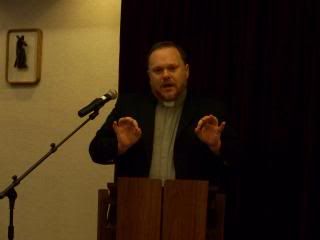
Deacon Nathan Allen making a point, not picking nits.
 

Despite Dale's jokes at his expense, Joseph Pearce still likes him. We think. Tom Martin seems to be trying to stay out of the fray.
 
 
A good time was had by all.


So, which character in the The Hobbit would you be?  

Thursday, September 12, 2013

Rochester Chesterton Conference - September 21


The Chestertonians are coming! The Chestertonians are coming!

The annual Rochester Chesterton Conference is scheduled for September from 9 a.m. to 3 p.m. at St John Fisher College .

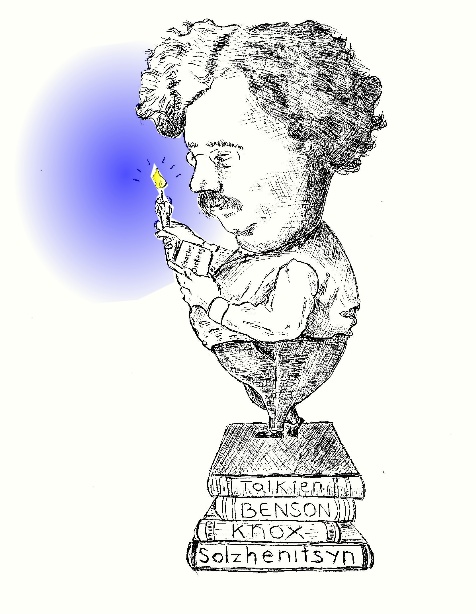
Illustration of Chesterton with a candle, on books: Tolkien, Benson, Knox, Solzhenitsyn

The theme this year is:

Points of Light: Literary Voices Against the Darkness 

The speakers and their topics are Joseph Pearce (JRR Tolkien), Rev. Nathan Allen (Benson and Knox), Dale Ahlquist (Dickens), and Dr. Tom Martin (Solzhenitsyn).

Cost is $10, Lunch will be available for an added cost. 

Always a great event. If you are within a few hours' drive, wander on over.  


Monday, September 02, 2013

Playground Politics

When the republican's are 'in the house' the media says war is evil and the pres is an enemy to the people. When the dems are in office the media says war is a necessary evil and the pres is saving the people. Our current occupant dragged his heel across the sand box when he said: "Use of chemical weapons by Syria would cross a ‘red line’". Well Syria crossed it and said 'You talkin to me?" 


now Obama is stuck pulling on the rope of war.

As Khrushchev said when Russia and the US were on the brink of war:     "If you did this as the first step towards the unleashing of war, well then, it is evident that nothing else is left to us but to accept this challenge of yours. If, however, you have not lost your self-control and sensibly conceive what this might lead to, then, Mr. President, we and you ought not now to pull on the ends of the rope in which you have tied the knot of war, because the more the two of us pull, the tighter that knot will be tied. And a moment may come when that knot will be tied so tight that even he who tied it will not have the strength to untie it, and then it will be necessary to cut that knot, and what that would mean is not for me to explain to you, because you yourself understand perfectly of what terrible forces our countries dispose. (read the whole letter here).


Wednesday, August 28, 2013

Lift a Glass

It has been suggested the GKC be made patron saint of beer drinkers. If that happens he will be in good company

auggy doggy day

St. Augustine feast day today - he showed us the truth:

"You have made us for yourself, O Lord, and our heart is restless until it rests in you." 
Thus Joy is found.

Which brings us to Uncle Gilbert
"The mass of men have been forced to be gay about the little things, but sad about the big ones. Nevertheless (I offer my last dogma defiantly) it is not native to man to be so. Man is more himself, man is more manlike, when joy is the fundamental thing in him, and grief the superficial. Melancholy should be an innocent interlude, a tender and fugitive frame of mind; praise should be the permanent pulsation of the soul. Pessimism is at best an emotional half-holiday; joy is the uproarious labour by which all things live. Yet, according to the apparent estate of man as seen by the pagan or the agnostic, this primary need of human nature can never be fulfilled. Joy ought to be expansive; but for the agnostic it must be contracted, it must cling to one corner of the world. Grief ought to be a concentration; but for the agnostic its desolation is spread through an unthinkable eternity. This is what I call being born upside down. The sceptic may truly be said to be topsy-turvy; for his feet are dancing upwards in idle ecstasies, while his brain is in the abyss. To the modern man the heavens are actually below the earth. The explanation is simple; he is standing on his head; which is a very weak pedestal to stand on. But when he has found his feet again he knows it. Christianity satisfies suddenly and perfectly man's ancestral instinct for being the right way up; satisfies it supremely in this; that by its creed joy becomes something gigantic and sadness something special and small. The vault above us is not deaf because the universe is an idiot; the silence is not the heartless silence of an endless and aimless world. Rather the silence around us is a small and pitiful stillness like the prompt stillness in a sick-room. We are perhaps permitted tragedy as a sort of merciful comedy: because the frantic energy of divine things would knock us down like a drunken farce. We can take our own tears more lightly than we could take the tremendous levities of the angels. So we sit perhaps in a starry chamber of silence, while the laughter of the heavens is too loud for us to hear." Orthodoxy

You can not steal the Joy of a Christian.


Monday, August 26, 2013

A Few "Comic" Clerihews


I've never seen Steve Martin
in tartan.
But to me he doesn't look right
in anything but white.


Kathy Griffin
Likes to joke about sexual sin.
But to be honest all she does is bore
When she tries to play the whore.


Steven Wright
Is right:
Boycott shampoo,
demand the real poo.


I sometimes think Frankie Boyle
Fills his mouth with soil.
As for his jokes, he’s out of luck:
I won’t repeat anything containing words like #@&!

Saturday, August 24, 2013

Banned in New York


New York City has gotten a reputation for banning strange things  - like large soft drinks. That one is thanks to mayor Bloomberg,

But the NY Department of Education have topped him.

They've banned certain words and phrases from class rooms and tests. They don't want the children to feel "bad."

Being ignorant is apparently acceptable, though.

Imagine trying to teach history without using words like "slavery" or "war."  Or science without "tsunamis" or "evolution."

"Religion" also made the no-no list - but we kind of knew that.

So has "witchcraft" - but that seems fair given that religion ban.

Oh, and don't mention "sex" or "pornography" or even "television" - given the predominance of the first two on television shows that makes sense.

GKC might take exception to the ban on "alcohol" or tobacco products.

And don't bring up "cancer" or "politics" - which seem to be related anyway.

Here's a list of words and phrases to avoid:
  • Abuse (physical, sexual, emotional, or psychological)
  • Alcohol (beer and liquor), tobacco, or drugs
  • Birthday celebrations (and birthdays)
  • Bodily functions
  • Cancer (and other diseases)
  • Catastrophes/disasters (tsunamis and hurricanes)
  • Celebrities
  • Children dealing with serious issues
  • Cigarettes (and other smoking paraphernalia)
  • Computers in the home (acceptable in a school or library setting)
  • Crime
  • Death and disease
  • Divorce
  • Evolution
  • Expensive gifts, vacations, and prizes
  • Gambling involving money
  • Halloween
  • Homelessness
  • Homes with swimming pools
  • Hunting
  • Junk food
  • In-depth discussions of sports that require prior knowledge
  • Loss of employment
  • Nuclear weapons
  • Occult topics (i.e. fortune-telling)
  • Parapsychology
  • Politics
  • Pornography
  • Poverty
  • Rap Music
  • Religion
  • Religious holidays and festivals (including but not limited to Christmas, Yom Kippur, and Ramadan)
  • Rock-and-Roll music
  • Running away
  • Sex
  • Slavery
  • Terrorism
  • Television and video games (excessive use)
  • Traumatic material (including material that may be particularly upsetting such as animal shelters)
  • Vermin (rats and roaches)
  • Violence
  • War and bloodshed
  • Weapons (guns, knives, etc.)
  • Witchcraft, sorcery, etc.
No mention of a ban on "education," but they seem to be working on that anyway.

Wednesday, August 21, 2013

in support of his cause.

A 300 lb cigar smoking saint? Cool. When he gets his plaque put up in the catholic hall of fame, aka sainthood, to who or what will he be crowned patron saint? Before answering keep in mind the type of sense of humor the Church has, St. Lawrence is the patron of barbecue and St Steven is the patron of stonemasons. Maybe St Gilbert will be the patron saint of runway models. 

Tuesday, August 20, 2013

More on St. Chesterton (okay, jumping the gun)


In Crisis Magazine, Dale Ahlquist talks about the news that the first step in a potential cause for canonization of Chesterton has begun. He explains it far better than I can.

Sunday, August 11, 2013

Prayer for the intercession of Chesterton

In light of the first steps in the possible start of Chesterton's cause, here's a prayer from the American Chesterton Society: 
 
Prayer for the intercession of G. K. Chesterton
 
God our Father,
 
You filled the life of your servant Gilbert Keith Chesterton with a sense of wonder and joy, and gave him a faith which was the foundation of his ceaseless work, a hope which sprang from his enduring gratitude for the gift of human life, and a charity towards all men, particularly his opponents.
 
May his innocence and his laughter, his constancy in fighting for the Christian faith in a world losing belief, his lifelong devotion to the Blessed Virgin Mary and his love for all men, especially for the poor, bring cheerfulness to those in despair, conviction and warmth to lukewarm believers and the knowledge of God to those without faith.
 
We beg you to grant the favors we ask through his intercession, [and especially for ……] so that his holiness may be recognized by all and the Church may proclaim him Blessed.
 
We ask this through Christ our Lord.
 
Amen.

Friday, August 02, 2013

NPR's sci fi/fantasy list - read the usual suspects


NPR has put out a list of the top 100 science fiction and fantasy novels.

I looked at the list with interest, having been a fan of such fiction for a long time.

I was bemused to find I had read only 33 of the 100 books on the list. Hmm. I need to do more reading!

There are a couple of givens. J. R.R. Tolkien made it with The Lord of the Rings. And C. S. Lewis made it with his science fiction trilogy. Tolkien's The Silmarillion also made the list, which pleased me.

And Walter Miller's great A Canticle for Leibowitz made it.

But there were a number of missing titles - including anything by Chesterton. I consider The Man Who Was Thursday or The Napoleon of Notting Hill better than some of the titles on the list.

Other notable missing titles include Tolkien's The Hobbit, and Lewis's The Chronicles of Narnia and The Screwtape Letters. I could also put in a word for Lewis's Till We Have Faces - his retelling of the Cupid and Psyche myth.

Or how about A Case of Conscience by James Blish, about a race on another planet that is completely moral and ethical with no belief in or sense of God or religion? Or anything by Madeleine L'Engle (A Wrinkle in Time, A Wind in the Door, or A Swiftly Tilting Planet)?

To be fair, maybe the people selection decided L'Engle's books, or Narnia, or even The Hobbit children's books and that's why they didn't pick them. But I'd argue that they are still better than some of the other books on the list. Oh well: All such lists are subjective.

It's an interesting list and a good conversation/debate starter. What titles would other folks include that would be of interest to Chestertonians?

St. Gilbert?


Here is the reported wording from Dale Ahlquist's announcement at the GKC conference:

"Martin Thompson says that Bishop Peter Doyle 'has given me permission to report that the Bishop of Northampton is sympathetic to our wishes and is seeking a suitable cleric to begin an investigation into the potential for opening a cause for Chesterton.'"

Okay - qualified, just a possible start, but at least it's movement!

Saturday, July 27, 2013

Happy Birthday Hilaire


He's the fellow in the center. Anyone know who the other two gents are? (wink)

Today is Hilaire Belloc's birthday.

Were he still alive - instead of dying 60 years ago this month - he would be 143 years old.

While he did not live on, his writings have.

A toast to him.

Thursday, July 25, 2013

Chesterton on Hermits

I have long been interested in and attracted to the hermit life. I've chosen to live in the world - my wife would be upset if I suddenly headed off to the woods - but the desire for solitude still tugs at my heart and soul.

Still, there have been efforts to help those so incli8ned to lead a modified eremetical life while still living actively in the world. Catherine Doherty's fine spiritual book, Poustinia, describes one method. Some people also take periodic breaks from the world to go off to hermitages periodically for some alone time. And there is even Raven's Bread Hermit Ministries, which has a newsletter, a website, and books to help support those inclined to solitude.

Chesterton was not a hermit. He enjoyed getting out in public for a drink, a talk, a debate, conversation, and so on. He did address the subject of hermits in a wonderful essay, "The Case for Hermits," contained in The Well and the Shallows.

Chesterton noted that the hermits, the solitaries, are often considered "savages or man-haters" by a society that regards being sociable as the norm. But he pointed out this was not the case: "But many of them really had charity--even to human beings. They felt more kindly about men than men in the Forum or the Mart felt about each other."

In fact, he observed, "The reason why even the normal human being should be half a hermit is that it is the only way in which his mind can have a half-holiday. It is the only way to get any fun even out of the facts of life; yes, even if the facts are games and dances and operas."

So for us semi-hermits our time alone is like a holiday. That makes sense to me. My wife, aware of my need for alone time, periodically goes off shopping or with friends just to give me an afternoon alone - a mini holiday. And as a teacher, summer is often a daily holiday, with lots of time alone. I use that time to get things done - mowing the lawn, painting the fence, trimming the bushes, etc. - but also to pray, walk in the woods, meditate.

I know for me my time alone enables me to be more kindly disposed toward others. As Chesterton said, "It is in society that men quarrel with their friends; it is in solitude that they forgive them. And before the society-man criticises the saint, let him remember that the man in the desert often had a soul that was like a honey-pot of human kindness, though no man came near to taste it; and the man in the modern salon, in his intellectual hospitality, generally serves out wormwood for wine."

Here's his full essay:

Anyone who has ever protected a little boy from being bullied at school, or a little girl from some childish persecution at a party, or any natural person from any minor nuisance, knows that the being thus badgered tends to cry out, in a simple but singular English idiom, "Let me alone!" It is seldom that the child of nature breaks into the cry, "Let me enjoy the fraternal solidarity of a more socially organised group-life." It is rare even for the protest to leap to the lips in the form, "Let me run around with some crowd that has got dough enough to hit the high spots." Not one of these positive modern ideals presents itself to that untutored mind; but only the ideal of being "let alone." It is rather interesting that so spontaneous, instinctive, almost animal an ejaculation contains the word alone.

There are now a great many boys and girls, both old and young, who are really in that state of mind; not only through being teased, but also through being petted. Most of them will fiercely deny it, since it contradicts the conventions of their new generation; just as a child kept up too late at night will more and more indignantly deny the desire to go to bed. Indeed I am always expecting to hear that a scientific campaign has been opened against Sleep. Sooner or later the Prohibitionists will turn their attention to the old tribal traditional superstition of Sleep; and they will say that the sluggard is merely encouraged by the cowardice of the moderate sleeper. There will be tables of statistics, showing how many hours of output are lost by miners, smelters, plumbers, plasterers, and every trade in which (it will be noted) men have contracted the habit of sleep; tables showing the shortage of aconite, alum, apples, beef, beetroot, bootlaces, etc., and other statistics carefully demonstrating that work of this kind can only rarely be performed by sleep-walkers. There will be all the scientific facts, except one scientific fact. And that is the fact that if men do not have Sleep, they go mad. It is also a fact that if men do not have Solitude, they go mad. You can see that, by the way they go on, when the poor miserable devils only have Society.

The incident of Miss Fitzpatrick, the lady who really liked to be alone, challenges all recent fashions, which are all for Society without Solitude. We must Get Together; as the gunman said when he ran his machine-gun into two other machine-guns and killed all the children caught between them. And we know that this sociability and communal organisation has already produced in fashionable society all that sweetness and light, all that courtesy and charity, all that True Christianity of pardon and patience, which we see in the modern organisers of gangs  or "group-life." In contrast with this happy mood now pervading our literature and conversation, it is customary to point to hermits and solitaries as if they were savages and man-haters.

But it is not true. It is not true in History or human fact. The line that ran, "Turn, gentle hermit of the Vale," was truer to the real tradition about the real hermits. They were doubtless, from a modern standpoint, lunatics; but they were nice lunatics. Twenty touches could illustrate what I mean; for instance, the fact that they could make pets of the wild animals that came naturally to them. But many of them really had charity--even to human beings. They felt more kindly about men than men in the Forum or the Mart felt about each other. Doubtless there have been merely sulky solitaries; unquestionably there have been sham cynics and cabotins, like Diogenes. But he and his sort are very careful not to be really solitary; careful to hang about the market-place like any demagogue. Diogenes was a tub-thumper, as well as a tub-dweller. And that sort of professional sulks remains; but it is sulks without solitude. We all know there are geniuses, who must go out into polite society in order to be impolite. We all know there are hostesses who collect lions and find they have got bears. I fear there was a touch of that in the social legend of Thomas Carlyle and perhaps of Tennyson. But these men must have a society in which to be unsociable. The hermits, especially the saints, had a solitude in which to be sociable.

St. Jerome lived with a real lion; a good way to avoid being lionised. But he was very sociable with the lion. In his time, as in ours, sociability of the conventional sort had become social suffocation. In the decline of the Roman Empire, people got together in amphitheatres and public festivals, just as they now get together in trams and tubes. And there were the same feelings of mutual love and tenderness, between two men trying to get a seat in the Colosseum, as there are now between two men trying to get the one remaining seat on a Tooting tram. Consequently, in that last Roman phase, all the most amiable people rushed away into the desert, to find what is called a hermitage; but might almost be called a holiday. The man was a hermit because he was more of a human being; not less. It was not merely that he felt he could get on better with a lion  than with the sort of men who would throw him to the lions. It was also that he actually liked men better when they let him alone. Now nobody expects anybody, except a very exceptional person, to become a complete solitary. But there is a strong case for more Solitude; especially now that there is really no Solitude.

The reason why even the normal human being should be half a hermit is that it is the only way in which his mind can have a half-holiday. It is the only way to get any fun even out of the facts of life; yes, even if the facts are games and dances and operas. It bears most resemblance to  the unpacking of luggage. It has been said that we live on a railway station; many of us live in a luggage van; or wander about the world with luggage that we never unpack at all. For the best things that happen to  us are those we get out of what has already happened. If men were honest with themselves, they would agree that actual social engagements, even with those they love, often seem strangely brief, breathless, thwarted or inconclusive. Mere society is a way of turning friends into acquaintances, the real profit is not in meeting our friends, but in having met them. Now when people merely plunge from crush to crush, and from crowd to crowd, they never discover the positive joy of life. They are like men always hungry, because their food never digests; also, like those men, they are cross. There is surely something the matter with modern life when all the literature of the young is so cross. That is something of the secret of the saints who went into the desert. It is in society that men quarrel with their friends; it is in solitude that they forgive them. And before the society-man criticises the saint, let him remember that the man in the desert often had a soul that was like a honey-pot of human kindness, though no man came near to taste it; and the man in the modern salon, in his intellectual hospitality, generally serves out wormwood for wine.

In conclusion, I will take one very modern and even topical case. I do not believe in Communism, certainly not in compulsory Communism. And it is typical of this acrid age that what we all discuss is compulsory Communism. I often sympathise with Communists, which is quite a different thing; but even these I respect rather as bold or honest or logical than as particularly genial or kindly. Nobody will claim that modern Communism is a specially sweet-tempered or amiable thing. But if you will look up the legends of the earliest Hermits, you will find a very charming anecdote, about two monks who really were Communists. And  one of them tried to explain to the other how it was that quarrels arose about private property. So he thumped down a stone and  observed theatrically, "This stone is mine." The other, slightly wondering at his taste, said, "All right; take it." Then the teacher of economics became quite vexed and said, "No, no; you mustn't say that. You must say it is yours; and then we can fight." So the second hermit said it was his; whereupon the first hermit mechanically gave it up; and the whole lesson in Business Methods seems to have broken down. Now you may agree or disagree with the Communist ideal, of cutting oneself off from commerce, which those two ascetics followed. But is there not something to suggest that they were rather nicer people than the Communists we now meet in Society? Somehow as if Solitude improved the temper?

Thursday, July 11, 2013

A Catholic Reading List


Father John McCloskey over at Catholicity.com has compiled A Catholic Lifetime Reading Plan. He is not alone in having done this - I even remember a book by that title by Father Hardon a few years back.

There are a number of interesting titles on Father McCloskey's list - including ones by some of our favorite authors here.

Chesterton shows up with four titles: Everlasting Man, Orthodoxy, St. Thomas Aquinas, and St. Francis of Assisi. I can't argue with any of those choices. I wonder if an essay collection could be added - but which one? (Maybe In Defense of Sanity, selected by Ahlquist, Mackey, and Pearce?)

If I read the list correctly, by the way, Chesterton has the most individual titles listed. However, Father does say "Opera Omnia" (the complete works) for Popes Benedict XVI and John Paul II. 

Belloc shows up with three titles: The Great Heresies, How The Reformation Happened, and Survivals and New Arrivals, Alas, no room for his poetry!

C. S. Lewis also has three titles: The Problem of Pain, Mere Christianity, and The Screwtape Letters. No Narnia. Interestingly, Fathers has a typo here, calling the first book the Problem with Pain! And, of course, Lewis' good friend, J. R. R. Tolkien, makes the list with The Lord of Rings. Since that was published as a trilogy, maybe we should count that as three titles. 

Among the other authors associated with this blog who made the list are Christopher Dawson, Christianity and European Culture; Monsignor Ronald Knox, Enthusiasm; and Malcolm Muggeridge, Something Beautiful for God ( a lovely book about Mother Teresa).

There are other favorite of mine:

Dorothy Day – The Long Loneliness
Scott Hahn – Rome Sweet Home
Pope John XXIII – Journal of a Soul
Thomas Merton – Seven Storey Mountain
Gerard Manley Hopkins (poetry)
Confessions of St. Augustine

There are plenty of other titles I'd like to read. I think maybe the list could have more poetry (Date made the list, by the way.) And drama - though of course plays are more meant to be watched than read (ah, but something like A Man for All Seasons is a wonderful read.)

Now, what should I read next?

Sunday, June 30, 2013

Our St. Thomas More Moment


"Sir Thomas More is more important at this moment than at any moment since his death, but he is not quite so important as he will be in a hundred years time."  - G. K. Chesterton, in 1919

At our school we've added classic/significant movies to our English summer reading lists to help promote cultural literacy. For the seniors, who are taking what's basically a British literature course, the movie is A Man for All Seasons.

I've always loved that movie. I've also had a fondness for St. Thomas More for his faith and his courage, but also for the fact that he was a Secular Franciscan.

He's been on my mind lately.

More died because he refused to go along with King Henry's desired to challenge the Church over it marriage rules. Henry wanted the pope to grant him an annulment from his first marriage - never mind that the pope had given his special permission to marry Catherine of Aragon in the first place - but the pope refused. So Henry broke from the Church, dissolved the marriage, and married Anne Boleyn.

More sided with the Church, and quit his government post. But he also did not say anything, hoping that as long as he did not publicly states his views he and his family would remain safe. As the movie makes clear, he did not even tell his family his views so that they could not be called upon to testify.

But everyone knew where he stood.

Henry then got a law approved that required people to swear that they supported the King - and thus More's silence could no longer protect him.

I was thinking about More because we are faced with another marriage issue - and one in which people of faith are increasingly being forced to go along or face persecution.

The current issue is, of course, homosexual so-called marriage. The U.S. Supreme Court decisions last week are just another step in the process toward legal recognition of such marriages - which are allowed in a number of states (including my own).

We've received all sorts of assurances that churches will not be forced to perform such wedding ceremonies, and that people will not be forced to go against their religious beliefs when it comes to such marriages.

But it's already begun to happen - and it will increase.

People who defend traditional marriage can't do so at work. If they speak out, they can be fired. Some  had hoped they could simply keep their mouths shut, but in some government agencies they are now required to at least pretend they support such marriages - just as Henry required peopel to take an oth in support of his marriage and defiance of the Church. Some government workers who perform wedding have already been forced to quit their jobs because  they will be required to perform such weddings.

Meanwhile, photographers, florists, inn keepers, and more have been sued if they have declined to provide their services for marriages and couple they don't recognize on moral grounds.

There are more and more stories of people facing persecution because they do not go along with the homosexual agenda. Like More, they are increasingly not protected by silence.

We are faced with the kind of choice More faced. He provides an important model for us. We too may be called upon to pay a price for upholding our beliefs and our Church (though, we don't face death for doing so, at least not yet).

It seems that Chesterton's 1919 prediction is indeed coming true a century later.

Thursday, June 13, 2013

C. S. Lewis Conference Next Week


This November 22 will mark the 50th anniversary of the death of C. S. Lewis.

To mark the anniversary The C. S. Lewis Foundation has scheduled the C. S. Lewis Summer Conference for June 21-23 in San Diego at the University of San Diego.

The theme is "Living Legacy: The Vision, Voice & Vocation of C. S. Lewis."

Among the scheduled speakers is Peter Kreeft - who's also scheduled for the Chesterton Conference in Massachusetts August 1-3.

The breakout sessions include Doing What the Inklings Did, Between Heaven and Hell, Did C. S. Lewis Get it Wrong, Lewis and Women, the Art of Prayer, and The Screwtape Letter: C. S. Lewis' Other Autobiography.

Sound interesting. For West Coast folk who can't make it to the Chesterton Conference, this might be a reasonable alternative.

For more info go here.

Saturday, June 08, 2013

Chesterton is indeed "The Complete Thinker"


I've just read The Complete Thinker: The Marvelous Mind of G. K. Chesterton by Dale Ahlquist.

I'd recommend that fans of Chesterton do so too - and not just because buying a copy might put a few bucks in Dale's pocket (though he deserves it).

The book is a survey of Chesterton's thinking on any number of issues and topics. Given the range of Chesterton's writings the book needed an appendix to try to fit everything in - and I suspect Dale could have added another appendix or two if he'd wanted to.

Chesterton was noted for inserting himself and his thought into everything he was writing, so it's no surprise that amidst the exploration of GKC's thoughts, Ahquist also managed to sneak in bits of his own Chesterton-colored observations about contemporary issues.

Given the volume of Chesterton's writings and the range of topics he covered, the book is by necessity only a taste of Chesterton. But it might just inspire readers to explore him more seriously and more in depth. Although I have been reading Chesterton fairly regularly for the past 20 years, I learned a few things from this book - and made some connections I hadn't before.

I found reading the book like reading Chesterton - at least for me. Some people can guzzle his writing. I find I need to sip and savor. So it takes me a while to get through any of Chesterton's books. It took me months to finish Ahlquist's book. Better minds would likely be able to get through it much quicker.

But whatever your approach, I do recommend this book. Even if you are not a fan of Chesterton, I think you'll find this book thought-provoking and eye-opening.

So buy it, and keep Dale's bank account solvent.

Thursday, May 30, 2013

Happy Birthday Chesterton


Happy Birthday (yesterday)!
 
“Children are grateful when Santa Claus puts in their stockings gifts of toys or sweets. Could I not be grateful to Santa Claus when he put in my stockings the gift of two miraculous legs? We thank people for birthday presents of cigars and slippers. Can I thank no one
for the birthday present of birth?”
 - Orthodoxy

Monday, May 27, 2013

Chesterton shows up in Canada (faith doesn't)


There was a piece in a Canadian newspaper about people in Canada leaving organized religion, and especially Christianity. Some folks are going to other religions - Islam has doubled its numbers, for example. But a significant part of the population surveyed now identify themselves as having no religious affiliation.

The writer - Martin Wissmath - notes that the decision to leave faith and be unaffiliated has an effect on society and culture.

I think he's right, but it's not limited to Canada. Go to the movies, read a secular publication or book, watch television shows and news, or look at the decisions of government in the U.S. and Europe and you see signs of the waning of religion and desertion of Christian and moral values. Heck, a lesbian coming of age story involving scenes of graphic sex between a minor and an adult just won at Cannes.

Wissmath also points out that as people leave faith, it's not due to passion or thought.

"It's not so much an examined rejection of faith in favour of some other philosophical worldview, as a passive, fading, giving up. They just don't care anymore."

In grumpier moments I think it's not so much that people don't care, it's just that they don't care about anything that interferes with their own self fulfillment and gratification. They care about what feels good for themselves. Other things that require work - practicing religion, growing intellectually, being an informed citizen, etc. - are deemed not worth the effort.

Wissmath concludes by citing two great writers, one of them being, of course, G.K. Chesterton.

Since at least the 19th century Christianity has been waning in North America and Europe. With the exception of some years of resurgence, such as the 1950s, it's been a very gradual ebbing of the tide: the "melancholy, long, withdrawing roar," of the Sea of Faith that the poet Matthew Arnold predicted almost 250 years ago. But the shore of post-Christianity is emerging faster than ever.

The words of the early 20th century English journalist G.K. Chesterton come to mind as an apt description of the situation, even timelier now. He wrote, "the Christian ideal has not been tried and found wanting; it has been found difficult, and left untried."

Indeed.

Friday, May 17, 2013

The Not Quite Great Gatsby


I went with some students and fellow teachers to see the new film version of The Great Gatsby.

There are some things to praise about the film, some to criticize. There are good moments and performances, but not enough to make it a great film or for me to heartily endorse it. In too much of it, flash and style take precedence over substance. And I'm not happy with some of the ways it strays from the novel.

But I began to wonder what Chesterton made of the novel when it came out.

I haven't found any comments by Chesterton about the book or even about F. Scott Fitzgerald yet - though they may be there (wiser and better-read Chestertonians may know of some).

But I have seen references to Fitzgerald - a fallen Catholic - being familiar with Chesterton's writings. There's even a post on this blog that predates my joining the team:

A collection of the letters of F. Scott Fitzgerald shows a number of references to Chesterton as the writer struggled in 1917 with his unsuccessful first draft of This Side of Paradise. He wrote Edmund Wilson that the novel "shows traces of Chesterton," and that he put "Barrie and Chesterton above anyone except Wells." Fitzgerald complained to biographer Shane Leslie of "gloomy, half-twilight realism," asking "Where are the novels of five years ago?" Fitzgerald included Chesterton's Manalive on his approved novel list, and also confided to Leslie that he was planning to quote some Chesterton gibberish on his new novel's title page ("Highty-ighty, tiddly-ighty, tiddley-ighty, ow!" from The Club of Queer Trades). [A Life in Letters, Edited by Mat-thew Bruccoli, Scribner's 1994, pp. 12-20] - Eric Scheske (July 28, 2005)

I'll keep searching,


.

Friday, May 10, 2013

A Benghazi Thought


“Men are ruled, at this minute by the clock, by liars who refuse them news, and by fools who cannot govern.” - GKC

I have been thinking about this week's Benghazi testimony. People died. Requests for help were not honored.

Meanwhile, Obama administration officials testified and gave speeches that were false. It's going to be hard to prove that people deliberately lied, but it's clear that the "truth" was shaped by the administration to suit its political ends.

Will anyone face charges? I seriously doubt it.

Will someone lose his or her job? Maybe - though some folks who have already left their jobs may serve as handy scapegoats.

Will political futures be affected? Perhaps. I think the odds of Hillary Clinton running for President in 2016 just grew longer. Of course, the average American voters - people of severely shallow thought and limited memory - may not even recall hearing about Benghazi by the time the 2016 primaries roll around. Heck, many will likely have forgotten whatchamacallit by the All Star break.

I'm not a supporter of the death penalty, but I'm tempted to think Chesterton may have had it right: “It is terrible to contemplate how few politicians are hanged. ”

Thursday, May 02, 2013

Live Action does it again


Live Action continues to expose the abortion industry. They view themselves as investigative journalists. I wonder how Chesterton, as a journalist, would have viewed their actions. He certainly would have agreed with their aims.

Thursday, April 25, 2013

On tap


“No animal ever invented anything as bad as drunkenness – or as good as drink.” – G.K. Chesterton


Tonight, I decided to have a beer. I don't know why; just in the mood.

As I sipped my Guinness Stout, I wondered if that was one of the beers Chesterton drank. Perhaps a scholar out there has studied the particular brands he drank. Perhaps a dedicated Chestertonian might then set a goal of drinking a pint of each brand the great one imbibed. I would be happy to volunteer.

Given GKC's distributist ideas, perhaps he preferred locally brewed beverages. Ales and porters of London and its environs? Hmm.

But perhaps he did sample a Guinness. I'll settle for that now.


Saturday, April 20, 2013

A Gosnell reflection


I don't know if late-term abortionist Kermit Gosnell
will end up in Hell,
but I bet he's hoping all those babies who died
won't be helping God to decide.

Friday, April 12, 2013

Today I wore Chesterton


At the Catholic school where I teach, I've been sneaking in Chesterton - essays and poetry in a couple of classes. Just a taste, but at least some of the students have now heard of him.

I've also been wearing him  on dress down days like today. Specifically, I have a Chesterton Academy sweatshirt. People assume it's a tribute just to Chesterton, not that it represents another high school. I don't explain. But I do proclaim.

Chesterton lives! 

Thursday, April 04, 2013

In which I spout heresy


I've read a goodly amount of Chesterton's writings. My tally is no where near the amount the great Dale Ahlquist has read - I suspect he has studied even Chesterton's shopping lists ("Two cigars, three pieces of chalk, brown paper, ...") - but it's more than most people. I credit his biography of St. Francis with helping to save my faith, and I followed that up with such books as his biography of Aquinas, The Everlasting Man, and Orthodoxy, a slew of his essays, and a broad selection of his poetry.

But I had not read many of his Father Brown stories.

I had read a few of the Brown mysteries - the ones that are regularly anthologized - and I enjoyed them.

So this past Christmas I was delighted when youngest daughter gave me a first American edition of The Wisdom of Father Brown that she had found in a used bookstore.

I had a few other things to read first, then I got to this treasure full of anticipation.

With each story I grew more disappointed.

I am a fan of mysteries. I've read almost all the Sherlock Holmes tales, many of the Tony Hillerman Navajo stories, a number of Parker's Spenser books (where I learned a better way to cook pasta!), all the Father Dowling books my local library had, and I even got to interview the incredible (though sadly, now late) Ed Hoch, who's stories I love.

I just didn't think the mysteries in this Father Brown book were particularly good as mystery stories.

Then I got to "The God of the Gongs."

I was more than disappointed. I was offended.

I understand that it was a different time period and that racial names were viewed differently then, but I found the frequent use of "Nigger" jarring. If it had just been that - I've read The Adventures of  Huckleberry Finn - I could have understood the use of that word. But there was also an attitude of racial superiority that came through in various lines about Italians, darker races, and Blacks, and when Father Brown observed, "That negro who has just swaggered out is one of the most dangerous men on earth, for he has the brains of a European, with the instincts of a cannibal," I nearly threw the book down.

I don't think Chesterton was a racist. I think he was a product of his time.

I would not be surprised if such attitudes might be found in some of his other writings - I've only begun to mine the mother lode. But they have literary riches that outweigh such racial slag.

But as for the Father Brown tales ,,,

I'll finish reading the book - it was a gift and I feel obligated - but it may be a while before I'll read any more Father Brown mysteries. I've lost the desire.