Friday, February 24, 2006
Seriously Good News
Fr. Robert Barron, in an article for the Catholic Archdiocese of Chicago newspaper, gives his framework for effectively spreading the Good News (link). Barron says that many people today have a weak sense of their own faith heritage. "We have an extremely smart, rich, and profound tradition, including the incomparable Scriptures, treasures of theology, spirituality, art, architecture, literature, and the inspiring witness of the saints. To know this tradition is to enter into a densely textured and illuminating world of meaning; not to know it deprives one of spiritual joy, and perhaps even more regrettably, renders one incapable of explaining the Catholic faith to those who seek to understand it better."
Barron suggests that we resolve to read a "serious" book this year: "perhaps a classic such as St. Augustine’s Confessions or Thomas Merton’s Seven Story Mountain. Make an effort this year to delve into a great Catholic literary master such as Dante, G.K. Chesterton or Flannery O’Connor. Or study the paintings of Caravaggio and Michelangelo, and the sculptures and architecture of Bernini. Enter into the prayerful reading of the Bible."
The idea of reading a "serious" book might sound dreadful. But Chesterton reminds us that "serious" is not the opposite of "funny" ... "Funny is the opposite of not funny, and of nothing else." (Heretics, XVI. On Mr. McCabe and a Divine Frivolity)
Barron suggests that we resolve to read a "serious" book this year: "perhaps a classic such as St. Augustine’s Confessions or Thomas Merton’s Seven Story Mountain. Make an effort this year to delve into a great Catholic literary master such as Dante, G.K. Chesterton or Flannery O’Connor. Or study the paintings of Caravaggio and Michelangelo, and the sculptures and architecture of Bernini. Enter into the prayerful reading of the Bible."
The idea of reading a "serious" book might sound dreadful. But Chesterton reminds us that "serious" is not the opposite of "funny" ... "Funny is the opposite of not funny, and of nothing else." (Heretics, XVI. On Mr. McCabe and a Divine Frivolity)
Thursday, February 23, 2006
Don't Miss: To A Modern Poet
Make sure to read Chesterton's poem To A Modern Poet. "Dr. Thursday" has posted it to his blog, GKC's Favourite, and reminds (warns) us to finish drinking our beer and eating our food before reading. Read it here.
Same Stories, Different Decade
“News is old things happening to new people.”read the entire article by Jim Hillibish in the Canton Repository (February 18, 2006)
Newspaperman Malcolm Muggeridge penned this warning to self-assured newsmakers who ignore history and believe they are unique for their times.
A friend of mine offered evidence of this in a flat box of yellowed newsprint she found in her grandfather’s attic, proof there’s nothing new on our favorite planet.
Inside were Puck tabloids, named for Shakespeare’s meddling sprite in “A Midsummer Night’s Dream.” Joseph Keppler in 1871 converted mischief into cartoons and stories in his national weekly, inventing the first political humor magazine.
I realized the genius of Muggeridge while working my way through this pile of musty mirth. They had terrorist bombers, assassins, religious and political fanatics and legions of officious folks trying to tell everybody how to think, disguised as special interests.
Politicians were bought with “campaign contributions,” responded to accusations with “lies of convenience” and created political parties threatening “free thinking among an endangered species — the voter.”
Americans were worried sick about their jobs going overseas. Instead of Microsoft and Wal-Mart, the monopolists of the telegraph and railroads were the fat cats draining us poor citizens of scarce dollars. So were usurious credit companies. So was religion.
“Kissing pastors who make love to the funds of the church have palled upon our taste.”
Sound familiar?
The only difference was the Democrats were conservative leg draggers and the Republicans were liberal buffoons, roles reversed today. Puck lambasted both sides with words mightier than swords.
Wednesday, February 22, 2006
Chesterton is EVERYWHERE
Where did I find a Chesterton quote this week? On a girlie site, dedicated to "tasteful nudes of beautiful women."
And no, I didn't run across it as part of my regular morning stimulation. I heard about it here, then checked it out myself. If you want to check out the GKC quote and the girls, go to that link. It has a link to the girlie site.
Here's the quote:
"There are no wise few. Every aristocracy that has ever existed has behaved, in all essential points, exactly like a small mob." "Heretics", 1905
And no, I didn't run across it as part of my regular morning stimulation. I heard about it here, then checked it out myself. If you want to check out the GKC quote and the girls, go to that link. It has a link to the girlie site.
Here's the quote:
"There are no wise few. Every aristocracy that has ever existed has behaved, in all essential points, exactly like a small mob." "Heretics", 1905
Tuesday, February 21, 2006
GKC and Porn
GKC invoked in the fight against porn, which is, in my opinion, one of the greatest scourages of our culture.
"All healthy men, ancient and modern, know there is a certain fury in sex that we cannot afford to inflame, and that a certain mystery and awe must ever surround it if we are to remain sane.”
When author G.K. Chesterton wrote these words nearly a century ago, he couldn’t have comprehended the fury pornography had yet to unleash on society.
A $57-billion worldwide industry, pornography is no secret pastime. It’s an epidemic infecting far more than the sole viewer, according to experts who say spouses, children, health, employment and good standing in society are often contaminated too.
Monday, February 20, 2006
More from The Coloured Lands
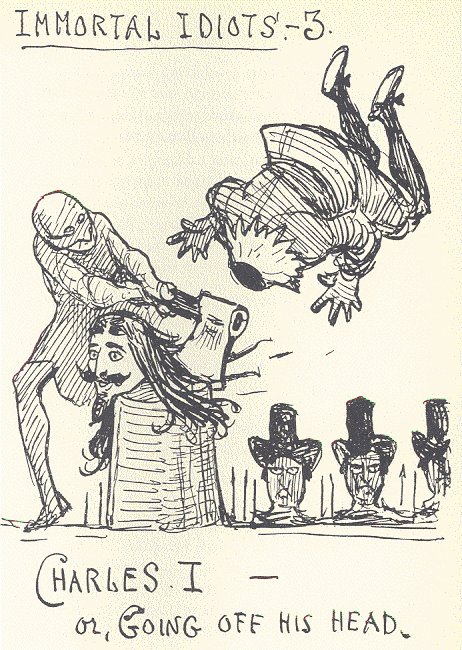
As promised, we will continue our excursion into The Coloured Lands with a series of caricatures entitled "Immortal Idiots," as well as a wee bit of text. We'll begin with the images, curious as they are. As always, remember to click on them to see an enlarged and more glorious version.
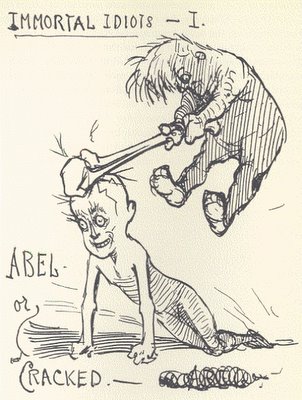
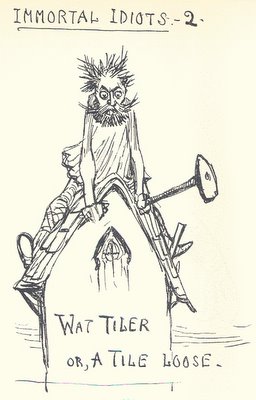
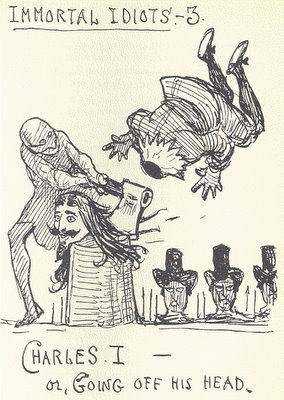
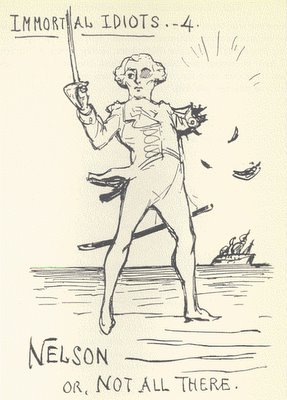
Of the four, Charles II is my favourite artistically, and Abel thematically. Also, for those of you unfamiliar with Wat Tiler, he was, along with Jack Straw, the leader of a peasant rebellion against Richard II in 1381. The rebellion faltered when the army was overcome by Richard II's charm. Tiler himself was killed in a fight with the mayor of London soon after. The Nelson one, regrettably, leaves me kind of flat, but that's mostly due to my radical bias in favour of the man.
Anyhow, some text...
Paints in a Paint-Box
By G.K. Chesterton
There has often arisen before my mind the image of an individual who should collect with laborious care articles which no other person valued and make an exhaustive classification of things which everyone else regarded as insignificant and inane. This being might have a magnificent and futile pre-eminence in many enterprises. He might have the finest collection of disused cigar ends in the world. He might accumulate pipe ashes and the parings of lead pencils with an enthusiasm and a poetry worthy of a better cause. He might, if he were a millionaire, carry this immense crusade into even larger matters. He might build great museums in which nothing was exhibited except lost umbrellas and bad pennies. He might found important papers and magazines in which nothing was recorded except unimportant things; in which stunning head lines announced the loss of three burnt matches out of an ash tray and long and philosophical leading articles were devoted to such questions as the Christian names of the Fulham omnibus conductors, or the number of green window-blinds in the Harrow Road. If a man did seriously devote himself to these inanities he would unquestionably be the object of a great deal of derision. Nevertheless, if he chose to turn round upon us and defend his position, we should suddenly realise that our whole civilisation was as moonstruck as his hobby. He would say with truth that there was, philosophically speaking, as much to be said for collecting the ferrules of gentlemen's umbrellas as for collecting books or banknotes.
For all essential purposes there is no reason which can be offered for the preference which mankind exhibits for one material rather than another. It is impossible to suggest a single valid reason why gold should be more expensive than a genuinely rich red mud. It is impossible to say why a precious stone should be more valued than a copying-ink pencil or an old green bottle, which are both more useful and more picturesque. Almost all the theories which profess to explain this paradox from the metaphysical point of view have failed entirely. It is commonly said, for example, that materials are valued on account of their rarity. Clearly, however, this cannot be maintained. There are a great many things more rare than gold and silver; however small may be the chances for any one of us of picking up half-a-sovereign in the gutter, the chances that we should pick up a latch-key tied up with red ribbon, or a copy of The Times descriptive of the introduction of the first Home Rule Bill, are even less. Yet people do not make a private museum of latch-keys with red ribbons or boast of a unique collection of copies of The Times for that particular date in 1885.
Those who speak of rarity as the essence of value seem scarcely to realise how prodigious are the consequences of their view. The things in this world which are thoroughly insignificant are precisely the things which are singularly rare. It is very rare for a solicitor with a red moustache born in Devonshire to lend 1s. 6d. to the nephew of a Scotch cloth-merchant residing in Clement's Inn; such a thing perhaps has only happened once, if at all; yet we do not write the incident in letters of gold, or attach any particular importance to any incidentals, rags or relics, which may have been found to be commemorative of the spot where it occurred. Mere rarity certainly is not the test of value. if it were so, gold would be less valuable than many varieties of street mud, and beautiful things upon the whole much less valuable than ugly ones. The fact of the matter is, that mankind has selected certain unmeaning objects as things of value without either intrinsic or comparative criticism. It has made one material infinitely more valuable than another material by a mere process of selecting one kind of mud from another. In many respects the current conception of the substance which is valuable is decidedly an inferior one. Value, for example, almost entirely centres around metals, which are the dullest and most uncommunicative, the most material, of all earthly things. They belong to the mineral creation, which is the very canaille of the cosmic order. It is extraordinary when one comes to think of it that so thoroughly base a thing as gold metal should be the form in which all our most human and humanising tendencies are bound up. Whenever we apply for payment in cash, we fulfill almost to the point of detail the word of the parable, we ask for bread and we receive a stone.
Again, the theory that materials are valued on account of their beauty will not support criticism. There are a great many objects which are more beautiful than precious objects. Peacocks' feathers are more beautiful, and autumn leaves and split firewood and clean copper. Nevertheless, it has not occurred to any person to swagger in a purse-proud manner over his possession of firewood or to cling to every advantage which could be founded upon copper. The miser who should spend a laborious life in hoarding and counting the autumn leaves has, I think, yet to be born.
Substances have, however, a real intrinsic spirituality. Materials are not likely to be despised except by materialists. Children, for example, are fully conscious of a certain mystical, and yet practical, quality in the things they handle; they love the essential quality of an object chivalrously, and for its own sake. A child has an ingrained fancy for coal, not for the gross materialistic reason that it builds up fires by which we cook and are warmed, but for the infinitely nobler and more abstract reason that it blacks his fingers. In almost all the old primitive literatures we find the presence of this splendid love of materials for their own sake. We find no delicate and cunning combinations of colour, such as those which are the essence of our latter-day art, but we find a gigantic appetite for materials linked with their own natural characteristics, for red gold, and green grass; not the taste for green gold and red grass which marks so much contemporary literature. They did not require either contrast or harmony to tickle their aesthetic hunger. They loved the redness of wine or the white splendour of the sword in all their virginity and loveliness, a single splash of crimson or silver upon the black background of old Night.
The poetry of substances exists, and it takes no account of the ordinary codes of value. Gold is certainly a less fascinating substance than silver. And even silver is to the spirit which retains its childhood less fascinating than lead. Lead is a truly epic substance; it contains every quality that could be required for that purpose. In colour it is the most delicate tint of dimmed silver, a kind of metallic splendour under a perpetual cloud; in consistency again it unites two of the antagonistic and indispensable elements of a fascinating substance. It is at once robust and malleable, it bends and it resists; we have the same feeling towards a stiff layer of lead that we have towards destiny. It is stiff, yet it yields sufficiently to make us fancy that it might yield altogether. Another substance which presents in a somewhat different way the same contradiction is common wood. It is the most fascinating and the most symbolic of substances, since it has just enough essential toughness to resist the amateur, and just enough pliability to become like a musical instrument in the hands of the expert. Working in wood is the supreme example of creation; creation in a material which resists just enough and not an iota too much. It was surely no wonder that the greatest who ever wore the form of man was a carpenter.
There remains one definite order of materials which have to the imaginative eye far more essential value than any jewels. All pigments and colour materials have one supreme advantage over mere diamonds and amethysts. They are, so to speak, ancestors as well as descendants; they propagate an infinite progeny of images and ideas. If we look at a solid bar of blue chalk we do not see a thing merely mechanical and final. We see bound up in that blue column a whole fairyland of potential pictures and tales. No other material object gives us this sense of multiplying itself. If we leave a cigar in a corner we do not expect that we shall find it the next day surrounded by a family of cigarettes. A diamond ring does not contribute in any way to the production of innumerable necklaces and bracelets. But the chalks in a box, or the paints in a paint-box, do actually embrace in themselves an infinity of new possibilities. A cake of Prussian Blue contains all the sea stories in the world, a cake of emerald green encloses a hundred meadows, a cake of crimson is compounded of forgotten sunsets.
Some day, for all we know, this eternal metaphysical value in chalks and paints may be recognized as of monetary value; men will proudly show a cake of chrome yellow in their rings, and a cake of ultramarine in their scarf pins. There is no saying what wild fashions the changes of time may make; a century may find us economising in pebbles and collecting straws. But whatever may come, the essential ground of this habit will remain the same as the essential ground of all the religions, that we can only take a sample of the universe, and that that sample, even if it be a handful of dust (which is also a beautiful substance), will always assert the magic of itself, and hint at the magic of all things.
==
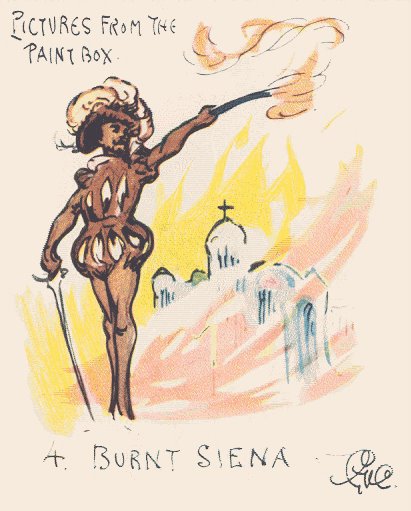
Well, that's quite a mouthful. In our next installment (which may come sometime mid-week), we will see some of the illustrations that were produced to accompany "Paints in a Paint-Box," as well, perhaps, as something else (note: the "Burnt Siena" image from the last Coloured Lands update was from this story). There's a good series of self-deprecating caricatures that Gilbert produced of himself that will definitely prove worthwhile, as well as a story that is told purely in illustration and drawn text. I will, of course, provide a transcription of that text for the hard of vision.
Be sure to let any Chestertonians you know what's going on here. The Coloured Lands only had very few editions, and it's rare indeed that anyone ever sees it. You will definitely want to be on hand for the transcription of the gloriously-illustrated fable, "The Disadvantage of Having Two Heads: A Story." All this and more as the days go by.


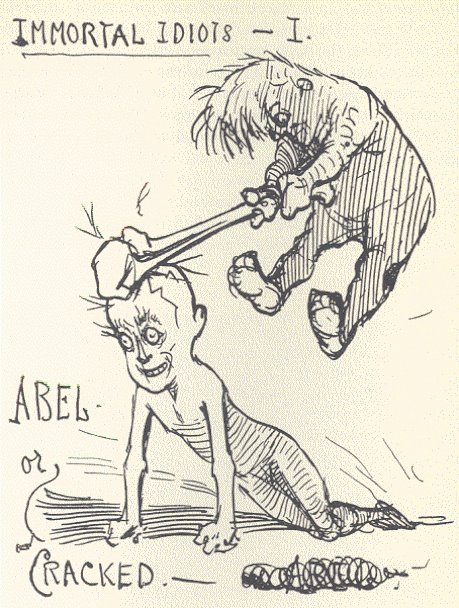
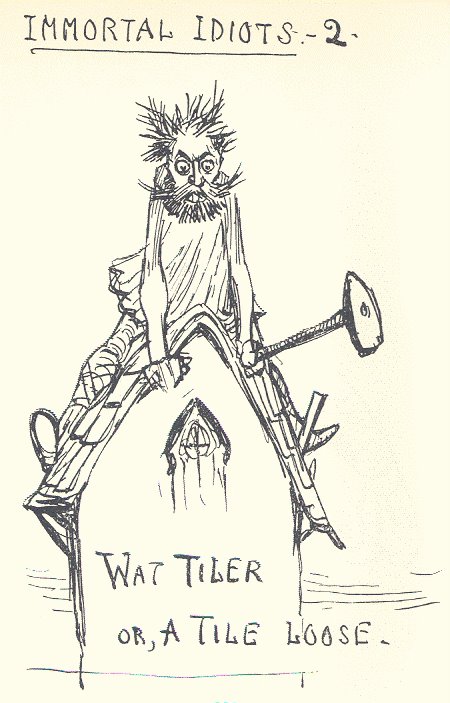
Of the four, Charles II is my favourite artistically, and Abel thematically. Also, for those of you unfamiliar with Wat Tiler, he was, along with Jack Straw, the leader of a peasant rebellion against Richard II in 1381. The rebellion faltered when the army was overcome by Richard II's charm. Tiler himself was killed in a fight with the mayor of London soon after. The Nelson one, regrettably, leaves me kind of flat, but that's mostly due to my radical bias in favour of the man.Anyhow, some text...
Paints in a Paint-Box
By G.K. Chesterton
There has often arisen before my mind the image of an individual who should collect with laborious care articles which no other person valued and make an exhaustive classification of things which everyone else regarded as insignificant and inane. This being might have a magnificent and futile pre-eminence in many enterprises. He might have the finest collection of disused cigar ends in the world. He might accumulate pipe ashes and the parings of lead pencils with an enthusiasm and a poetry worthy of a better cause. He might, if he were a millionaire, carry this immense crusade into even larger matters. He might build great museums in which nothing was exhibited except lost umbrellas and bad pennies. He might found important papers and magazines in which nothing was recorded except unimportant things; in which stunning head lines announced the loss of three burnt matches out of an ash tray and long and philosophical leading articles were devoted to such questions as the Christian names of the Fulham omnibus conductors, or the number of green window-blinds in the Harrow Road. If a man did seriously devote himself to these inanities he would unquestionably be the object of a great deal of derision. Nevertheless, if he chose to turn round upon us and defend his position, we should suddenly realise that our whole civilisation was as moonstruck as his hobby. He would say with truth that there was, philosophically speaking, as much to be said for collecting the ferrules of gentlemen's umbrellas as for collecting books or banknotes.
For all essential purposes there is no reason which can be offered for the preference which mankind exhibits for one material rather than another. It is impossible to suggest a single valid reason why gold should be more expensive than a genuinely rich red mud. It is impossible to say why a precious stone should be more valued than a copying-ink pencil or an old green bottle, which are both more useful and more picturesque. Almost all the theories which profess to explain this paradox from the metaphysical point of view have failed entirely. It is commonly said, for example, that materials are valued on account of their rarity. Clearly, however, this cannot be maintained. There are a great many things more rare than gold and silver; however small may be the chances for any one of us of picking up half-a-sovereign in the gutter, the chances that we should pick up a latch-key tied up with red ribbon, or a copy of The Times descriptive of the introduction of the first Home Rule Bill, are even less. Yet people do not make a private museum of latch-keys with red ribbons or boast of a unique collection of copies of The Times for that particular date in 1885.
Those who speak of rarity as the essence of value seem scarcely to realise how prodigious are the consequences of their view. The things in this world which are thoroughly insignificant are precisely the things which are singularly rare. It is very rare for a solicitor with a red moustache born in Devonshire to lend 1s. 6d. to the nephew of a Scotch cloth-merchant residing in Clement's Inn; such a thing perhaps has only happened once, if at all; yet we do not write the incident in letters of gold, or attach any particular importance to any incidentals, rags or relics, which may have been found to be commemorative of the spot where it occurred. Mere rarity certainly is not the test of value. if it were so, gold would be less valuable than many varieties of street mud, and beautiful things upon the whole much less valuable than ugly ones. The fact of the matter is, that mankind has selected certain unmeaning objects as things of value without either intrinsic or comparative criticism. It has made one material infinitely more valuable than another material by a mere process of selecting one kind of mud from another. In many respects the current conception of the substance which is valuable is decidedly an inferior one. Value, for example, almost entirely centres around metals, which are the dullest and most uncommunicative, the most material, of all earthly things. They belong to the mineral creation, which is the very canaille of the cosmic order. It is extraordinary when one comes to think of it that so thoroughly base a thing as gold metal should be the form in which all our most human and humanising tendencies are bound up. Whenever we apply for payment in cash, we fulfill almost to the point of detail the word of the parable, we ask for bread and we receive a stone.
Again, the theory that materials are valued on account of their beauty will not support criticism. There are a great many objects which are more beautiful than precious objects. Peacocks' feathers are more beautiful, and autumn leaves and split firewood and clean copper. Nevertheless, it has not occurred to any person to swagger in a purse-proud manner over his possession of firewood or to cling to every advantage which could be founded upon copper. The miser who should spend a laborious life in hoarding and counting the autumn leaves has, I think, yet to be born.
Substances have, however, a real intrinsic spirituality. Materials are not likely to be despised except by materialists. Children, for example, are fully conscious of a certain mystical, and yet practical, quality in the things they handle; they love the essential quality of an object chivalrously, and for its own sake. A child has an ingrained fancy for coal, not for the gross materialistic reason that it builds up fires by which we cook and are warmed, but for the infinitely nobler and more abstract reason that it blacks his fingers. In almost all the old primitive literatures we find the presence of this splendid love of materials for their own sake. We find no delicate and cunning combinations of colour, such as those which are the essence of our latter-day art, but we find a gigantic appetite for materials linked with their own natural characteristics, for red gold, and green grass; not the taste for green gold and red grass which marks so much contemporary literature. They did not require either contrast or harmony to tickle their aesthetic hunger. They loved the redness of wine or the white splendour of the sword in all their virginity and loveliness, a single splash of crimson or silver upon the black background of old Night.
The poetry of substances exists, and it takes no account of the ordinary codes of value. Gold is certainly a less fascinating substance than silver. And even silver is to the spirit which retains its childhood less fascinating than lead. Lead is a truly epic substance; it contains every quality that could be required for that purpose. In colour it is the most delicate tint of dimmed silver, a kind of metallic splendour under a perpetual cloud; in consistency again it unites two of the antagonistic and indispensable elements of a fascinating substance. It is at once robust and malleable, it bends and it resists; we have the same feeling towards a stiff layer of lead that we have towards destiny. It is stiff, yet it yields sufficiently to make us fancy that it might yield altogether. Another substance which presents in a somewhat different way the same contradiction is common wood. It is the most fascinating and the most symbolic of substances, since it has just enough essential toughness to resist the amateur, and just enough pliability to become like a musical instrument in the hands of the expert. Working in wood is the supreme example of creation; creation in a material which resists just enough and not an iota too much. It was surely no wonder that the greatest who ever wore the form of man was a carpenter.
There remains one definite order of materials which have to the imaginative eye far more essential value than any jewels. All pigments and colour materials have one supreme advantage over mere diamonds and amethysts. They are, so to speak, ancestors as well as descendants; they propagate an infinite progeny of images and ideas. If we look at a solid bar of blue chalk we do not see a thing merely mechanical and final. We see bound up in that blue column a whole fairyland of potential pictures and tales. No other material object gives us this sense of multiplying itself. If we leave a cigar in a corner we do not expect that we shall find it the next day surrounded by a family of cigarettes. A diamond ring does not contribute in any way to the production of innumerable necklaces and bracelets. But the chalks in a box, or the paints in a paint-box, do actually embrace in themselves an infinity of new possibilities. A cake of Prussian Blue contains all the sea stories in the world, a cake of emerald green encloses a hundred meadows, a cake of crimson is compounded of forgotten sunsets.
Some day, for all we know, this eternal metaphysical value in chalks and paints may be recognized as of monetary value; men will proudly show a cake of chrome yellow in their rings, and a cake of ultramarine in their scarf pins. There is no saying what wild fashions the changes of time may make; a century may find us economising in pebbles and collecting straws. But whatever may come, the essential ground of this habit will remain the same as the essential ground of all the religions, that we can only take a sample of the universe, and that that sample, even if it be a handful of dust (which is also a beautiful substance), will always assert the magic of itself, and hint at the magic of all things.
==
Well, that's quite a mouthful. In our next installment (which may come sometime mid-week), we will see some of the illustrations that were produced to accompany "Paints in a Paint-Box," as well, perhaps, as something else (note: the "Burnt Siena" image from the last Coloured Lands update was from this story). There's a good series of self-deprecating caricatures that Gilbert produced of himself that will definitely prove worthwhile, as well as a story that is told purely in illustration and drawn text. I will, of course, provide a transcription of that text for the hard of vision.
Be sure to let any Chestertonians you know what's going on here. The Coloured Lands only had very few editions, and it's rare indeed that anyone ever sees it. You will definitely want to be on hand for the transcription of the gloriously-illustrated fable, "The Disadvantage of Having Two Heads: A Story." All this and more as the days go by.
Friday, February 17, 2006
GKC in IT Week
Patrick Forsyth, writing in IT Week, uses the Chesterton Quote For All Seasons to promote time management:
G. K. Chesterton once wrote that the reason Christianity was declining was ‘not because it has been tried and found wanting, but because it has been found difficult and therefore not tried’. So too with time management. There is no magic formula and circumstances – and interruptions – often seem to conspire to prevent best intentions from working out. Some people, perhaps failing to achieve what they want, despair and give up.You can read the entire article Get Tougher With Time here.
Thursday, February 16, 2006
Some scans from The Coloured Lands
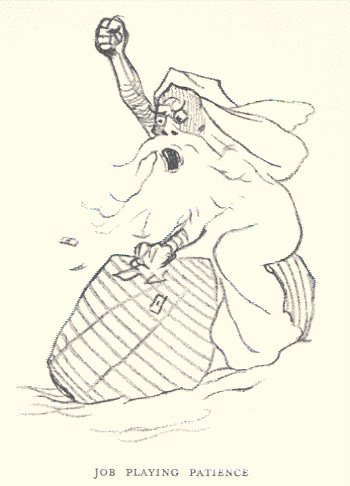
As promised, here are some images from Chesterton's The Coloured Lands that have never before been seen online (or so my most ardent searching would seem to indicate). The images are nice and big, so be sure to click on them for the enlarged view.


And we shall round it out with one of his darling caricatures of rage:
Next time there will be some more text from the book, as well as a caricature series entitled "Immortal Idiots" in which such characters as Abel, Charles I, and Horatio Nelson meet their doom.


And we shall round it out with one of his darling caricatures of rage:
Next time there will be some more text from the book, as well as a caricature series entitled "Immortal Idiots" in which such characters as Abel, Charles I, and Horatio Nelson meet their doom.
Sassoon: Friend of Belloc
IgnatiusInsight.com recently posted selections from Joseph Pearce's Flowers of Heaven: One Thousand Years of Christian Verse. An excerpt about Siegfried Sassoon (1886-1967) mentions his "admiration for Belloc:"
Click here to read the entire article, Well Versed In Faith, at IgnatiusInsight.com.
Siegfried Sassoon was a septuagenarian when he was received into the Catholic Church in 1957. An early and lasting admiration for Belloc and a late friendship with Ronald Knox were both significant factors in his spiritual journey, but most important was his own introspective mysticism. His final acceptance of Christianity was the culmination of a lifetime’s search, traceable through his poetry back to his youth.
A Prayer in Old Age
Being no expectance of heaven unearned
No hunger for beatitude to be
Until the lesson of my life is learned
Through what Thou didst for me.
Bring no assurance of redeemed rest
No intimation of awarded grace
Only contrition, cleavingly confessed
To Thy forgiving face.
I ask one world of everlasting loss
In all I am, that other world to win.
My nothingness must kneel below Thy Cross.
There let new life begin.
Click here to read the entire article, Well Versed In Faith, at IgnatiusInsight.com.
Wednesday, February 15, 2006
Max's Favorite
On March 15 and 16, 1954, Edmund Wilson called on Max Beerbohm in Beerbohm's villa at Rapallo. Wilson found that Chesterton remained a favorite subject for the great caricaturist, mentioning in particular a mural of Chesterton that had been painted at the entrance hall, and the title page of a volume of Chesterton's essays covered with "an expanding caricature" in which the printed words "Thirteenth Edition" were displayed in Chesterton's open mouth. [The Bit between My Teeth, New York: Farrar, Strause, 1965]
Tuesday, February 14, 2006
Fr. Brown Book
"The Blue Cross" Study Edition by Nancy Carpentier Brown.
To be honest, I'm not a big fan of mystery stories and, in fact, other than Fr. Brown stories and the talented John Peterson's excellent short stories in Gilbert Magazine, I never read 'em. I have read "The Blue Cross," though, and I trust Ms. Brown to produce a good read. This is tempting.
"G. K. Chesterton was one of the greatest Catholic writers of the 20th century, and more and more people today are discovering the treasure in his works. This guide focuses on the very first "Father Brown Mystery" that he wrote.
"Mrs. Brown has written a comprehensive study guide with vocabulary, discussion questions, and word study. Your student will find much food for thought while becoming acquainted with this great writer.
"The study guide includes the complete text of the story along with illustrations by Sean Fitzpatrick."
Link.
To be honest, I'm not a big fan of mystery stories and, in fact, other than Fr. Brown stories and the talented John Peterson's excellent short stories in Gilbert Magazine, I never read 'em. I have read "The Blue Cross," though, and I trust Ms. Brown to produce a good read. This is tempting.
"G. K. Chesterton was one of the greatest Catholic writers of the 20th century, and more and more people today are discovering the treasure in his works. This guide focuses on the very first "Father Brown Mystery" that he wrote.
"Mrs. Brown has written a comprehensive study guide with vocabulary, discussion questions, and word study. Your student will find much food for thought while becoming acquainted with this great writer.
"The study guide includes the complete text of the story along with illustrations by Sean Fitzpatrick."
Link.
Monday, February 13, 2006
Great news
It's good news for me, because it gives me enough content for the next month of posting, at least. It's good news for you for the same reason!
Yes, my copy of Chesterton's The Coloured Lands arrived in the mail yesterday, in all its colourful glory. Contained within are rare essays, poems and images produced by Chesterton at various stages of his life, and collected into a single volume by his biographer, Maisie Ward. The most thrilling gems in this gaudy crown include several coloured plates produced merely as an excuse to use a certain colour (such as "Prussian Blue" and "Burnt Siena"). More intriguing still is a lengthy illustrated demonology that Chesterton wrote at the age of 17.
We shall see much of these as time passes (including scans of the artwork), but we will not take the book in order. For now, we shall merely bear witness to a short tale which may prove appropriate for the morrow - St. Valentine's Day.
The Whale's Wooing
By G.K. Chesterton
A newspaper famous for its urgency about practical and pressing affairs recently filled a large part of its space with the headline, "Do Whales Have Two Wives?" There was a second headline saying that Science was about to investigate the matter in a highly exact and scientific fashion. And indeed it may be hoped that science is more exact than journalism. One peculiarity of that sentence is that it really says almost the opposite of what it intended to say. We might suppose that, before printing a short phrase in large letters, a man might at least look at it to see whether it said what he meant. But behind all this hustle there is not only carelessness but a great weariness. Strictly speaking, the phrase, "Do Whales Have Two Wives?" could only mean, if it meant anything, "Do all whales, in their collective capacity, have only two wives between them?" But the journalist did not mean to suggest this extreme practice of polyandry. He only meant to ask whether the individual whale can be reproached with the practice of bigamy. At first sight there is something rather quaint and alluring about the notion of watching a whale to see whether he lives a double life. A whale scarcely seems designed for secrecy or for shy and furtive flirtation. The thought of a whale assuming various disguises, designed to make him inconspicuous among other fishes, puts rather a strain on the imagination. He would have to keep his two establishments, one at the North Pole and the other at the South, if his two wives were likely to be jealous of each other; and if he really wished to becoming a bone (or whale-bone) of contention. In truth the most frivolous philanderer would hardly wish to conduct his frivolities on quite so large a scale; and the loves of the whales may well appear a theme for a bolder pen than any that has yet traced the tremendous epic of the loves of the giants.
But we have a sort of fancy or faint suspicion about where it may end. Science, or what journalism calls Science, is always up to its little games; and this might possibly be one of them. We know how some people perpetually preach to us that there is no morality in nature and therefore nothing natural in morality. We know that we have been told to learn everything from the herd instinct or the law of the jungle; to learn our manners from a monkey-house and morals from a dog-fight. May we not find a model in a far more impressive and serene animal? Shall we not be told that Leviathan refuses to put forth his nose to the hook of monogamy, and laughs at the shaking of the chivalric spear? To the supine and superstitious person, who has lingered with one wife for a whole lifetime, will not the rebuke be uttered in ancient words; "Go to the whale, thou sluggard." Contemplating the cetaceous experiments in polygamy, will not the moralist exclaim once more: "How doth the little busy whale improve the shining hour!" Will not the way of this superior mammal be a new argument for the cult of the new Cupid; the sort of Cupid who likes to have two strings to his bow? For we are bound to regard the monster as a moral superior, according to the current moral judgments. We are perpetually told that the human being is small, that even the earth itself is small, compared with the splendid size of the solar system. If we are to surrender to the size of the world, why not to the size of the whale? If we are to bow down before planets which are large than our own, why not before animals that are larger than ourselves? Why not, with a yet more graceful bow, yield the pas (if the phrase be sufficiently aquatic) to the great mountain of blubber? In many ways, he looks very like the highest moral ideal of our time.
Yes, my copy of Chesterton's The Coloured Lands arrived in the mail yesterday, in all its colourful glory. Contained within are rare essays, poems and images produced by Chesterton at various stages of his life, and collected into a single volume by his biographer, Maisie Ward. The most thrilling gems in this gaudy crown include several coloured plates produced merely as an excuse to use a certain colour (such as "Prussian Blue" and "Burnt Siena"). More intriguing still is a lengthy illustrated demonology that Chesterton wrote at the age of 17.
We shall see much of these as time passes (including scans of the artwork), but we will not take the book in order. For now, we shall merely bear witness to a short tale which may prove appropriate for the morrow - St. Valentine's Day.
The Whale's Wooing
By G.K. Chesterton
A newspaper famous for its urgency about practical and pressing affairs recently filled a large part of its space with the headline, "Do Whales Have Two Wives?" There was a second headline saying that Science was about to investigate the matter in a highly exact and scientific fashion. And indeed it may be hoped that science is more exact than journalism. One peculiarity of that sentence is that it really says almost the opposite of what it intended to say. We might suppose that, before printing a short phrase in large letters, a man might at least look at it to see whether it said what he meant. But behind all this hustle there is not only carelessness but a great weariness. Strictly speaking, the phrase, "Do Whales Have Two Wives?" could only mean, if it meant anything, "Do all whales, in their collective capacity, have only two wives between them?" But the journalist did not mean to suggest this extreme practice of polyandry. He only meant to ask whether the individual whale can be reproached with the practice of bigamy. At first sight there is something rather quaint and alluring about the notion of watching a whale to see whether he lives a double life. A whale scarcely seems designed for secrecy or for shy and furtive flirtation. The thought of a whale assuming various disguises, designed to make him inconspicuous among other fishes, puts rather a strain on the imagination. He would have to keep his two establishments, one at the North Pole and the other at the South, if his two wives were likely to be jealous of each other; and if he really wished to becoming a bone (or whale-bone) of contention. In truth the most frivolous philanderer would hardly wish to conduct his frivolities on quite so large a scale; and the loves of the whales may well appear a theme for a bolder pen than any that has yet traced the tremendous epic of the loves of the giants.
But we have a sort of fancy or faint suspicion about where it may end. Science, or what journalism calls Science, is always up to its little games; and this might possibly be one of them. We know how some people perpetually preach to us that there is no morality in nature and therefore nothing natural in morality. We know that we have been told to learn everything from the herd instinct or the law of the jungle; to learn our manners from a monkey-house and morals from a dog-fight. May we not find a model in a far more impressive and serene animal? Shall we not be told that Leviathan refuses to put forth his nose to the hook of monogamy, and laughs at the shaking of the chivalric spear? To the supine and superstitious person, who has lingered with one wife for a whole lifetime, will not the rebuke be uttered in ancient words; "Go to the whale, thou sluggard." Contemplating the cetaceous experiments in polygamy, will not the moralist exclaim once more: "How doth the little busy whale improve the shining hour!" Will not the way of this superior mammal be a new argument for the cult of the new Cupid; the sort of Cupid who likes to have two strings to his bow? For we are bound to regard the monster as a moral superior, according to the current moral judgments. We are perpetually told that the human being is small, that even the earth itself is small, compared with the splendid size of the solar system. If we are to surrender to the size of the world, why not to the size of the whale? If we are to bow down before planets which are large than our own, why not before animals that are larger than ourselves? Why not, with a yet more graceful bow, yield the pas (if the phrase be sufficiently aquatic) to the great mountain of blubber? In many ways, he looks very like the highest moral ideal of our time.
Saturday, February 11, 2006
Thursday, February 09, 2006
Free Prize Inside!
Trading cards for smokers: In 1937, a pack of Wills's Cigarettes came with a card from the "Famous British Authors" series.

Thanks to Cruz y Fierro for finding this.
Wednesday, February 08, 2006
GKC is Everywhere: Sighting in New York
In his review of Seven Gone to New York: Adventures in the City, the Sunday Telegraph's Harry Mount opens with lines from GKC:
"G. K. Chesterton said that it was much braver to drop in on your neighbour unannounced than it was to go on a round-the-world trip. That's sort of the principle behind this collection of essays about New York by Ian Frazier, a long-time contributor to The New Yorker, who moved to the city in the early 1970s from small-town Ohio.
"Frazier's version of the Chesterton line is that you get a much sharper view of New York by looking at the tiny, everyday, dreary things that go on unremarked in the city than you would by, say, climbing the Empire State Building and having a Martini with Rudy Giuliani and Frank Sinatra."
"G. K. Chesterton said that it was much braver to drop in on your neighbour unannounced than it was to go on a round-the-world trip. That's sort of the principle behind this collection of essays about New York by Ian Frazier, a long-time contributor to The New Yorker, who moved to the city in the early 1970s from small-town Ohio.
"Frazier's version of the Chesterton line is that you get a much sharper view of New York by looking at the tiny, everyday, dreary things that go on unremarked in the city than you would by, say, climbing the Empire State Building and having a Martini with Rudy Giuliani and Frank Sinatra."
Tuesday, February 07, 2006
More GKC Friends in the Blogosphere
I've mentioned it before, but I never cease to be fascinated by the number of times that Chesterton is mentioned in the blogosphere. For a writer who has largely been forgotten, his words are constantly remembered.
Today's sample:
"'It would be much truer to say that a man will certainly fail, because he believes in himself. Complete self-confidence is not merely a sin; complete self-confidence is a weakness.'
"Chesterton used the words just mentioned to illustrate the claim with which he opened the chapter. "Thoroughly worldly people," he claimed, "never understand even the world; they rely altogether on a few cynical maxims, which are not true." Indeed, our sarcastically honest social commentator was right!
"Some people just didn't understand the most basic reason for man's existence and progress: God willed it an allows it to happen. Nothing is or happens apart from God, regardless of how much one man believes in himself. Sadly, Chesterton's message was not heeded by many. Far too few men and women in the 21st century acknowledge that we need more to survive than simply our own faculties."
Musings from Memphis.
Today's sample:
"'It would be much truer to say that a man will certainly fail, because he believes in himself. Complete self-confidence is not merely a sin; complete self-confidence is a weakness.'
"Chesterton used the words just mentioned to illustrate the claim with which he opened the chapter. "Thoroughly worldly people," he claimed, "never understand even the world; they rely altogether on a few cynical maxims, which are not true." Indeed, our sarcastically honest social commentator was right!
"Some people just didn't understand the most basic reason for man's existence and progress: God willed it an allows it to happen. Nothing is or happens apart from God, regardless of how much one man believes in himself. Sadly, Chesterton's message was not heeded by many. Far too few men and women in the 21st century acknowledge that we need more to survive than simply our own faculties."
Musings from Memphis.
Monday, February 06, 2006
Chesterton on Islam
As our less cloistered readers are aware, there is currently something of a tumult in the works regarding a certain lampooning of a certain desert religion's founder. One would have hoped perhaps that they would take in stride, drawing - again perhaps - upon the example set by Christendom, the founder of which was lampooned quite manfully even at the moment of his death.
However, we can not expect too much of people. The first time is always a sting.
Chesterton had some things to say about Islam, as he had things to say about everything, and much of it is both profound and prescient.
First, with regard to the situation at hand:
Next, we have some fairly hard words on Islam's peaceful tendencies (or remarkable lack thereof):
Next, we have a discussion of the positive qualities of the Koran, and why, even after all of the turmoil it has fomented, it deserves a measure of respect:
Finally (and most intriguingly), we have a sort of prediction of dynamic Islam's chief means of making change in the world:
==
The analysis of For Four Guilds approaches; I've been caught up in other things, however, and it has been tragically delayed. This, however, should suffice for now.
However, we can not expect too much of people. The first time is always a sting.
Chesterton had some things to say about Islam, as he had things to say about everything, and much of it is both profound and prescient.
First, with regard to the situation at hand:
"...a man preaching what he thinks is a platitude is far more intolerant than a man preaching what he admits is a paradox. It was exactly because it seemed self-evident, to Moslems as to Bolshevists, that their simple creed was suited to everybody, that they wished in that particular sweeping fashion to impose it on everybody. It was because Islam was broad that Moslems were narrow. And because it was not a hard religion it was a heavy rule. Because it was without a self-correcting complexity, it allowed of those simple and masculine but mostly rather dangerous appetites that show themselves in a chieftain or a lord. As it had the simplest sort of religion, monotheism, so it had the simplest sort of government, monarchy. There was exactly the same direct spirit in its despotism as in its deism. The Code, the Common Law, the give and take of charters and chivalric vows, did not grow in that golden desert. The great sun was in the sky and the great Saladin was in his tent, and he must be obeyed unless he were assassinated. Those who complain of our creeds as elaborate often forget that the elaborate Western creeds have produced the elaborate Western constitutions; and that they are elaborate because they are emancipated." ("The Fall of Chivalry," The New Jerusalem)
"There is in Islam a paradox which is perhaps a permanent menace. The great creed born in the desert creates a kind of ecstasy out of the very emptiness of its own land, and even, one may say, out of the emptiness of its own theology. It affirms, with no little sublimity, something that is not merely the singleness but rather the solitude of God. There is the same extreme simplification in the solitary figure of the Prophet; and yet this isolation perpetually reacts into its own opposite. A void is made in the heart of Islam which has to be filled up again and again by a mere repetition of the revolution that founded it. There are no sacraments; the only thing that can happen is a sort of apocalypse, as unique as the end of the world; so the apocalypse can only be repeated and the world end again and again. There are no priests; and yet this equality can only breed a multitude of lawless prophets almost as numerous as priests. The very dogma that there is only one Mahomet produces an endless procession of Mahomets. Of these the mightiest in modern times were the man whose name was Ahmed, and whose more famous title was the Mahdi; and his more ferocious successor Abdullahi, who was generally known as the Khalifa. These great fanatics, or great creators of fanaticism, succeeded in making a militarism almost as famous and formidable as that of the Turkish Empire on whose frontiers it hovered, and in spreading a reign of terror such as can seldom be organised except by civilisation…" (Lord Kitchener)
"I do not know much about Mohammed or Mohammedanism. I do not take the Koran to bed with me every night. But, if I did on some one particular night, there is one sense at least in which I know what I should not find there. I apprehend that I should not find the work abounding in strong encouragements to the worship of idols; that the praises of polytheism would not be loudly sung; that the character of Mohammed would not be subjected to anything resembling hatred and derision; and that the great modern doctrine of the unimportance of religion would not be needlessly emphasised." (ILN Nov. 15, 1913)
"A good Moslem king was one who was strict in religion, valiant in battle, just in giving judgment among his people, but not one who had the slightest objection in international matters to removing his neighbour's landmark." (ILN Nov. 4, 1911)
The analysis of For Four Guilds approaches; I've been caught up in other things, however, and it has been tragically delayed. This, however, should suffice for now.
American Book Review: 100 Best First Lines From Novels
The American Book Review (Illinois State University) published a list of 100 best first lines from novels (The Pantagraph. Feb 3, 2006). C.S. Lewis and G.K. Chesterton made the list:
Happily, my personal favorite first line (though not a Chesterton line) made the list:
47. There was a boy called Eustace Clarence Scrubb, and he almost deserved it. — C. S. Lewis, The Voyage of the Dawn Treader (1952)
63. The human race, to which so many of my readers belong, has been playing at children's games from the beginning, and will probably do it till the end, which is a nuisance for the few people who grow up. — G. K. Chesterton, The Napoleon of Notting Hill (1904)
Happily, my personal favorite first line (though not a Chesterton line) made the list:
70. Francis Marion Tarwater's uncle had been dead for only half a day when the boy got too drunk to finish digging his grave and a Negro named Buford Munson, who had come to get a jug filled, had to finish it and drag the body from the breakfast table where it was still sitting and bury it in a decent and Christian way, with the sign of its Saviour at the head of the grave and enough dirt on top to keep the dogs from digging it up. — Flannery O'Connor, The Violent Bear it Away (1960)
Friday, February 03, 2006
Out of This Perpetual Dog-Fight
Christian History & Biography has an article about C.S. Lewis and the influence of friendship:
"You modify one another's thought; out of this perpetual dog-fight a community of mind and a deep affection emerge." That is what C.S. Lewis said about his enduring friendship with Owen Barfield, who greatly influenced his bedrock views on imagination and myth.link to the entire article by Colin Duriez, "The Way of Friendship" at Christian History & Biography
...
Rather like the texts of literature, a friend provides another vantage point from which to view the world. For Lewis, his different friends opened up reality in varying ways. Owen Barfield, for instance, was very different from Arthur Greeves, who had revealed to Lewis he was not alone in the world. Though Barfield shared with Lewis a view of what was important, and asked strikingly similar questions, the conclusions he came to usually differed radically from those of Lewis. Throughout the 1920s, the two had waged what Lewis called a "Great War," a long dispute over the kind of knowledge that imagination can give. As Lewis put it, it was as if Barfield spoke his language but mispronounced it.
Lewis's friendship with J.R.R. Tolkien, like that with Barfield, was based upon irreducible differences as well as likenesses. Initially, the two were drawn together by a love of myth, fairytale, and saga, a bond that deepened when Lewis became a Christian. There were emerging differences of temperament, churchmanship, and storytelling style, however, which strained yet enriched the friendship.
Thursday, February 02, 2006
For Four Guilds: The Bell-Ringers
And so we reach the final part of this forgotten gem. Chesterton pulls it all together, going out with an almost apocalyptic synthesis of imagery and exultation. But, even at that, it is a grim conclusion, even as it is a hopeful conclusion. What an extraordinary comment on life.
IV: The Bell-Ringers
The angels are singling like birds in a tree
In the organ of good St. Cecily:
And the parson reads with his hand upon
The graven eagle of great St. John:
But never the fluted pipes shall go
Like the fifes of an army all a-row,
Merrily marching down the street
To the marts where the busy and idle meet;
And never the brazen bird shall fly
Out of the window and into the sky,
Till men in cities and shires and ships
Look up at the living Apocalypse.
But all can hark at the dark of even
The bells that bay like the hounds of heaven,
Tolling and telling that over and under,
In the ways of the air like a wandering thunder,
The hunt is up over hills untrod:
For the wind is the way of the dogs of God:
From the tyrant's tower to the outlaw's den
Hunting the souls of the sons of men.
Ruler and robber and pedlar and peer,
Who will not hearken and yet will hear;
Filling men's heads with the hurry and hum
Making them welcome before they come.
And we poor men stand under the steeple
Drawing the cords that can draw the people,
And in our leash like the leaping dogs
Are God's most deafening demagogues:
And we are but little, like dwarfs underground,
While hang up in heaven the houses of sound,
Moving like mountains that faith sets free,
Yawning like caverns that roar with the sea,
As awfully loaded, as airily buoyed,
Armoured archangels that trample the void:
Wild as with dancing and weighty with dooms,
Heavy as their panoply, light as their plumes.
Neither preacher nor priest are we:
Each man mount to his own degree:
Only remember that just such a cord
Tosses in heaven the trumpet and sword;
Souls on their terraces, saints on their towers,
Rise up in arms at alarum like ours:
Glow like great watchfires that redden the skies
Titans whose wings are a glory of eyes,
Crowned constellations by twelves and by sevens,
Domed dominations more old than the heavens,
Virtues that thunder and thrones that endure
Sway like a bell to the prayers of the poor.
==
For Four Guilds completed. For now, let us revel in its majesty; tomorrow shall come the analysis.
IV: The Bell-Ringers
The angels are singling like birds in a tree
In the organ of good St. Cecily:
And the parson reads with his hand upon
The graven eagle of great St. John:
But never the fluted pipes shall go
Like the fifes of an army all a-row,
Merrily marching down the street
To the marts where the busy and idle meet;
And never the brazen bird shall fly
Out of the window and into the sky,
Till men in cities and shires and ships
Look up at the living Apocalypse.
But all can hark at the dark of even
The bells that bay like the hounds of heaven,
Tolling and telling that over and under,
In the ways of the air like a wandering thunder,
The hunt is up over hills untrod:
For the wind is the way of the dogs of God:
From the tyrant's tower to the outlaw's den
Hunting the souls of the sons of men.
Ruler and robber and pedlar and peer,
Who will not hearken and yet will hear;
Filling men's heads with the hurry and hum
Making them welcome before they come.
And we poor men stand under the steeple
Drawing the cords that can draw the people,
And in our leash like the leaping dogs
Are God's most deafening demagogues:
And we are but little, like dwarfs underground,
While hang up in heaven the houses of sound,
Moving like mountains that faith sets free,
Yawning like caverns that roar with the sea,
As awfully loaded, as airily buoyed,
Armoured archangels that trample the void:
Wild as with dancing and weighty with dooms,
Heavy as their panoply, light as their plumes.
Neither preacher nor priest are we:
Each man mount to his own degree:
Only remember that just such a cord
Tosses in heaven the trumpet and sword;
Souls on their terraces, saints on their towers,
Rise up in arms at alarum like ours:
Glow like great watchfires that redden the skies
Titans whose wings are a glory of eyes,
Crowned constellations by twelves and by sevens,
Domed dominations more old than the heavens,
Virtues that thunder and thrones that endure
Sway like a bell to the prayers of the poor.
==
For Four Guilds completed. For now, let us revel in its majesty; tomorrow shall come the analysis.
The (Wo)Man Who Heard Thursday
You, too, can be a (Wo)Man Who Heard Thursday: Nancy has the scoop at the Blog of the A.C.S.
Tolkien & Temptation
From a new article at IgnatiusInsight.com about Tolkien, temptation, and the "unquenchable thirst for knowledge":
What separates Tolkien’s work from other narratives, especially those inspired by his prose, is the rich profundity and dexterity with which he wove his tapestry. Recent scholarship has shown the interconnectedness of Tolkien’s writing to the vaunted schools of ancient philosophy, specifically those of ancient Greece. However, there exists in The Lord of the Rings a subtle yet quite detectable call to the thought of the medieval philosopher St. Augustine. This call is particularly resonant today, an age where there appears to prevail an unquenchable thirst for knowledge. Augustine, as a student of the ancients (in particular of Plato), knew well that knowledge was not synonymous with wisdom. Often, the quest for the former entailed the preclusion of the latter.-- Dr. Jose Yulo, "The Temptation of the Earthly City: Tolkien's Augustinian Vision" at IgnatiusInsight.com; Feb 1, 2006
Wednesday, February 01, 2006
For Four Guilds III: Stone-Masons
We come now to the third of the four parts of Chesterton's For Four Guilds, a poem found in The Ballad of St. Barbara and Other Verses, but not previously available online. Of the four parts to this poem, this one is my favourite.
III. The Stone-Masons
We have graven the mountain of God with hands,
As our hands were graven of God, they say,
Where the seraphs burn in the sun like brands
And the devils carry the rains away;
Making a thrift of the throats of hell,
Our gargoyles gather the roaring rain,
Whose yawn is more than a frozen yell
And their very vomiting not in vain.
Wilder than all that a tongue can utter,
Wiser than all that is told in words,
The wings of stone of the soaring gutter
Fly out and follow the flight of the birds;
The rush and rout of the angel wars
Stand out above the astounded street,
Where we flung our gutters against the stars
For a sign that the first and last shall meet.
We have graven the forest of heaven with hands,
Being great with a mirth too gross for pride,
In the stone that battered him Stephen stands
And Peter himself is petrified:
Such hands as have grubbed in the glebe for bread
Have bidden the blank rock blossom and thrive,
Such hands as have stricken a live man dead
Have struck, and stricken the dead alive.
Fold your hands before heaven in praying,
Lift up your hands into heaven and cry;
But look where our dizziest spires are saying
What the hands of a man did up in the sky:
Drenched before you have heard the thunder,
White before you have felt the snow;
For the giants lift up their hands to wonder
How high the hands of a man may go.
==
We will conclude tomorrow with the fourth part (the bell-ringers), and Friday will possibly see some small analysis of the poem.
III. The Stone-Masons
We have graven the mountain of God with hands,
As our hands were graven of God, they say,
Where the seraphs burn in the sun like brands
And the devils carry the rains away;
Making a thrift of the throats of hell,
Our gargoyles gather the roaring rain,
Whose yawn is more than a frozen yell
And their very vomiting not in vain.
Wilder than all that a tongue can utter,
Wiser than all that is told in words,
The wings of stone of the soaring gutter
Fly out and follow the flight of the birds;
The rush and rout of the angel wars
Stand out above the astounded street,
Where we flung our gutters against the stars
For a sign that the first and last shall meet.
We have graven the forest of heaven with hands,
Being great with a mirth too gross for pride,
In the stone that battered him Stephen stands
And Peter himself is petrified:
Such hands as have grubbed in the glebe for bread
Have bidden the blank rock blossom and thrive,
Such hands as have stricken a live man dead
Have struck, and stricken the dead alive.
Fold your hands before heaven in praying,
Lift up your hands into heaven and cry;
But look where our dizziest spires are saying
What the hands of a man did up in the sky:
Drenched before you have heard the thunder,
White before you have felt the snow;
For the giants lift up their hands to wonder
How high the hands of a man may go.
==
We will conclude tomorrow with the fourth part (the bell-ringers), and Friday will possibly see some small analysis of the poem.
Tuesday, January 31, 2006
For Four Guilds: The Bridge-Builders
Chesterton's For Four Guilds continues apace. We come now to those venerable mediators, the bridge-builders.
II. The Bridge-Builders
In the world's whitest morning
As hoary with hope,
The Builder of Bridges
Was priest and was pope:
And the mitre of mystery
And the canopy his,
Who darkened the chasms
And domed the abyss.
To eastward and westward
Spread wings at his word
The arch with the key-stone
That stoops like a bird;
That rides the wild air
And the daylight cast under;
The highway of danger,
The gateway of wonder.
Of his throne were the thunders
That rivet and fix
Wild weddings of strangers
That meet and not mix;
The town and the cornland;
The bride and the groom:
In the breaking of bridges
Is treason and doom.
But he bade us, who fashion
The road that can fly,
That we build not too heavy
And build not too high:
Seeing always that under
The dark arch's bend
Shine death and white daylight
Unchanged to the end.
Who walk on his mercy
Walk light, as he saith,
Seeing that our life
Is a bridge above death;
And the world and its gardens
And hills, as ye heard,
Are born above space
On the wings of a bird.
Not high and not heavy
Is building of his:
When ye seal up the flood
And forget the abyss,
When your towers are uplifted,
Your banners unfurled,
In the breaking of bridges
Is the end of the world.
===
Part three (Stone-Masons) will come tomorrow, of course.
II. The Bridge-Builders
In the world's whitest morning
As hoary with hope,
The Builder of Bridges
Was priest and was pope:
And the mitre of mystery
And the canopy his,
Who darkened the chasms
And domed the abyss.
To eastward and westward
Spread wings at his word
The arch with the key-stone
That stoops like a bird;
That rides the wild air
And the daylight cast under;
The highway of danger,
The gateway of wonder.
Of his throne were the thunders
That rivet and fix
Wild weddings of strangers
That meet and not mix;
The town and the cornland;
The bride and the groom:
In the breaking of bridges
Is treason and doom.
But he bade us, who fashion
The road that can fly,
That we build not too heavy
And build not too high:
Seeing always that under
The dark arch's bend
Shine death and white daylight
Unchanged to the end.
Who walk on his mercy
Walk light, as he saith,
Seeing that our life
Is a bridge above death;
And the world and its gardens
And hills, as ye heard,
Are born above space
On the wings of a bird.
Not high and not heavy
Is building of his:
When ye seal up the flood
And forget the abyss,
When your towers are uplifted,
Your banners unfurled,
In the breaking of bridges
Is the end of the world.
===
Part three (Stone-Masons) will come tomorrow, of course.
GKC and Confession
The Anchoress invokes GKC:
As Voltaire said: ‘Repentance for our faults can alone take the place of innocence, and that, to show ourselves repentant, we must begin by declaring them.’ Few Catholic customs have been subjected to greater criticism than that of going to Confession. One can do no better than to initiate this discussion with the sneering comment of George Bernard Shaw to G.K Chesterton after his conversion: ‘Your portly kneeling figure’ in the confessional would be ‘incredible, monstrous, comic.’ More enlightened was Chesterton’s answer: ‘When a Catholic comes from Confession, he does truly, by definition, step out into that dawn of his own beginning… in that brief ritual God has really remade him in His own image. He may be grey and gouty; but he is only five minutes old.’
Monday, January 30, 2006
For Four Guilds: The Glass-Stainers
In my continuing efforts to expand the breadth of Chesterton's online presence (which would, perhaps, be like trying to make the world rounder), I plan to put up all four parts of Chesterton's wonderful and forgotten poem, "For Four Guilds," which can be found in the out-of-print Ballad of St. Barbara and Other Verses. The poem is a tribute to four faculties of human expression, and it simply wonderful to read. Dale Ahlquist, in his lecture on Ballad, had this to say:
It is depressing, then, that this selection is not available online. Let's fix that.
For Four Guilds
I. The Glass-Stainers
To every Man his Mystery,
A trade and only one:
The masons make the hives of men,
The domes of grey or dun,
But we have wrought in rose and gold
The houses of the sun.
The shipwrights build the houses high,
Whose green foundations sway
Alive with fish like little flames,
When the wind goes out to slay.
But we abide with painted sails
The cyclone of the day.
The weavers make the clothes of men
And coats for everyone;
They walk the streets like sunset clouds;
But we have woven and spun
In scarlet or in golden-green
The gay coats of the sun.
You whom the usurers and the lords
With insolent liveries trod,
Deep in dark church behold, above
Their lance-lengths by a rod,
Where we have blazed the tabard
Of the trumpeter of God.
==
Part Two (bridge-builders) will follow tomorrow. I have also been able to acquire a first edition (possibly the only edition, though I couldn't speak with authority) of The Coloured Lands, a book of poetry, prose, and artwork collected by Maisie Ward after Chesterton's death. It should arrive soon, and the transcription of that may begin. I will, of course, be sure to scan any sketches or watercolours contained therein.
The most stunning verse in this collection are the poems, "For Four Guilds." Chesterton is at his lyrical best, with intricate phrasing, and image returning upon brilliant image, like the reflections within a prism, with an even brighter image beyond: the Glass-Stainers who weave with light; the Bridge-Builders who make roads fly; the Bell-Ringers who "draw the cords that draw the people," and the Stonemasons who carve saints and gargoyles high on the cathedrals.
For Four Guilds
I. The Glass-Stainers
To every Man his Mystery,
A trade and only one:
The masons make the hives of men,
The domes of grey or dun,
But we have wrought in rose and gold
The houses of the sun.
The shipwrights build the houses high,
Whose green foundations sway
Alive with fish like little flames,
When the wind goes out to slay.
But we abide with painted sails
The cyclone of the day.
The weavers make the clothes of men
And coats for everyone;
They walk the streets like sunset clouds;
But we have woven and spun
In scarlet or in golden-green
The gay coats of the sun.
You whom the usurers and the lords
With insolent liveries trod,
Deep in dark church behold, above
Their lance-lengths by a rod,
Where we have blazed the tabard
Of the trumpeter of God.
==
Part Two (bridge-builders) will follow tomorrow. I have also been able to acquire a first edition (possibly the only edition, though I couldn't speak with authority) of The Coloured Lands, a book of poetry, prose, and artwork collected by Maisie Ward after Chesterton's death. It should arrive soon, and the transcription of that may begin. I will, of course, be sure to scan any sketches or watercolours contained therein.
Friday, January 27, 2006
Chesterton on Deus Caritas Est
[T]here is no saying which the humanitarians of a broad religion more commonly offer as a model of simplicity than that most mystical affirmation "God is Love." And there is no theological quarrel of the Councils of the Church which they, especially Mr. Wells, more commonly deride as bitter and barren than that at the Council of Nicea about the Co-eternity of the Divine Son. Yet the subtle statement is simply a metaphysical explanation of the simple statement; and it would be quite possible even to make it a popular explanation, by saying that God could not love when there was nothing to be loved.
-- G.K. Chesterton, The New Jerusalem (1920)
If there is one question which the enlightened and liberal have the habit of deriding and holding up as a dreadful example of barren dogma and senseless sectarian strife, it is this Athanasian question of the Co-Eternity of the Divine Son. On the other hand, if there is one thing that the same liberals always offer us as a piece of pure and simple Christianity, untroubled by doctrinal disputes, it is the single sentence, 'God is Love.' Yet the two statements are almost identical; at least one is very nearly nonsense without the other.
-- G.K. Chesterton, The Everlasting Man (1925)
The faith in a future life, the hope of a future happiness, the belief that God is Love and that loyalty is eternal life, these things do not produce lunacy and anarchy, IF they are taken along with the other Catholic doctrines about duty and vigilance and watchfulness against the powers of hell. They might produce lunacy and anarchy, if they were taken alone.
-- G.K. Chesterton, The Thing (1929)
-- G.K. Chesterton, The New Jerusalem (1920)
If there is one question which the enlightened and liberal have the habit of deriding and holding up as a dreadful example of barren dogma and senseless sectarian strife, it is this Athanasian question of the Co-Eternity of the Divine Son. On the other hand, if there is one thing that the same liberals always offer us as a piece of pure and simple Christianity, untroubled by doctrinal disputes, it is the single sentence, 'God is Love.' Yet the two statements are almost identical; at least one is very nearly nonsense without the other.
-- G.K. Chesterton, The Everlasting Man (1925)
The faith in a future life, the hope of a future happiness, the belief that God is Love and that loyalty is eternal life, these things do not produce lunacy and anarchy, IF they are taken along with the other Catholic doctrines about duty and vigilance and watchfulness against the powers of hell. They might produce lunacy and anarchy, if they were taken alone.
-- G.K. Chesterton, The Thing (1929)
Thursday, January 26, 2006
The Voice of Tolkien
Denny Hartford, blogger (The Book Den) and Chestertonian, pointed out that Harper Collins has made some interesting audio clips available online (see Denny's post "Do You Hear What I Hear?", Jan 20). Especially exciting is J.R.R. Tolkien reading from The Lord of the Rings: about Treebeard, cooking conies on the way to Mount Doom, and more.
The clips from HarperAudio! are available here.
Wednesday, January 25, 2006
Colloquium
If you're going to be in Upland, IN from June 1st through 4th this year, you might consider attending the Frances White Ewbank Colloquium on C.S. Lewis & Friends. The event, held at Taylor University, will feature addresses, panels, dramatic presentations, and presumably a great deal of sitting. The line-up looks excellent, though the George MacDonald reenactment and the panel on the mystery literature of G.K. Chesterton and Dorothy L. Sayers seem to be particularly promising.
There is also a student essay competition, wherein papers on topics relating to the Colloquium's focus will be judged by Joseph Pearce. The winner, it is said, will receive $100, as well as free registration to the Colloquium, and free room and board. I'd enter myself if I weren't already planning to go to the Chesterton Conference later that month, but there's nothing to say that some other lucky punk could do it. Try!
So, if you have an interest in C.S. Lewis, J.R.R. Tolkien, George MacDonald, G.K. Chesterton, etc., this could be a nice way to kick off the summer. You can read all about the event here.
There is also a student essay competition, wherein papers on topics relating to the Colloquium's focus will be judged by Joseph Pearce. The winner, it is said, will receive $100, as well as free registration to the Colloquium, and free room and board. I'd enter myself if I weren't already planning to go to the Chesterton Conference later that month, but there's nothing to say that some other lucky punk could do it. Try!
So, if you have an interest in C.S. Lewis, J.R.R. Tolkien, George MacDonald, G.K. Chesterton, etc., this could be a nice way to kick off the summer. You can read all about the event here.
Splitcat Chintzibobs
Dr. Thursday recently wrote about the "difficult question" of character names in fiction. Several snippets from Chesterton are included. It is gut splitting funny; as Dr. T. advises at the top of his post: "Put the drink down now! You have been warned."
link to Dr. Thursday's On names - a difficult question
Tuesday, January 24, 2006
Another Chesterton Fan in Blogdom
I'm constantly amazed at how many Chesterton references I see in blogdom. At least two or three a day. The latest:
A blogger responds to a blog meme, and lists the four books he could read over and over:
Four books I could read over and over (series count as one, and excluding the Bible):
A Pattern Language – Christopher Alexander
Against Christianity – Peter Leithart
Tell We Have Faces – C.S. Lewis
Orthodoxy – G.K. Chesterton
A blogger responds to a blog meme, and lists the four books he could read over and over:
Four books I could read over and over (series count as one, and excluding the Bible):
A Pattern Language – Christopher Alexander
Against Christianity – Peter Leithart
Tell We Have Faces – C.S. Lewis
Orthodoxy – G.K. Chesterton
John Derbyshire on Chesterton
Yesterday on National Review Online John Derbyshire took a weak stab against GKC:
"It was merry in England before this new learning came up," said the Third Duke of Norfolk. (He was referring to the rise of general literacy, a new thing in his time.) "I would have all things as they were in times past." That could not be. With the invention of printing, the wood had been made into a boat. The same can be said of G. K. Chesterton's fantasy of Britain returning to a feudal condition, jolly squires gazing on benignly as their plump tenants swilled mugs of ale, tonsured monks in the back ground to answer life's hard questions when required. Attitudes like this go beyond conservative. Standing athwart History crying "Stop!" is conservative; hopeless longing for what is irreversibly gone (if it ever actually existed in the imagined form) is reactionary.
Saturday, January 21, 2006
A new Chesterton poem
The title of this post is not accurate.
The poem was first published in 1922, in The Ballad of St. Barbara, and Other Verses. This book is out of print, and only selections from it have been reprinted in The Complete Works series. It was with considerable glee that I discovered not only an edition of St. Barbara while out rummaging yesterday, but a first edition at that. There are a number of pieces therein that I shall be transcribing for the benefit of the world. These, once added to the running file I have been keeping of "fresh" Chestertonia, will eventually be forwarded to Martin Ward for addition to his marvelous site.
It is not a new poem, but it is new to the Internet.
Anyhow, here is "Nightmare," a poem that has no relation to the Chesterton essay of the same name.
Nightmare
The silver and violet leopard of the night
Spotted with stars and smooth with silence sprang;
And though three doors stood open, the end of light
Closed like a trap; and stillness was a clang.
Under the leopard sky of lurid stars
I strove with evil sleep the hot night long,
Dreams dumb and swollen of triumphs without wars,
Of tongueless trumpet and unanswering gong.
I saw a pale imperial pomp go by,
Helmet and hornèd mitre and heavy wreath;
Their high strange ensigns hung upon the sky
And their great shields were like the doors of death.
Their mitres were as moving pyramids
And all their crowns as marching towers were tall;
Their eyes were cold under their carven lids
And the same carven smile was on them all.
Over a paven plain that seemed unending
They passed unfaltering till it found an end
In one long shallow step; and these descending
Fared forth anew as long away to wend.
I thought they travelled for a thousand years;
And at the end was nothing for them all,
For all that splendour of sceptres and of spears,
But a new step, another easy fall.
The smile of stone seemed but a little less,
The load of silver but a little more:
And ever was that terraced wilderness
And falling plain paved like a palace floor.
Rust red as gore crawled on their arms of might
And on their faces wrinkles and not scars:
Till the dream suddenly ended; noise and light
Loosened the tyranny of the tropic stars.
But over them like a subterranean sun
I saw the sign of all the fiends that fell;
And a wild voice cried "Hasten and be done,
Is there no steepness in the stairs of hell?"
He that returns, He that remains the same,
Turned the round real world, His iron vice;
Down the grey garden paths a bird called twice,
And through three doors mysterious daylight came.
==
There will be a few more of these in the future, most likely.
The poem was first published in 1922, in The Ballad of St. Barbara, and Other Verses. This book is out of print, and only selections from it have been reprinted in The Complete Works series. It was with considerable glee that I discovered not only an edition of St. Barbara while out rummaging yesterday, but a first edition at that. There are a number of pieces therein that I shall be transcribing for the benefit of the world. These, once added to the running file I have been keeping of "fresh" Chestertonia, will eventually be forwarded to Martin Ward for addition to his marvelous site.
It is not a new poem, but it is new to the Internet.
Anyhow, here is "Nightmare," a poem that has no relation to the Chesterton essay of the same name.
Nightmare
The silver and violet leopard of the night
Spotted with stars and smooth with silence sprang;
And though three doors stood open, the end of light
Closed like a trap; and stillness was a clang.
Under the leopard sky of lurid stars
I strove with evil sleep the hot night long,
Dreams dumb and swollen of triumphs without wars,
Of tongueless trumpet and unanswering gong.
I saw a pale imperial pomp go by,
Helmet and hornèd mitre and heavy wreath;
Their high strange ensigns hung upon the sky
And their great shields were like the doors of death.
Their mitres were as moving pyramids
And all their crowns as marching towers were tall;
Their eyes were cold under their carven lids
And the same carven smile was on them all.
Over a paven plain that seemed unending
They passed unfaltering till it found an end
In one long shallow step; and these descending
Fared forth anew as long away to wend.
I thought they travelled for a thousand years;
And at the end was nothing for them all,
For all that splendour of sceptres and of spears,
But a new step, another easy fall.
The smile of stone seemed but a little less,
The load of silver but a little more:
And ever was that terraced wilderness
And falling plain paved like a palace floor.
Rust red as gore crawled on their arms of might
And on their faces wrinkles and not scars:
Till the dream suddenly ended; noise and light
Loosened the tyranny of the tropic stars.
But over them like a subterranean sun
I saw the sign of all the fiends that fell;
And a wild voice cried "Hasten and be done,
Is there no steepness in the stairs of hell?"
He that returns, He that remains the same,
Turned the round real world, His iron vice;
Down the grey garden paths a bird called twice,
And through three doors mysterious daylight came.
==
There will be a few more of these in the future, most likely.
Friday, January 20, 2006
The Romance Of Tristan And Iseult
The Romance Of Tristan And Iseult was retold in French by Joseph Bédier (1900); and our Hilaire Belloc provided an English translation of Bédier's work (1945). (link to Belloc's translation of Bédier's The Romance Of Tristan And Iseult at gutenberg.org). You can learn about the Tristan and Iseult legends at the web site TRISTAN and ISOLDE . net; the web site is not associated with the new movie and treats the subject generally. As for the new movie, here is an excerpt from one review:
The New York Times noted the PG-13 rating was due "to some fairly bloodless fighting and some very chaste lovemaking."
It’s almost pointless to debate the film’s inaccuracies when it comes to plot and character relationships because there are so many different versions of the original story. But “Tristan and Isolde” does leave out some vital elements of the love affair, including its connection to the Arthurian legend, a potion binding the lovers in enduring love through life and death, Tristan’s marriage to another woman, the public accusation of lechery, the subsequent trial and Isolde’s sentence to life as a prostitute in a leper colony.(link to review of Tristan and Isolde in The Michigan Daily)
There’s so much more to the story than is depicted — years of suffering and betrayal, longing and desperation. The film wraps it all into a nice, two-hour-long MTV rendering where all of the honorable characters have the svelte bodies and glowing skin of runway models, and the bad guys look more like Grima Wormtongue. It’s entertaining, sure — but the reshaping of the story makes it tragically insubstantial.
The tale’s real power is in the epic quality of the love story. The film has been stripped of its historical significance, mystery and all the qualities that have made the legend so enduring in our culture. By catering to adolescent girls’ infatuation with stories of forbidden love, “Tristan and Isolde” loses its potential to become anything more than a sexier version of “A Knight’s Tale,” and settles for an easy spot in the middle of the bell curve.
The New York Times noted the PG-13 rating was due "to some fairly bloodless fighting and some very chaste lovemaking."
Thursday, January 19, 2006
Japan with a Beard
"Momus" at Wired News begins his article about population decline in Japan by quoting Chesterton:
And jeremiad, in my opinion, is too somber a word to describe anything written by Chesterton.
G.K. Chesterton opens his breezy 1910 jeremiad What's Wrong With the World with a humorous warning regarding "the gaping absurdity of perpetually talking about 'young nations' and 'dying nations,' as if a nation had a fixed and physical span of life.Then the author goes on to say that Japan is in a mid-life crisis ... or "growing a lovely long white beard."
"Thus people will say that Spain has entered a final senility; they might as well say that Spain is losing all her teeth," he wrote. "Or people will say that Canada should soon produce a literature; which is like saying that Canada must soon grow a new moustache. Nations consist of people; the first generation may be decrepit, or the 10,000th may be vigorous."
Despite Chesterton's sensible warning, people continue to map nations metaphorically to the lifespan of individuals; Mark Steyn, in a somewhat hysterical essay about Muslim population growth in Europe published in January's New Criterion, says, "As fertility shrivels, societies get older -- and Japan and much of Europe are set to get older than any functioning societies have ever been. And we know what comes after old age."
And jeremiad, in my opinion, is too somber a word to describe anything written by Chesterton.
Wednesday, January 18, 2006
Rich and Dumb
This reminds me of G.K. Chesterton’s observation that in order to be smart enough to earn a lot of money, you must be dumb enough to want a lot of money (rough quote, at best):
A developing list of stupid ways rich people spend their money, including $38 bottles of water and a $47,000 princess bed for a little girl.
Tuesday, January 17, 2006
Kirk was a GKC Friend
The anonymous blogger at Burke to Kirk quotes Chesterton to make a larger point about capital punishment. I don't necessarily agree with it, but it's thought-provoking:
"G.K. Chesterton once said that when you vote, you are putting on the uniform of every official, soldier, or executioner who will perform grim actions on behalf of the public. Thus, in a democracy, when you pull the lever, you are taking responsibility for every life that might be taken by and for the state."
Remembering the Big Guy
Alexander Woollcott first met Chesterton in May of 1914, when they lunched together in Soho. Woolcott recalled what GKC had said on the difference between power and authority: "If a rhinoceros were to enter this restaurant now, there is no denying he would have great power here. But I should be the first to rise and assure him that he had no authority whatever." The luncheon broke off at four o'clock at which point Chesterton was loaded into a cab, "probably," according to Woollcott's blurred recollection, "with the use of a derrick and shoehorn." [Foreward, Charles Dickens, by G.K. Chesterton, New York: Reader's, 1942, pp. xii-xii.]
Monday, January 16, 2006
Chesterton on Shaw & Spelling
This excerpt from Chesterton's George Bernard Shaw may be interesting to you after reading the essay Nick found, Hilaire Belloc's On Spelling.
... Mr. Shaw has found himself, led by the same mad imp of modernity, on the side of the people who want to have phonetic spelling. The people who want phonetic spelling generally depress the world with tireless and tasteless explanations of how much easier it would be for children or foreign bagmen if "height" were spelt "hite." Now children would curse spelling whatever it was, and we are not going to permit foreign bagmen to improve Shakespeare. Bernard Shaw charged along quite a different line; he urged that Shakespeare himself believed in phonetic spelling, since he spelt his own name in six different ways. According to Shaw, phonetic spelling is merely a return to the freedom and flexibility of Elizabethan literature. That, again, is exactly the kind of blow the old speller does not expect. As a matter of fact there is an answer to both the ingenuities I have quoted. When women have fought in revolutions they have generally shown that it was not natural to them, by their hysterical cruelty and insolence; it was the men who fought in the Revolution; it was the women who tortured the prisoners and mutilated the dead. And because Shakespeare could sing better than he could spell, it does not follow that his spelling and ours ought to be abruptly altered by a race that has lost all instinct for singing. But I do not wish to discuss these points; I only quote them as examples of the startling ability which really brought Shaw to the front; the ability to brighten even our modern movements with original and suggestive thoughts.
Belloc in Expression
Though he is overshadowed (sometimes, perhaps unfairly) by his enormous friend G.K. Chesterton, Hilaire Belloc was nonetheless capable of speaking with force, candour and good humour when the situation called for it. We have seen a good example of this in the essay to which I linked yesterday. I offer today two more examples, though smaller in scope.
Belloc, as most of you will hopefully be aware, was one of few politically-minded authors of his time to actually hold office. Contemporaries like H.G. Wells and Jack London ran - and lost.
Belloc ran for the House of Commons in 1906, and, though he eventually won, he had to overcome his share of intolerance, both with regard to his actual politics and to his religion.
On the occasion of his forst campaign speech, Belloc took to the stage with a rosary in his hands and an angry stare, the piercing gimlet eyes we have so often seen in his pictures sweeping across the audience like machine gun fire. Saith he, "gentlemen, I am a Catholic. As far as possible I go to mass every day... As far as possible, I kneel down and tell these beads every day. If you reject me on account of my religion, I shall thank God that He has spared me the indignity of being your representative."
Though this pronouncement is demonstrative of the righteous thunder that Belloc could bring down upon the unwary, he was also archly aware of the foibles of his particular lifestyle. He once famously advised that a young writer should "concentrate on one subject. Let him, when he is twenty, write about the earthworm. Let him continue for forty years to write of nothing but the earthworm. When he is sixty, pilgrims will make a hollow path with their feet to the door of the world's great authority on the earthworm. They will knock at his door and humbly beg to be allowed to see the Master of the Earthworm."
Finally, we can turn to his ingenuity with light verse. Chesterton has remarked in his Autobiography upon Belloc's production of the only real battle song for social movements. It was "real," Chesterton opined, because it actually had some elements of battle and strategy to it. While Belloc's counterparts relied on bland appeals to the sun rising, or the approach of dawn, or other various inevitabilities, Belloc... well, let's let Chesterton tell it:
So turn a thought to Hilaire Belloc in your idle moments, if you've the mind. He is worth a look.
Belloc, as most of you will hopefully be aware, was one of few politically-minded authors of his time to actually hold office. Contemporaries like H.G. Wells and Jack London ran - and lost.
Belloc ran for the House of Commons in 1906, and, though he eventually won, he had to overcome his share of intolerance, both with regard to his actual politics and to his religion.
On the occasion of his forst campaign speech, Belloc took to the stage with a rosary in his hands and an angry stare, the piercing gimlet eyes we have so often seen in his pictures sweeping across the audience like machine gun fire. Saith he, "gentlemen, I am a Catholic. As far as possible I go to mass every day... As far as possible, I kneel down and tell these beads every day. If you reject me on account of my religion, I shall thank God that He has spared me the indignity of being your representative."
Though this pronouncement is demonstrative of the righteous thunder that Belloc could bring down upon the unwary, he was also archly aware of the foibles of his particular lifestyle. He once famously advised that a young writer should "concentrate on one subject. Let him, when he is twenty, write about the earthworm. Let him continue for forty years to write of nothing but the earthworm. When he is sixty, pilgrims will make a hollow path with their feet to the door of the world's great authority on the earthworm. They will knock at his door and humbly beg to be allowed to see the Master of the Earthworm."
Finally, we can turn to his ingenuity with light verse. Chesterton has remarked in his Autobiography upon Belloc's production of the only real battle song for social movements. It was "real," Chesterton opined, because it actually had some elements of battle and strategy to it. While Belloc's counterparts relied on bland appeals to the sun rising, or the approach of dawn, or other various inevitabilities, Belloc... well, let's let Chesterton tell it:
And then Belloc wrote a poem called "The Rebel," and nobody noticed the interesting point about it. It is a very violent and bitter poem; it would be much too revolutionary for most of the revolutionists; even those with red ties would blush, and those with pale green ties would turn pale and green with sickness, at such threats against the rich as break out here--"and hack their horses at the knees and hew to death their timber trees," and the very fine ending, "and all these things I mean to do; for fear perhaps my little son should break his hands as I have done."
That is not a Song Before Sunrise. That is an attack before sunrise. But the peculiar point I wish to note here, appears in the previous verse about the actual nature of the attack. It is the only revolutionary poem I ever read, that suggested that there was any plan for making any attack. The first two lines of the verse run: "When we shall find them where they stand, a mile of men on either hand?" The Comrades of the Dawn always seemed to be marching in column, and singing. They never seemed to have heard of deploying; into the long line that faces the foe for battle. The next two lines are: "I mean to charge from right away, and force the flanks of their array." Whoever heard of the Comrades of the Dawn having so complicated an idea as that of turning the enemy's flank? Then comes the encirclement:
And press them inward from the plains
And drive them clamouring down the lanes,
And gallop and harry and have them down,
And carry the gates and hold the town.
The Pursuit; and then the Holding of the Bridgehead.
Now that is the only Song of the Class War I ever read that has the haziest notion of what a war would be like. In this wild lyric, full of vindictive violence and destruction, there is also in quite swift lyrical form a perfectly clear tactical plan and military map; a definite description of how men may storm a fortress, if it has to be stormed. The violence of this democratic, though doubtless dramatic, utterance goes far beyond anything that any Communist will reach in a hundred years. But it involves also the real character of battle; and a battle, like every human work, is at once designed in its beginning and doubtful in its end. Now the Comrades of the Dawn already annoyed me; because their revolution was wildly undesigned in its beginning, but had no doubt about its end. Just like Imperialism; and the South African War.
Saturday, January 14, 2006
Belloc in the New Statesman
The upcoming issue of the New Statesman (Jan. 16, 2006) will feature a reprint of Hilaire Belloc's 1930 essay, "On Spelling," as a part of their "Backward Glance" series. An excerpt follows:
Spelling is a great breeder of hatred among the nations and of divisions, misapprehensions, wars - or as our fathers more splendidly put it (to a roll of drums) "Warres"; as also of Dissencyons and Broils. Here myself I confess to the weakness; to see "labour" spelt "labor" makes me see red; and the more openly we admit it the better for international and domestic prose.You can read the rest of the essay here, although only once per day owing to the New Statesman's non-subscriber access policy. My advice to you would be to save the article to Notepad, or some such thing, that you might enjoy it in future times. It does not appear anywhere else on the Internet, as far as I can find.
Now that this word "labor" should be so abhorrent to the intimate taste of the English mind is a very good reply to the pedants who will defend spelling as a reminder of the origin of words. "Labor" is right. "Labour" is a twisted thing, coming round by way of a dead French usage. You may say, of course, if you like, that even so, it teaches you a little history and that at least such spelling reminds you that the gentry were French before they were English. But if you say this you lie; for it teaches people nothing of the sort, and such few people as hear this truth about the English gentry only fall into a passion and disbelieve it.
Again, who when he comes across a little word "ink" considers that imperial liquid which only the Basileus on his Constantinopolitan throne could use for his most awful signature? If there is one word the spelling of which ought to teach every child the whole story of Europe and of the great Byzantine centre thereof it is the little word "ink" - and it teaches nothing at all. Neither, for that matter, does Constantinopolitan, hard as it is to spell.
No, all that talk of spelling teaching one the past of words and things is nonsense. If there was any sense in it we should spell the Canon of a Cathedral after the same way in which we spell a gun. They are the same word; and yet I suppose there is not one man in 20,000 who would not ridicule the spelling of the Piece with one "n" and of the Ecclesiastic with two. For my part, if I had to give the extra "n" to either I should give it to the cleric, as one of God’s creatures and a hierarch and therefore infinitely nobler than a piece of brute metal.
Friday, January 13, 2006
Chesterton in Rolling Stone
G.K. Chesterton is quoted (sort of) in a new article about Neil Young in Rolling Stone magazine:
"[Neil Young] receives songs as much as he writes them. The exchange is a mystical one, and mysticism, as G.K. Chesterton somewhere remarks, keeps people and cultures sane. Logic, too emphatically embraced, is what undoes the mind."
link to article
"[Neil Young] receives songs as much as he writes them. The exchange is a mystical one, and mysticism, as G.K. Chesterton somewhere remarks, keeps people and cultures sane. Logic, too emphatically embraced, is what undoes the mind."
link to article
Pearce: Chesterton Was Wrong
Carl Olson recently interviewed Joseph Pearce about his new book Flowers of Heaven: One Thousand Years of Christian Verse (IgnatiusInsight.com, Jan 13, 2006):
IgnatiusInsight.com: One of your favorite authors, G.K. Chesterton, was frank about his dislike for modern poetry, including the work of T.S. Eliot. What do you think of Chesterton's assessment of Eliot's poetry?Click here for the entire IgnatiusInsight.com interview with Joseph Pearce.
Joseph Pearce: He was wrong! Frankly, I don’t believe Chesterton understood Eliot’s poetry, though he admired Eliot’s play, Murder in the Cathedral. Like many others of his generation, Chesterton disliked the novelty of Eliot’s avant garde approach to meter and rhyme. I like to think that Chesterton would have grown to admire Eliot if he had lived longer. Eliot’s Four Quartets, a deeply mystical and religious work and arguably his masterpiece, was not published until several years after Chesterton’s death.
Thursday, January 12, 2006
Nate Blake on Trickle-Down Philosophy
I would like to inform, as a member of the Nate Blake Fan Club, that Nathanael Blake has another fine article up at the Oregon State Daily Barometer; Muggeridge made the cut this time:
How many intellectuals have loudly proclaimed that there is no real right and wrong, only to be appalled when people behave as if there is no right and wrong?
Once loosed, ideas originally proposed as personal rationalization or as the intellectual baubles of the arrogant cognoscenti will not be easily leashed again. Malcolm Muggeridge acerbically commented, "Previous civilizations have been overthrown from without by the incursions of barbarian hordes; ours has dreamed up its own dissolution in the minds of its own intellectual elites."
Ideas that become part of the cultural background will relentlessly seek their logical conclusion, regardless of whether their proponents have bothered to think them out. Most people, of course, largely accept the presumptions of their environment uncritically; we might call the percolation of ideas from the intellectuals to the masses "trickle-down philosophy."
CR: Fantasy Special Issue
The latest Chesterton Review is a special edition on fantasy literature. If the faerie writings of Tolkien, Lewis, MacDonald, or even Rowling interest you, then get your eyes on the 300 pages of this issue.
The end this edition's Letters section mentions a new Chesterton web resource, G.K. Chesterton ir Lietuva - Krikščioniškosios vertybės ir kultūra šiandien. For the reader who prefers English to Lithuanian you are in luck; the web site has an English resources section. Presently this includes an article by Stratford Caldecott - Evangelising the Imagination through Story: J.R.R. Tolkien and C.S. Lewis.
Wednesday, January 11, 2006
GKC's Long Reach
A blogger from India invokes the big man's name to attack secularism, though it appears to be a re-print from an article in The Hindu ("India's National Newspaper"), who may have been re-printing it from The Guardian. It's hard to say, but I'm always interested to see GKC get mentioned on the other side of the Euphrates.
"By all means, let's have a serious debate about religious belief, one of the most complex and fascinating phenomena on the planet, but the suspicion is that it's not what this chorus wants. Behind unsubstantiated assertions, sweeping generalisations and random anecdotal evidence, there's the unmistakable whiff of panic; they fear religion is on the march again. There's an aggrieved frustration that they've been short-changed by history; we were supposed to be all atheist rationalists by now. Secularisation was supposed to be an inextricable part of progress. Even more grating, what secularisation there has been is accompanied by the growth of weird irrationalities from crystals to ley lines. As G.K. Chesterton pointed out, the problem when people don't believe in God is not that they believe nothing, it is that they believe anything."
Link.
"By all means, let's have a serious debate about religious belief, one of the most complex and fascinating phenomena on the planet, but the suspicion is that it's not what this chorus wants. Behind unsubstantiated assertions, sweeping generalisations and random anecdotal evidence, there's the unmistakable whiff of panic; they fear religion is on the march again. There's an aggrieved frustration that they've been short-changed by history; we were supposed to be all atheist rationalists by now. Secularisation was supposed to be an inextricable part of progress. Even more grating, what secularisation there has been is accompanied by the growth of weird irrationalities from crystals to ley lines. As G.K. Chesterton pointed out, the problem when people don't believe in God is not that they believe nothing, it is that they believe anything."
Link.
Tuesday, January 10, 2006
The Old Way to RSS Feed
In October of 1927 when the Shaws had moved into a new apartment in Westminster, George Bernard immediately befriended the young assistant in the foyer bookshop and assigned her to keep him informed of any new articles by G.K. Chesterton. [Michael Holroyd, Bernard Shaw, v. III, p. 139]
Monday, January 09, 2006
Reunification?
There have been various rumblings lately (in the form of a cordial declaration on the part of the Eastern Church about being "open to talks" and of some more concrete pronouncements from leaders of the Traditional Anglican Community) that the beginnings of a reunification could be at hand.
This is a wonderful time to hear about it, of course; we're just coming off of Christmas (or going into it, for our Julian readers), and Benedict XVI's upcoming encyclical, Deus est Caritas, could prove just the catalyst to reinvigorate the love of man and spirit of reconciliation that are meant to be manifestations of the love of God, but so often and so tragically fall by the wayside.
Now, there is clearly a sort of general optimism about all of this that is, I would hope, infectious. Things are at a very early and uncertain stage, but all things, as we know, are possible with His stewardship. The concept of a reconciliation - particularly with the Eastern Church - is a serious matter, of course; a matter over which I exert no control and in which I have no great stake. I am thrilled nonetheless.
It is in this buzz of possibility that I recalled one of Chesterton's better - and snarkier - editorial replies. It is a delightful and browpeating piece of verse, penned at the height of the debate over the Welsh Disestablishment Bill. It could almost be belted out in a tavern were it not so esoteric. It is as follows:
Antichrist -or- The Reunion of Christendom
'A Bill which has shocked the conscience of every Christian community in Europe.' -- Mr. F.E. Smith, on the Welsh Disestablishment Bill.
Until such time as I can produce a light verse sketch of Pope Urban II and the Emperor Romanus shaking hands warmly in St. Peter's square without it seeming sordid, it would be worthwhile to keep the efforts of the various ecclesiastic diplomats in our thoughts. As with all things, we should watch and pray.
This is a wonderful time to hear about it, of course; we're just coming off of Christmas (or going into it, for our Julian readers), and Benedict XVI's upcoming encyclical, Deus est Caritas, could prove just the catalyst to reinvigorate the love of man and spirit of reconciliation that are meant to be manifestations of the love of God, but so often and so tragically fall by the wayside.
Now, there is clearly a sort of general optimism about all of this that is, I would hope, infectious. Things are at a very early and uncertain stage, but all things, as we know, are possible with His stewardship. The concept of a reconciliation - particularly with the Eastern Church - is a serious matter, of course; a matter over which I exert no control and in which I have no great stake. I am thrilled nonetheless.
It is in this buzz of possibility that I recalled one of Chesterton's better - and snarkier - editorial replies. It is a delightful and browpeating piece of verse, penned at the height of the debate over the Welsh Disestablishment Bill. It could almost be belted out in a tavern were it not so esoteric. It is as follows:
Antichrist -or- The Reunion of Christendom
'A Bill which has shocked the conscience of every Christian community in Europe.' -- Mr. F.E. Smith, on the Welsh Disestablishment Bill.
- Are they clinging to their crosses,
- F.E. Smith,
- Where the Breton boat-fleet tosses,
- Are they, Smith?
- Do they, fasting, trembling, bleeding,
- Wait the news from this our city?
- Groaning 'That's the Second Reading!'
- Hissing 'There is still Committee!'
- If the voice of Cecil falters,
- If McKenna's point has pith,
- Do they tremble for their altars?
- Do they, Smith?
- Russian peasants round their pope
- Huddled, Smith,
- Hear about it all, I hope,
- Don't they, Smith?
- In the mountain hamlets clothing
- Peaks beyond Caucasian pales,
- Where Establishment means nothing
- And they never heard of Wales,
- Do they read it all in Hansard
- With a crib to read it with --
- 'Welsh Tithes: Dr Clifford Answered.'
- Really, Smith?
- In the lands where Christians were,
- F.E. Smith,
- In the little lands laid bare,
- Smith, O Smith!
- Where the Turkish bands are busy
- And the Tory name is blessed
- Since they hailed the Cross of Dizzy
- On the banners from the West!
- Men don't think it half so hard if
- Islam burns their kin and kith,
- Since a curate lives in Cardiff
- Saved by Smith.
- It would greatly, I must own,
- Soothe me, Smith!
- If you left this theme alone,
- Holy Smith!
- For your legal cause or civil
- You fight well and get your fee;
- For your God or dream or devil
- You will answer, not to me.
- Talk about the pews and steeples
- And the Cash that goes therewith!
- But the souls of Christian peoples . . .
- Chuck it, Smith!
Until such time as I can produce a light verse sketch of Pope Urban II and the Emperor Romanus shaking hands warmly in St. Peter's square without it seeming sordid, it would be worthwhile to keep the efforts of the various ecclesiastic diplomats in our thoughts. As with all things, we should watch and pray.
Saturday, January 07, 2006
Continuing on the theme of Epiphany
I'd like to thank Joe and Eric for so graciously inviting me to contribute to this project. I've been a great fan of theirs for some time, and it's good to know that my efforts at self-promotion are finally bearing fruit.
My post for today was inspired in part by yesterday's feast, the poem Joe posted, and something else. I came upon this, my favourite picture of Chesterton, while searching for something earlier today, and it struck me as being a fitting illustration, perhaps, of the spirit of the Epiphany.
In the events commemorated at Epiphany, we can see much that is symbolic as well as literal. On a basic level, there is the arrival of the three magi and their subsequent adoration of the infant Christ, the baptism of the adult Christ in the river Jordan, and the wedding miracle at Cana.
In the first, we see the initial turning of the Pagan world towards the Lord, though they know it not. They come bearing gifts, and guided by mystery. It is what one might call the culmination - or almost a purgative vindication - of the moral, philosophic and aesthetic efforts of the Pagans. They are guided by the great Star of David into the House of Israel at last; towards what St. Leo the Great called Israelitica dignitas. The old world looks down upon the rising son and offers up riches in supplication.
In the second, we witness the breathtaking - we could say scandalous - entry of Jesus Christ into the contemporary public eye. He stands before John the Baptist and insists upon the baptism of repentence. There is a hesitancy to John's eventual agreement to do this thing, but he is compelled to. Then the Dove of the Holy Spirit descends upon Jesus, and He is proclaimed as the Son. He receives the gift of baptism, though He does not need it; just as He received the sweet spices and gold of the magi, though they were without value to one such as He. A gift from John of the Levites - the Israelites turn towards the Lord.
In the third, He attends a wedding in Cana. It is important to see this as a reflection of the social, familial nature of Christendom; indeed, Jesus attends the wedding with His Mother. In what is His first miracle, Christ turns water into wine, the party's supplies of wine having long since been exhausted by the jubilant guests. It is thought by some that the groom intentionally saved the best wine for last, so delicious did it prove. What has this wrought, then? We can see the importance of the Mother Mary to the Lord; an importance we would do well to remember. Christ brings forth wine, the drink that fires the emotions and enflames the spirit, and at a wedding no less. He has reached into the heart of fellowship, both romantic and filial, and kicked it up a notch. And, though it may seem as though the point is being belaboured, the wine that flows is better than any that had e'er come before. The New Love burned like the sun in a room of candles.
The important consideration that joins these narratives - and the reason for the use of the image above - is that the boons of these stories run both ways. The magi brought gifts; John the Levite gave a baptism; the wedding gave Christ the opportunity to step fully into the world in His most glorious aspect. All of this, indeed, without any of the benefactors being fully aware of the significance of their actions. But, for all of this, Christ grants an even greater gift to each in return. He is the respite at the end of the journey; He is the vindication of a life's work; He is, if we may be so glib, the life of the party.
==
"If I can put one touch of rosy sunset into the life of any man or woman, I shall feel that I have worked with God." - G.K. Chesterton
My post for today was inspired in part by yesterday's feast, the poem Joe posted, and something else. I came upon this, my favourite picture of Chesterton, while searching for something earlier today, and it struck me as being a fitting illustration, perhaps, of the spirit of the Epiphany.
In the events commemorated at Epiphany, we can see much that is symbolic as well as literal. On a basic level, there is the arrival of the three magi and their subsequent adoration of the infant Christ, the baptism of the adult Christ in the river Jordan, and the wedding miracle at Cana.In the first, we see the initial turning of the Pagan world towards the Lord, though they know it not. They come bearing gifts, and guided by mystery. It is what one might call the culmination - or almost a purgative vindication - of the moral, philosophic and aesthetic efforts of the Pagans. They are guided by the great Star of David into the House of Israel at last; towards what St. Leo the Great called Israelitica dignitas. The old world looks down upon the rising son and offers up riches in supplication.
In the second, we witness the breathtaking - we could say scandalous - entry of Jesus Christ into the contemporary public eye. He stands before John the Baptist and insists upon the baptism of repentence. There is a hesitancy to John's eventual agreement to do this thing, but he is compelled to. Then the Dove of the Holy Spirit descends upon Jesus, and He is proclaimed as the Son. He receives the gift of baptism, though He does not need it; just as He received the sweet spices and gold of the magi, though they were without value to one such as He. A gift from John of the Levites - the Israelites turn towards the Lord.
In the third, He attends a wedding in Cana. It is important to see this as a reflection of the social, familial nature of Christendom; indeed, Jesus attends the wedding with His Mother. In what is His first miracle, Christ turns water into wine, the party's supplies of wine having long since been exhausted by the jubilant guests. It is thought by some that the groom intentionally saved the best wine for last, so delicious did it prove. What has this wrought, then? We can see the importance of the Mother Mary to the Lord; an importance we would do well to remember. Christ brings forth wine, the drink that fires the emotions and enflames the spirit, and at a wedding no less. He has reached into the heart of fellowship, both romantic and filial, and kicked it up a notch. And, though it may seem as though the point is being belaboured, the wine that flows is better than any that had e'er come before. The New Love burned like the sun in a room of candles.
The important consideration that joins these narratives - and the reason for the use of the image above - is that the boons of these stories run both ways. The magi brought gifts; John the Levite gave a baptism; the wedding gave Christ the opportunity to step fully into the world in His most glorious aspect. All of this, indeed, without any of the benefactors being fully aware of the significance of their actions. But, for all of this, Christ grants an even greater gift to each in return. He is the respite at the end of the journey; He is the vindication of a life's work; He is, if we may be so glib, the life of the party.
==
"If I can put one touch of rosy sunset into the life of any man or woman, I shall feel that I have worked with God." - G.K. Chesterton
Friday, January 06, 2006
The Wise Men
(GKC reprinted in Chesterton Day by Day)JANUARY 6th
THE FEAST OF THE EPIPHANY
THE WISE MEN
STEP softly, under snow or rain,
To find the place where men can pray;
The way is all so very plain,
That we may lose the way.
Oh, we have learnt to peer and pore
On tortured puzzles from our youth.
We know all labyrinthine lore,
We are the three Wise Men of yore,
And we know all things but the truth.
Go humbly . . . it has hailed and snowed . . .
With voices low and lanterns lit,
So very simple is the road,
That we may stray from it.
The world grows terrible and white,
And blinding white the breaking day,
We walk bewildered in the light,
For something is too large for sight,
And something much too plain to say.
The Child that was ere worlds begun
( . . . We need but walk a little way . . .
We need but see a latch undone . . . )
The Child that played with moon and sun
Is playing with a little hay.
The house from which the heavens are fed,
The old strange house that is our own,
Where tricks of words are never said,
And Mercy is as plain as bread,
And Honour is as hard as stone,
Go humbly; humble are the skies,
And low and large and fierce the Star,
So very near the Manger lies,
That we may travel far.
Hark ! Laughter like a lion wakes
To roar to the resounding plain,
And the whole heaven shouts and shakes,
For God Himself is born again
And we are little children walking
Through the snow and rain.
Daily News
Motivational Poster
Every office needs a good motivational poster:

Thanks to Robert Pearson at New Victorian for pointing out the Motivator.
Thursday, January 05, 2006
New Yorker Cites GKC
I don't subscribe to The New Yorker. Its bigoted secularism is too much, but it has some fine writing, so I read it when a friend of mine gives me his past issues. I just got the November 21, 2005 issue, in which Adam Gopnik gives C.S. Lewis a rather ungenerous and slashing treatment. If you want to read it, go here: Link. I'm more interested, however, in the following statement from the beginning:
Praise a good writer too single-mindedly for too obviously ideological reasons for too long, and pretty soon you have him all to yourself. The same thing has happened to G. K. Chesterton: the enthusiasts are so busy chortling and snickering as their man throws another right hook at the rationalist that they don’t notice that the rationalist isn’t actually down on the canvas; he and his friends have long since left the building.
I'm not sure I fully understand the passage. Gopnik appears to be saying that people don't listen to GKC's defenders anymore because they unequivocally cheer for the man. It's an odd assessment. GKC defenders cheer for him (i) because he deserves it, and (ii) practically no one cheered for him for nearly fifty years after his death. The great man nearly fell off the literary map. I'm glad to see that Gopnik thinks the Chestertonians have made a big enough impact to push GKC from the forgotten, through the spotlight, to irrelevancy, but Gopnik is the first person I've ever heard make that complaint.
Praise a good writer too single-mindedly for too obviously ideological reasons for too long, and pretty soon you have him all to yourself. The same thing has happened to G. K. Chesterton: the enthusiasts are so busy chortling and snickering as their man throws another right hook at the rationalist that they don’t notice that the rationalist isn’t actually down on the canvas; he and his friends have long since left the building.
I'm not sure I fully understand the passage. Gopnik appears to be saying that people don't listen to GKC's defenders anymore because they unequivocally cheer for the man. It's an odd assessment. GKC defenders cheer for him (i) because he deserves it, and (ii) practically no one cheered for him for nearly fifty years after his death. The great man nearly fell off the literary map. I'm glad to see that Gopnik thinks the Chestertonians have made a big enough impact to push GKC from the forgotten, through the spotlight, to irrelevancy, but Gopnik is the first person I've ever heard make that complaint.
Beerbohm: Sundaram v. Epstein
Sundaram appears to think and write just like Joseph Epstein. Surely this will be the biggest plagiarism scandal since Stephen Ambrose.
Beerbohm was primarily and always an ironist, a comedian, an amused observer standing on the sidelines with a smile and a glass of wine in his hand. G.K. Chesterton said of him that "he does not indulge in the base idolatry of believing in himself."Joseph Epstein. "The Beerbohm Cult" in The Weekly Standard, 11/11/2002, LINK
Beerbohm was primarily and always an ironist, a comedian, an amused observer standing on the sidelines with a smile and a glass of wine in his hand. G K Chesterton rightly observed that 'he does not indulge in the base idolatry of believing in himself'.V. Sundaram. "The incomparable Max Beerbohm" in India's News Today, 1/4/2006, LINK
More on Beerbohm
V. Sundaram wrote an introduction to Max Beerbohm yesterday in India's News Today. A couple clippings:
As indeed in every other sphere of life, even in the world of journalism and mass media, we only have paid mercenaries to do allotted tasks in a routine manner. Most of the journalists today are more bureaucratic, soulless and gutless than most of the bureaucrats. In this enervating and asphyxiating atmosphere, I cannot help recalling a great English journalist like Max Beerbohm (1872-1956) who was also a talented novelist, caricaturist, short story writer, versifier, satirist, parodist, essayist and theatre-critic. Many of his journalistic pieces written between 1895 and 1925 can be read with interest and enthusiasm even today. There is nothing stale about them. They are very humane and contemporary.
...
Beerbohm was primarily and always an ironist, a comedian, an amused observer standing on the sidelines with a smile and a glass of wine in his hand. G K Chesterton rightly observed that 'he does not indulge in the base idolatry of believing in himself'.
Wednesday, January 04, 2006
GK New Year Quote
I found this on a blog. I can't vouch that it's accurate (and GKC is probably the most misquoted writer in history), but it rings a bell, and it's a great quote either way:
" The object of a new year is not that we should have a new year. It is that we should have a new soul."-G. K. Chesterton
Link.
" The object of a new year is not that we should have a new year. It is that we should have a new soul."-G. K. Chesterton
Link.
Welcome to Nick Milne
Nick Milne (a.k.a. Furor) of A Gentle Fuss and Evening Isles Fantastical will soon be posting his contributions here at Chesterton and Friends.
Welcome!
Welcome!
Tuesday, January 03, 2006
Mr. Max Beerbohm
Oliver Kamm writes about Max Beerbohm in his European culture and humor article (published today at The Times Online):
G.K. Chesterton wrote in All Things Considered that Max Beerbohm "has every merit except democracy".
[Beerbohm's] caricatures were affectionate but not obsequious representations of the great and the good. He was, said The Times, the greatest of English comic artists. His genius can be seen in, among many others, his cartoon of H. G. Wells, with whom he was friendly but whose utopianism he was repelled by. The cartoon shows a wide-eyed Wells conjuring up “the darling future”, a severe-looking bespectacled lady clutching a scientific instrument in one arm and an even more severe-looking baby in the other.You can find some of Beerbohm's drawings online here and here.
Beerbohm had little interest in politics but he had a social conscience. While strongly supporting the war effort in two world wars, he was opposed to the Boer War and drew a series of cartoons about it. He lent his name shortly before his death to a petition opposing atomic weapons.
Above all, Beerbohm’s sparkling Zuleika Dobson shows the devastating effects of single-mindedness. Beauty, in the form of the eponymous heroine, descends on Oxford and wreaks havoc among the aesthetes of the undergraduate population, who collectively commit suicide. The satire here is most particularly on a Romanticism represented by a brooding young aristocrat. It might have foreshadowed the selfabsorbed European culture that two decades later could not perceive till too late the deadliness of movements that seemed to promise a real historical dynamic.
G.K. Chesterton wrote in All Things Considered that Max Beerbohm "has every merit except democracy".
Subscribe to:
Posts (Atom)