Friday, April 28, 2006

An even deeper glimpse into the past

Well, it doesn't look like Eric is around today, so I guess I may as well throw up another gem from the hallowed pages of G.K.'s Weekly. What follows appeared in the very first issue, from the week ending Saturday, March 21, 1925.
FROM G.K.'s WEEKLY A HUNDRED YEARS AGO

[So many papers have printed with legitimate pride an extract from their issue of the previous century that we cannot consent to begin publication without equipping ourselves with so normal a feature of journalism; and our first issue seems the most appropriate moment for this slightly sentimental retrospect. After all, everybody seems to have a centenary these days without any particular difficulty. We are all centenarians now.]

March 21, 1825. -- Nearly ten years have passed since that glorious afternoon in summer, when Wellington and Blucher met and cemented an eternal peace between Prussia and England. Hopes of such a permanent peace, held out by the Holy Alliance, have not been contradicted by any great convulsion; and it seems probable that the conflict that ended at Waterloo may prove to be, in the witty phrase of an aged Russian diplomatist at the Council of Vienna, "the war that will end war." The anxious considerations that now weigh down a patriotic heart relate to the conditions of the country itself, so often forgotten in the glow of patriotism. That ingenious person, Mr. Bentham, delights to demonstrate that men only pursue their own interest in supporting an ordered society; in which case there would seem to be something highly and dangerously disinterested about the conduct of the landlords who set man-traps and tenants who burn hay-ricks. We have never joined in the universal invective against Mr. Cobbett, many of whose strictures seem to us to reflect credit in his head as well as in his heart; but we cannot but think him guilty of an exaggeration sometimes degenerating into enthusiasm (like that of the Methodists whom he loves to castigate) when he attributes so much of the evil to the prevalence of paper money. We allow for his rhetorical figures and highly coloured style; but there are conceits that appear incredible even when treated as tropes; and sometimes, in reading Mr. Cobbett, one would really imagine that a hundred years hence such a thing as a gold piece would never be seen in England; and that anyone dealing in some modest sum like ten shillings would solemnly present his neighbour with a piece of paper! The best students of political economy assure us that free competition, unhampered by any State interference, will soon find for every man the work for which he is most suited. But even the assurance of the whole population, in the year 1925, being in regular employment under merchants whose businesses will show a continually increasing security and prosperity, does not altogether reconcile us to the disappearance of the English yeoman and the systematic destruction of commons and rights of way. We are sorry to have nothing to oppose to predictions so solid and authoritative, except these sentimental regrets and these formless forebodings.
Oh, Gilbert. You do so love to have us on.

Thursday, April 27, 2006

An ancient treat, and hopefully the first of many

So, the library here has back issues of G.K.'s Weekly. Awesome.

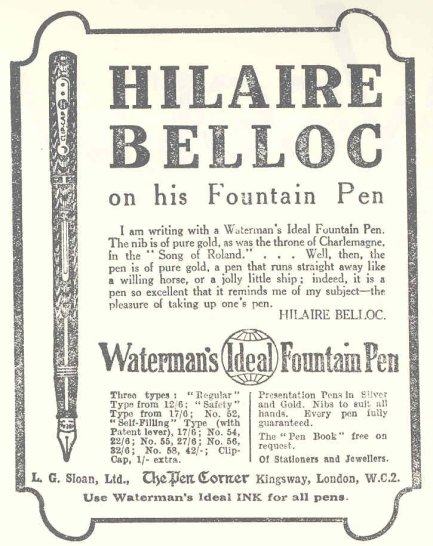
Those issues have advertisements.

Like this one:

You can click to enlarge it, of course, but I'll transcribe the relevant text for you here:
HILAIRE BELLOC on his Fountain Pen: I am writing with a Waterman's Ideal Fountain Pen. The nib is of pure gold, as was the throne of Charlemagne, in the "Song of Roland." . . . Well, then, the pen is of pure gold, a pen that runs straight away like a willing horse, or a jolly little ship; indeed, it is a pen so excellent that it reminds me of my subject - the pleasure of taking up one's pen.
I am geeking out here.

There are so many more things I should like to put up, but I'm going to save them for later. Keep coming back, obviously, for more.

Wednesday, April 26, 2006

Future Friend?

A budding teenage writer cites ten examples she wants to follow in her writing. It's quite ambitious, especially number 2:

"1) For plots, I want to write stories that sound like something out of a Bob Dylan ballad circa Blood on the Tracks. Old-timey feeling, semi-tragic, and driven towards some inevitable, unknowable wisdom. I want them to have a sanctity in the highest moment and a despair in the lowest, with a bit of both and an extra taste of notalgia in the end.

"2) For theory and sunsets, I'd like G. K. Chesterton, rollicking haphazard paradoxes and ravenous orthodoxy, crimson slashed through with vermillion and drenched in liquid gold."

Tuesday, April 25, 2006

Hollywood Friend

Saw this at Open Book:

Legendary Pictures is developing a live-action film version of Paradise Lost, John Milton’s epic poem, with Scott Derrickson (The Exorcism of Emily Rose) attached to direct, Variety reported. Vincent Newman (A Man Apart) will produce along with Legendary.

I mention it because the current issue of Gilbert Magazine has an interview with Derrickson. He’s a huge Chesterton fan, and he says many flattering things about the big guy. I don’t have the magazine in front of me right now, but he says GKC has the most astute mind of the 20th century.

Derrickson, though, also mentions that he doesn’t agree with Chesterton’s politics or religion. It’s gotta be tough to think someone is one of the greatest thinkers of all time, but then reject that thinker’s conclusions in two huge areas. But no matter. It’s good to see a Hollywood-type in the GKC camp.

Post Below

I posted a picture this morning, but the date stamp said it went up last night, with the result that it's a little bit buried. Go to the second post below to see it. Sorry for the confusion.

I'm sure there's a way to fix this dating problem, but if I knew how, I wouldn't be walking in the shoes of GKC, a man who couldn't have figured out date-stamp configurations if his wine depended on it.

Monday, April 24, 2006

Something brief, because I've been away for a bit

Thanks to Eric for his little cover today.

I don't have much to say, unfortunately, being as I am in the very endgame of the school year and mired in weird extra-curriculars like finding out about every edition of Farquhar's The Recruiting Officer that has ever been published and writing an opera about the assault on Dieppe in 1942. It's a heck of a time to be alive. The sandwiches are enormous.

So anyhow, I was browsing the ACS site's bibliography today, searching out information about the unfortunate (or so some critics were saying) Resurrection of Rome, and stumbled across a brief passage offered up as a sample of GK's work in As I Was Saying. I couldn't tell you what essay it's from, or what the essay was about, but I can tell you that a clearer summing-up of the dangers of things like The Da Vinci Code I have not seen:
"It is especially the educational film that threatens to darken and weaken the human intelligence. . . A false film might be refuted in a hundred books, without much affecting the million dupes who had never read the books but only seen the film." (Emphasis mine)
Golly.

The modern perception of scholarship is like that of a horse that is blind, but wears blinkers anyway. For the average member of the chattering classes, for a claim to gain currency it is merely enough that the claim be made in the first place. Some chump in tweed suggests that Jesus married the Magdelene, and that's the end of it. He did, obviously, and nobody has ever said otherwise. You can author books and articles about why this is lame until you're blue in the wrist, but you may as well be writing sestinas about economic policy for all the attention you'll get.

Of course, this isn't always true. Sometimes critical responses receive notice from the public. And why shouldn't they? The public is too smart to be taken in by these fruitless attempts by panicking powermongers to retain their hold on a crumbling orthodoxy, and it does them no harm to laugh such attempts to scorn. They know what's really going on. They have the secret knowledge. They've bucked the mainstream, torn the woolen scales from their eyes, and are now their own men, dammit, and nobody can say otherwise.

That is the state of pop history. Orthodoxy is a conspiracy, and anyone who says otherwise is biased, and trying to Cover Up The Truth. So tiring. So very, very tiring.

I respect G.K. more and more as I grow in myself and come into contact with those who disagree with me, often violently. The amount of effort it takes to deal with them is considerable, and these are only unformed students at an undergraduate level. Gilbert had to deal with the noted voices of his age. Somehow, however, deal with them he did, and managed even to take the likes of H.G. Wells and George Bernard Shaw as good friends.

This is the sort of lesson that I need to learn. A lot of us do.

GKC in my Basement Study


An assortment of GK biographies and a few other neat GKC books, chosen mostly at random from my GKC collection. The wine bottles are there for the effect. I haven't drank them yet, but plan to shortly.

Not the greatest shot, I know, but I'm still working on this digital camera thing. The black blob, by the way, is Coren's biography of the great man.

The two books standing upright are somewhat valuable editions of The Poet and the Lunatic and The Coloured Lands.

(I posted this, incidentally, on 4/25/2006, but I can't get the doggone date stamp to change.)

Friend on Friend

Fr. James Schall deserves to be included in a list of "GKC" friends. In this recent essay about Spain, he invokes another friend, Hilaire Belloc, to make his point. Enjoyable read.

Saturday, April 22, 2006

St. George's Day

I guess St. George's Day is making a comeback. I provided some coverage, along with a GKC poem, over at the Eudemon.

Friday, April 21, 2006

GKC: Holy Humor

GK is Everywhere (to steal a phrase from Gilbert Magazine):

"Everyone who attended church on Holy Humor Sunday at the Episcopal Church of the Holy Communion in Norwood, N.J., was given a button with a quote from G.K. Chesterton: "Angels can fly because they take themselves lightly." The cover of the church bulletin featured a print of "The Risen Christ by the Sea," a painting of a joyful, smiling, risen Jesus surprising his disciples at the Sea of Tiberias."

Link.

Thursday, April 20, 2006

White Horse Friend

It's not often you see the White Horse in the blogosphere, so I thought this post deserved a mention:

"I was reminded, unexpectedly, of Chesterton's The Ballad of the White Horse last night, and in order to convince all of you that that man could write, I will give you a sample of that work, which I believe to be among the greatest rallying speeches in English literature, right up there with the St. Crispin's Day soliloquy."

Wednesday, April 19, 2006

Throwing the Union a Bone

Viagra, Cialis and other erectile dysfunction drugs are costing General Motors Corp. a hefty sum. The company spends $17-million (U.S.) annually on such drugs, said GM spokeswoman Sharon Baldwin.

I wonder if Belloc would get a chuckle out of this: the corporate father providing penises to their workers. Chesterton wrote of Hudge and Grudge (big business and big government), but this kind of absurdity is more of a case of Hudge and Gudge and Won’t Budge: big business, big government, and big union.

Tuesday, April 18, 2006

Belloc Makes NYT

It's not every day that Hilaire Belloc makes it into a New York Times headline, but he did it this morning:

The Future of Journalism as Told by Hilaire Belloc in 1918.

Excerpt:

"The Free Press" is still worth reading, for it describes, with some important adjustments, the evolving relationship between political bloggers and the mainstream media.

The free press that Belloc describes was a horde of small, highly opinionated, sometimes propagandistic papers that arose in reaction to "the official Press of Capitalism." What characterized the free press, Belloc wrote, was "disparate particularism."

As he says, "the Free Press gives you the truth; but only in disjointed sections, for it is disparate and it is particularist." (For "particularism," Belloc offers the synonym "crankiness.") To get at the truth by reading the organs of the free press, you have to "add it all up and cancel out one exaggerated statement against another." But his point is that you can get at the truth.

There are whole paragraphs in Belloc's essay where, if you substitute "blogs" for "the Free Press," you will be struck by the parallels. He notes that the journals of the free press seldom pay their way and that they often suffer from the impediment of "imperfect information," simply because it is not in the politicians' interests to speak to them. They tend to preach to the converted. And they are limited by the founder's vision. "It is difficult," Belloc writes, "to see how any of the papers I have named would long survive a loss of their present editorship."

Belloc's point is not to expose the limitations of bloggers — excuse me, the Free Press. It is to show how, imperfect as they are, they can contribute enormously to our ability to learn what's going on. Anyone who spends much time reading political blogs will hear a familiar note — in far greater prose — among Belloc's certainties. He writes, in short, as a blogger of his own time.

Renaissance Man

Chesterton's contemporary, the English poet Alfred Noyes, reminisced in his autobiography about his 1902 weekends at R.C. Lehmann's home. There he remembered meeting G.K. Chesterton, who was standing in the library quoting William Morris. Later, at lunch, Chesterton "suddenly produced from his pocket and arranged on the table before him a number of little brass figures, Mr. Pickwick, Mr. Micawber, Sam Weller, and other characters from Dickens, giving one an almost uncanny sense that Gulliver held them alive in his hands." [Two Worlds for Memory, New York: Lippincott, 1953, pp. 27-28]

Thing about GKC is, he seemed to have a talent for a lot of "little" things: conversation, drawing, tomfoolery, playing with children, whatever. He's kind of the anti-Da Vinci. Whereas Da Vinci was a proud man who excelled in many major arts to support his lavish lifestyle, GKC was a humble man who excelled in many minor ones. I suspect he could've excelled in major ones, if he cared to try, but instead, he just worked at his writing so he could support his wife and simple lifestyle.

Monday, April 17, 2006

Chesterton Conference


It's that time of year again!

The 25th Annual G.K. Chesterton Conference is gearing up for its June 15th start date. The three-day event will play host to lectures, seminars, feasting and and the making of extravagant toasts, and is this year centered around Charles Dickens, coming as it does during the 100th anniversary of the publication of Chesterton's Charles Dickens.

The Conference runs from June 15th to June 17th at the University of St. Thomas in St. Paul, Minn.,, and attendance is free! Of course, you will have to register and pay for your lodging and food, unless you feel like making your own plans about that. But who would want to miss a grand banquet with other Chestertonians?

Of note on the agenda this year are the following...

  • "Chesterton and Marshall McLuhan," with John Peterson, founder of Gilbert Magazine
  • "Charles Dickens and Charles Darwin: The Two Who Never Met," with Stanley Jaki, acclaimed author
  • "Chesterton and C.S. Lewis," with Joseph Pearce, a most excellent gentleman and biographer of Chesterton, Belloc and Tolkien
  • "Chesterton and The Da Vinci Code," with Carl Olson, famed editor of IgnatiusInsight, the online magazine of the Ignatius Press
  • As a special treat, there is to be a performance of Chesterton's play, The Surprise
All in all, it looks very promising.

Further information (all relevant information, in fact) can be found here. Be sure to get moving on this soon, for June cometh right quick.

Saturday, April 15, 2006

Easter, 1916

Chesterton mentioned his interest in W.B. Yeats at several points in his Autobiography, and there exists a photograph of the two together with some other writers at someone's country house (though I'm afraid I can't find this picture).

What follows is Yeats' "Easter, 1916," a dreadfully beautiful poem that is awash in varied meaning. See what you can get out of it:
I HAVE met them at close of day
Coming with vivid faces
From counter or desk among grey
Eighteenth-century houses.
I have passed with a nod of the head
Or polite meaningless words,
Or have lingered awhile and said
Polite meaningless words,
And thought before I had done
Of a mocking tale or a gibe
To please a companion
Around the fire at the club,
Being certain that they and I
But lived where motley is worn:
All changed, changed utterly:
A terrible beauty is born.

That woman's days were spent
In ignorant good-will,
Her nights in argument
Until her voice grew shrill.
What voice more sweet than hers
When, young and beautiful,
She rode to harriers?
This man had kept a school
And rode our winged horse;
This other his helper and friend
Was coming into his force;
He might have won fame in the end,
So sensitive his nature seemed,
So daring and sweet his thought.
This other man I had dreamed
A drunken, vainglorious lout.
He had done most bitter wrong
To some who are near my heart,
Yet I number him in the song;
He, too, has resigned his part
In the casual comedy;
He, too, has been changed in his turn,
Transformed utterly:
A terrible beauty is born.

Hearts with one purpose alone
Through summer and winter seem
Enchanted to a stone
To trouble the living stream.
The horse that comes from the road.
The rider, the birds that range
From cloud to tumbling cloud,
Minute by minute they change;
A shadow of cloud on the stream
Changes minute by minute;
A horse-hoof slides on the brim,
And a horse plashes within it;
The long-legged moor-hens dive,
And hens to moor-cocks call;
Minute by minute they live:
The stone's in the midst of all.

Too long a sacrifice
Can make a stone of the heart.
O when may it suffice?
That is Heaven's part, our part
To murmur name upon name,
As a mother names her child
When sleep at last has come
On limbs that had run wild.
What is it but nightfall?
No, no, not night but death;
Was it needless death after all?
For England may keep faith
For all that is done and said.
We know their dream; enough
To know they dreamed and are dead;
And what if excess of love
Bewildered them till they died?
I write it out in a verse -
MacDonagh and MacBride
And Connolly and pearse
Now and in time to be,
Wherever green is worn,
Are changed, changed utterly:
A terrible beauty is born.
It gets me every time, particularly the refrain ("A terrible beauty is born"). I have a little poster that says that tacked up above my door. Simply wonderful.

Have a most excellent Triduum!

Wednesday, April 12, 2006

GKC Friend at The New Yorker

Caitlin Flanagan writes for The Atlantic Monthly and The New Yorker. She also writes as if she's read a lot of Chesterton on the issue of working mothers. But then again, she's probably just writing common sense, which is a Chestertonian way of writing. From a post at The Daily Eudemon today:

Fine stylist Caitlin Flanagan has waded further into the feminist wars with a book on working mothers. The LA Times has a pretty a good piece about it. Excerpt:

"These are the women who seem to be a natural audience for the 44-year old Flanagan, who lives in Hancock Park with her husband and two young sons. She socializes in liberal circles, and she writes about working mothers’ struggles: to keep households humming, to cope with ego-gratifying yet demanding careers, and to live with the nagging specter of the Perfect Mother. But because Flanagan writes cloaked as a (mostly) happy housewife, she’s raised the ire of her peers. In their view, the only thing more maddening than a happy housewife is a happy housewife who writes for the New Yorker."

I appreciate the LA Times’ honesty in this piece. It admits: liberal feminists hate Caitlin because she thinks mothers should stay home. They don’t just hate the idea. They hate her because of her opinion.

Why the hatred? I loathe pop psychology, but could the hatred come from guilt? Caitlin doesn’t pull many punches, and the overall gist of her message is so simple it cuts: you can’t have it all. Based on the LA Times piece, all she is saying is, “Something is lost. You can’t do it all. You can’t have it all.” That shouldn’t be incendiary. It should just be common sense. The full-time (not just eight hours a day) job of motherhood can’t be fully accomplished part-time.

Many sane working mothers acknowledge it and have chosen the trade off. That’s their choice. It’s only the ideologues that fly into rages when confronted with the common-sense notion that a person can’t work 36+ hours a day.

Aside: The best passage from the story:
A profile in this month’s Elle is a case in point of the impasse between Flanagan and her critics. In writer Laurie Abraham’s telling of their interview, Abraham arrived at Flanagan’s house flustered; back home, her daughter’s pet gerbil had just died. Flanagan at first sympathized. Then after their chat turned heated over the question of what’s lost when a mother works, she reminded Abraham: “The gerbil’s dead and you’re here.” “You could hear me gasp on the tape,” Abraham said in an interview.

Tuesday, April 11, 2006

GKC and Wells

Michael Coren relates a priceless anecdote about Chesterton in his biography of H. G. Wells:

"Wells was disarmed by Chesterton's good nature, disturbed by his inability to pigeon-hole the man. On a summers day in 1907, for example, Wells and Chesterton went to Oxford to attend a lecture. Walking together after the address Wells began to harangue his friend about the "bloody hand of Christianity." The diatribe lasted for over 35 minutes, without Chesterton making the slightest objection. At the end of it he turned to Wells, smiled and said, 'Yes, you do have a point.'"

Coren's book is rewarding both for the real low-down on Wells and for the insertion of Chesterton from time to time in the story. [The Invisible Man, New York: Athenaeum, 1993, p. 80]

Saturday, April 08, 2006

I'm Back

Thanks, Nick, for holding down the Chestertonian fort while I was gone. I'm back from my southern swing: Kentucky, Tennessee, Mississippi, Alabama, and Georgia. I didn't glean a lot of Chestertonian insight, but I did gain GKC-like pounds around the stomach.

GKC and Blair

This blogger mentions Tony Blair and GKC in the same post. Both are famous Catholic converts. Or at least Blair appears to be heading that way.

"Anyways, Mr. Blair would join a long list of British luminaries to convert to Catholicism which includes G.K. Chesterton, Sir Alec Guinness, Graham Leonard (former Anglican Bishop of London), John Henry Newman, and J.R.R. Tolkein just to name a few."