Saturday, November 30, 2013

Hochhuth clerihew


In attacking Pope Pius Rolf Hochhuth
penned a play full of untruth.
Sadly, many an ignorant dope
now believes the myth of "Hitler's pope."

Friday, November 22, 2013

C. S.Lewis - Poet? (and his legacy)


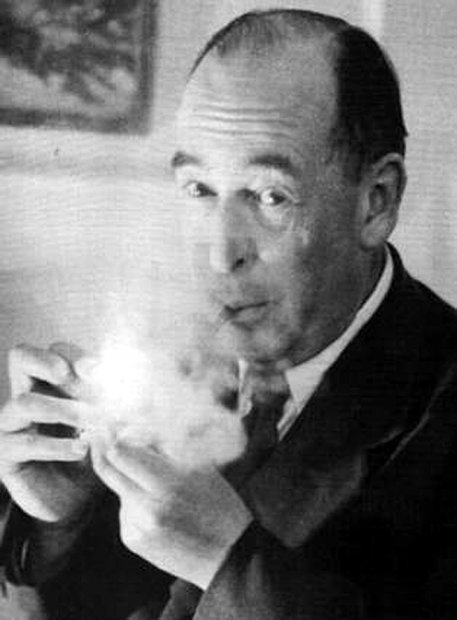
To mark the 50th anniversary of his death, C. S. Lewis has been honored with a memorial stone in the Poet's Corner at Westminster Abbey.

To be honest, I've never thought of Lewis as a poet. I love him for his theological works and his fiction. (Sort of like my thoughts about Chesterton.) I don't think I even own a collection of Lewis's poetry. (I own several volumes of Chesterton's - and have enjoyed them.)

I do remember one self-deprecating poem of Lewis's:

A Confession

I am so coarse, the things the poets see
Are obstinately invisible to me.
For twenty years I’ve stared my level best
To see if evening–any evening–would suggest
A patient etherized upon a table;
In vain. I simply wasn’t able.
To me each evening looked far more
Like the departure from a silent, yet a crowded, shore
Of a ship whose freight was everything, leaving behind
Gracefully, finally, without farewells, marooned mankind.

Red dawn behind a hedgerow in the east
Never, for me, resembled in the least
A chilblain on a cocktail-shaker’s nose;
Waterfalls don’t remind me of torn underclothes,
Nor glaciers of tin-cans. I’ve never known
The moon look like a hump-backed crone–
Rather, a prodigy, even now
Not naturalized, a riddle glaring from the Cyclops’ brow
Of the cold world, reminding me on what a place
I crawl and cling, a planet with no bulwarks, out in space.

Never the white sun of the wintriest day
Struck me as un crachat d’estaminet.
I’m like that odd man Wordsworth knew, to whom
A primrose was a yellow primrose, one whose doom
Keeps him forever in the list of dunces,
Compelled to live on stock responses,
Making the poor best that I can
Of dull things . . . peacocks, honey, the Great Wall, Aldebaran,
Silver weirs, new-cut grass, wave on the beach, hard gem,
The shapes of horse and woman, Athens, Troy, Jerusalem.

I need to dig out more of his poems.

Today is also the anniversary of the death of John Kennedy, whose tragic death overshadowed that of Lewis.

While both men had an impact on the world, I think Lewis's influence will ultimately be greater.

Kennedy's legacy is based on his incomplete term as President. The record was mixed - but his assassination and the emotional impact of his death overwhelmed objectivity in assessing that record. He's a martyr, a romantic tragic figure. I suspect that when the dust of history settles he will be judged somewhere in the second tier of presidents (in the 14/15 range). One has to wonder  what he would have achieved had he finished out his term - and, as I suspect he would have - served out a second term.

But Lewis has only grown in stature since his death. His Mere Christianity is ranked as one of the spiritual classics of the 20th Century. His Chronicles of Narnia books and The Screwtape Letters also rank high. They -  and a number of his other books - continue to sell briskly and to influence people. Many people have discovered or rediscovered faith through his works, and, through the case of Narnia, the movies made from them.

I suspect years from now people will still be reading and cherishing Lewis's writings.

Long after Kennedy's achievements are relegated to the history books.

But I'm still not certain how Lewis's poetry will be remembered.

Thursday, November 07, 2013

Chesterton ad


Ah, the great one keeps showing up in different places.

Up here in Western New York a local car company quotes Chesterton in an ad:

http://www.thatsmyvision.com/custom/vision-tv/

The ad begins with Chesterton saying "The greatest for of giving is Thanks-Giving."

The company says it will donate to a local charity during November, so maybe Chesterton would object to his name being linked to commercial venture.

Sunday, September 22, 2013

Rochester Chesterton Conference 2013 (images)


Dale Ahlquist hawking some shirts to raise money for the ACS. 
 
 
Lou Horvath offering greetings, but no explanations ... 

 
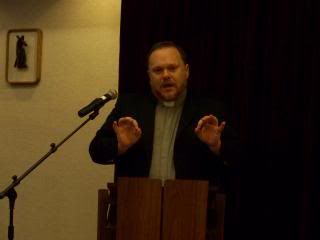
Deacon Nathan Allen making a point, not picking nits.
 

Despite Dale's jokes at his expense, Joseph Pearce still likes him. We think. Tom Martin seems to be trying to stay out of the fray.
 
 
A good time was had by all.


So, which character in the The Hobbit would you be?  

Thursday, September 12, 2013

Rochester Chesterton Conference - September 21


The Chestertonians are coming! The Chestertonians are coming!

The annual Rochester Chesterton Conference is scheduled for September from 9 a.m. to 3 p.m. at St John Fisher College .

Illustration of Chesterton with a candle, on books: Tolkien, Benson, Knox, Solzhenitsyn

The theme this year is:

Points of Light: Literary Voices Against the Darkness 

The speakers and their topics are Joseph Pearce (JRR Tolkien), Rev. Nathan Allen (Benson and Knox), Dale Ahlquist (Dickens), and Dr. Tom Martin (Solzhenitsyn).

Cost is $10, Lunch will be available for an added cost. 

Always a great event. If you are within a few hours' drive, wander on over.  


Monday, September 02, 2013

Playground Politics

When the republican's are 'in the house' the media says war is evil and the pres is an enemy to the people. When the dems are in office the media says war is a necessary evil and the pres is saving the people. Our current occupant dragged his heel across the sand box when he said: "Use of chemical weapons by Syria would cross a ‘red line". Well Syria crossed it and said 'You talkin to me?


now Obama is stuck pulling on the rope of war.

As Khrushchev said when Russia and the US were on the brink of war:     "If you did this as the first step towards the unleashing of war, well then, it is evident that nothing else is left to us but to accept this challenge of yours. If, however, you have not lost your self-control and sensibly conceive what this might lead to, then, Mr. President, we and you ought not now to pull on the ends of the rope in which you have tied the knot of war, because the more the two of us pull, the tighter that knot will be tied. And a moment may come when that knot will be tied so tight that even he who tied it will not have the strength to untie it, and then it will be necessary to cut that knot, and what that would mean is not for me to explain to you, because you yourself understand perfectly of what terrible forces our countries dispose. (read the whole letter here).


Wednesday, August 28, 2013

Lift a Glass

It has been suggested the GKC be made patron saint of beer drinkers. If that happens he will be in good company

auggy doggy day

St. Augustine feast day today - he showed us the truth:

"You have made us for yourself, O Lord, and our heart is restless until it rests in you." 
Thus Joy is found.

Which brings us to Uncle Gilbert
"The mass of men have been forced to be gay about the little things, but sad about the big ones. Nevertheless (I offer my last dogma defiantly) it is not native to man to be so. Man is more himself, man is more manlike, when joy is the fundamental thing in him, and grief the superficial. Melancholy should be an innocent interlude, a tender and fugitive frame of mind; praise should be the permanent pulsation of the soul. Pessimism is at best an emotional half-holiday; joy is the uproarious labour by which all things live. Yet, according to the apparent estate of man as seen by the pagan or the agnostic, this primary need of human nature can never be fulfilled. Joy ought to be expansive; but for the agnostic it must be contracted, it must cling to one corner of the world. Grief ought to be a concentration; but for the agnostic its desolation is spread through an unthinkable eternity. This is what I call being born upside down. The sceptic may truly be said to be topsy-turvy; for his feet are dancing upwards in idle ecstasies, while his brain is in the abyss. To the modern man the heavens are actually below the earth. The explanation is simple; he is standing on his head; which is a very weak pedestal to stand on. But when he has found his feet again he knows it. Christianity satisfies suddenly and perfectly man's ancestral instinct for being the right way up; satisfies it supremely in this; that by its creed joy becomes something gigantic and sadness something special and small. The vault above us is not deaf because the universe is an idiot; the silence is not the heartless silence of an endless and aimless world. Rather the silence around us is a small and pitiful stillness like the prompt stillness in a sick-room. We are perhaps permitted tragedy as a sort of merciful comedy: because the frantic energy of divine things would knock us down like a drunken farce. We can take our own tears more lightly than we could take the tremendous levities of the angels. So we sit perhaps in a starry chamber of silence, while the laughter of the heavens is too loud for us to hear." Orthodoxy

You can not steal the Joy of a Christian.


Monday, August 26, 2013

A Few "Comic" Clerihews


I've never seen Steve Martin
in tartan.
But to me he doesn't look right
in anything but white.


Kathy Griffin
Likes to joke about sexual sin.
But to be honest all she does is bore
When she tries to play the whore.


Steven Wright
Is right:
Boycott shampoo,
demand the real poo.


I sometimes think Frankie Boyle
Fills his mouth with soil.
As for his jokes, he’s out of luck:
I won’t repeat anything containing words like #@&!

Saturday, August 24, 2013

Banned in New York


New York City has gotten a reputation for banning strange things  - like large soft drinks. That one is thanks to mayor Bloomberg,

But the NY Department of Education have topped him.

They've banned certain words and phrases from class rooms and tests. They don't want the children to feel "bad."

Being ignorant is apparently acceptable, though.

Imagine trying to teach history without using words like "slavery" or "war."  Or science without "tsunamis" or "evolution."

"Religion" also made the no-no list - but we kind of knew that.

So has "witchcraft" - but that seems fair given that religion ban.

Oh, and don't mention "sex" or "pornography" or even "television" - given the predominance of the first two on television shows that makes sense.

GKC might take exception to the ban on "alcohol" or tobacco products.

And don't bring up "cancer" or "politics" - which seem to be related anyway.

Here's a list of words and phrases to avoid:
  • Abuse (physical, sexual, emotional, or psychological)
  • Alcohol (beer and liquor), tobacco, or drugs
  • Birthday celebrations (and birthdays)
  • Bodily functions
  • Cancer (and other diseases)
  • Catastrophes/disasters (tsunamis and hurricanes)
  • Celebrities
  • Children dealing with serious issues
  • Cigarettes (and other smoking paraphernalia)
  • Computers in the home (acceptable in a school or library setting)
  • Crime
  • Death and disease
  • Divorce
  • Evolution
  • Expensive gifts, vacations, and prizes
  • Gambling involving money
  • Halloween
  • Homelessness
  • Homes with swimming pools
  • Hunting
  • Junk food
  • In-depth discussions of sports that require prior knowledge
  • Loss of employment
  • Nuclear weapons
  • Occult topics (i.e. fortune-telling)
  • Parapsychology
  • Politics
  • Pornography
  • Poverty
  • Rap Music
  • Religion
  • Religious holidays and festivals (including but not limited to Christmas, Yom Kippur, and Ramadan)
  • Rock-and-Roll music
  • Running away
  • Sex
  • Slavery
  • Terrorism
  • Television and video games (excessive use)
  • Traumatic material (including material that may be particularly upsetting such as animal shelters)
  • Vermin (rats and roaches)
  • Violence
  • War and bloodshed
  • Weapons (guns, knives, etc.)
  • Witchcraft, sorcery, etc.
No mention of a ban on "education," but they seem to be working on that anyway.

Wednesday, August 21, 2013

in support of his cause.

A 300 lb cigar smoking saint? Cool. When he gets his plaque put up in the catholic hall of fame, aka sainthood, to who or what will he be crowned patron saint? Before answering keep in mind the type of sense of humor the Church has, St. Lawrence is the patron of barbecue and St Steven is the patron of stonemasons. Maybe St Gilbert will be the patron saint of runway models. 

Tuesday, August 20, 2013

More on St. Chesterton (okay, jumping the gun)


In Crisis Magazine, Dale Ahlquist talks about the news that the first step in a potential cause for canonization of Chesterton has begun. He explains it far better than I can.

Sunday, August 11, 2013

Prayer for the intercession of Chesterton

In light of the first steps in the possible start of Chesterton's cause, here's a prayer from the American Chesterton Society: 
 
Prayer for the intercession of G. K. Chesterton
 
God our Father,
 
You filled the life of your servant Gilbert Keith Chesterton with a sense of wonder and joy, and gave him a faith which was the foundation of his ceaseless work, a hope which sprang from his enduring gratitude for the gift of human life, and a charity towards all men, particularly his opponents.
 
May his innocence and his laughter, his constancy in fighting for the Christian faith in a world losing belief, his lifelong devotion to the Blessed Virgin Mary and his love for all men, especially for the poor, bring cheerfulness to those in despair, conviction and warmth to lukewarm believers and the knowledge of God to those without faith.
 
We beg you to grant the favors we ask through his intercession, [and especially for ……] so that his holiness may be recognized by all and the Church may proclaim him Blessed.
 
We ask this through Christ our Lord.
 
Amen.

Friday, August 02, 2013

NPR's sci fi/fantasy list - read the usual suspects


NPR has put out a list of the top 100 science fiction and fantasy novels.

I looked at the list with interest, having been a fan of such fiction for a long time.

I was bemused to find I had read only 33 of the 100 books on the list. Hmm. I need to do more reading!

There are a couple of givens. J. R.R. Tolkien made it with The Lord of the Rings. And C. S. Lewis made it with his science fiction trilogy. Tolkien's The Silmarillion also made the list, which pleased me.

And Walter Miller's great A Canticle for Leibowitz made it.

But there were a number of missing titles - including anything by Chesterton. I consider The Man Who Was Thursday or The Napoleon of Notting Hill better than some of the titles on the list.

Other notable missing titles include Tolkien's The Hobbit, and Lewis's The Chronicles of Narnia and The Screwtape Letters. I could also put in a word for Lewis's Till We Have Faces - his retelling of the Cupid and Psyche myth.

Or how about A Case of Conscience by James Blish, about a race on another planet that is completely moral and ethical with no belief in or sense of God or religion? Or anything by Madeleine L'Engle (A Wrinkle in Time, A Wind in the Door, or A Swiftly Tilting Planet)?

To be fair, maybe the people selection decided L'Engle's books, or Narnia, or even The Hobbit children's books and that's why they didn't pick them. But I'd argue that they are still better than some of the other books on the list. Oh well: All such lists are subjective.

It's an interesting list and a good conversation/debate starter. What titles would other folks include that would be of interest to Chestertonians?

St. Gilbert?


Here is the reported wording from Dale Ahlquist's announcement at the GKC conference:

"Martin Thompson says that Bishop Peter Doyle 'has given me permission to report that the Bishop of Northampton is sympathetic to our wishes and is seeking a suitable cleric to begin an investigation into the potential for opening a cause for Chesterton.'"

Okay - qualified, just a possible start, but at least it's movement!

Saturday, July 27, 2013

Happy Birthday Hilaire


He's the fellow in the center. Anyone know who the other two gents are? (wink)

Today is Hilaire Belloc's birthday.

Were he still alive - instead of dying 60 years ago this month - he would be 143 years old.

While he did not live on, his writings have.

A toast to him.

Thursday, July 25, 2013

Chesterton on Hermits

I have long been interested in and attracted to the hermit life. I've chosen to live in the world - my wife would be upset if I suddenly headed off to the woods - but the desire for solitude still tugs at my heart and soul.

Still, there have been efforts to help those so incli8ned to lead a modified eremetical life while still living actively in the world. Catherine Doherty's fine spiritual book, Poustinia, describes one method. Some people also take periodic breaks from the world to go off to hermitages periodically for some alone time. And there is even Raven's Bread Hermit Ministries, which has a newsletter, a website, and books to help support those inclined to solitude.

Chesterton was not a hermit. He enjoyed getting out in public for a drink, a talk, a debate, conversation, and so on. He did address the subject of hermits in a wonderful essay, "The Case for Hermits," contained in The Well and the Shallows.

Chesterton noted that the hermits, the solitaries, are often considered "savages or man-haters" by a society that regards being sociable as the norm. But he pointed out this was not the case: "But many of them really had charity--even to human beings. They felt more kindly about men than men in the Forum or the Mart felt about each other."

In fact, he observed, "The reason why even the normal human being should be half a hermit is that it is the only way in which his mind can have a half-holiday. It is the only way to get any fun even out of the facts of life; yes, even if the facts are games and dances and operas."

So for us semi-hermits our time alone is like a holiday. That makes sense to me. My wife, aware of my need for alone time, periodically goes off shopping or with friends just to give me an afternoon alone - a mini holiday. And as a teacher, summer is often a daily holiday, with lots of time alone. I use that time to get things done - mowing the lawn, painting the fence, trimming the bushes, etc. - but also to pray, walk in the woods, meditate.

I know for me my time alone enables me to be more kindly disposed toward others. As Chesterton said, "It is in society that men quarrel with their friends; it is in solitude that they forgive them. And before the society-man criticises the saint, let him remember that the man in the desert often had a soul that was like a honey-pot of human kindness, though no man came near to taste it; and the man in the modern salon, in his intellectual hospitality, generally serves out wormwood for wine."

Here's his full essay:

Anyone who has ever protected a little boy from being bullied at school, or a little girl from some childish persecution at a party, or any natural person from any minor nuisance, knows that the being thus badgered tends to cry out, in a simple but singular English idiom, "Let me alone!" It is seldom that the child of nature breaks into the cry, "Let me enjoy the fraternal solidarity of a more socially organised group-life." It is rare even for the protest to leap to the lips in the form, "Let me run around with some crowd that has got dough enough to hit the high spots." Not one of these positive modern ideals presents itself to that untutored mind; but only the ideal of being "let alone." It is rather interesting that so spontaneous, instinctive, almost animal an ejaculation contains the word alone.

There are now a great many boys and girls, both old and young, who are really in that state of mind; not only through being teased, but also through being petted. Most of them will fiercely deny it, since it contradicts the conventions of their new generation; just as a child kept up too late at night will more and more indignantly deny the desire to go to bed. Indeed I am always expecting to hear that a scientific campaign has been opened against Sleep. Sooner or later the Prohibitionists will turn their attention to the old tribal traditional superstition of Sleep; and they will say that the sluggard is merely encouraged by the cowardice of the moderate sleeper. There will be tables of statistics, showing how many hours of output are lost by miners, smelters, plumbers, plasterers, and every trade in which (it will be noted) men have contracted the habit of sleep; tables showing the shortage of aconite, alum, apples, beef, beetroot, bootlaces, etc., and other statistics carefully demonstrating that work of this kind can only rarely be performed by sleep-walkers. There will be all the scientific facts, except one scientific fact. And that is the fact that if men do not have Sleep, they go mad. It is also a fact that if men do not have Solitude, they go mad. You can see that, by the way they go on, when the poor miserable devils only have Society.

The incident of Miss Fitzpatrick, the lady who really liked to be alone, challenges all recent fashions, which are all for Society without Solitude. We must Get Together; as the gunman said when he ran his machine-gun into two other machine-guns and killed all the children caught between them. And we know that this sociability and communal organisation has already produced in fashionable society all that sweetness and light, all that courtesy and charity, all that True Christianity of pardon and patience, which we see in the modern organisers of gangs  or "group-life." In contrast with this happy mood now pervading our literature and conversation, it is customary to point to hermits and solitaries as if they were savages and man-haters.

But it is not true. It is not true in History or human fact. The line that ran, "Turn, gentle hermit of the Vale," was truer to the real tradition about the real hermits. They were doubtless, from a modern standpoint, lunatics; but they were nice lunatics. Twenty touches could illustrate what I mean; for instance, the fact that they could make pets of the wild animals that came naturally to them. But many of them really had charity--even to human beings. They felt more kindly about men than men in the Forum or the Mart felt about each other. Doubtless there have been merely sulky solitaries; unquestionably there have been sham cynics and cabotins, like Diogenes. But he and his sort are very careful not to be really solitary; careful to hang about the market-place like any demagogue. Diogenes was a tub-thumper, as well as a tub-dweller. And that sort of professional sulks remains; but it is sulks without solitude. We all know there are geniuses, who must go out into polite society in order to be impolite. We all know there are hostesses who collect lions and find they have got bears. I fear there was a touch of that in the social legend of Thomas Carlyle and perhaps of Tennyson. But these men must have a society in which to be unsociable. The hermits, especially the saints, had a solitude in which to be sociable.

St. Jerome lived with a real lion; a good way to avoid being lionised. But he was very sociable with the lion. In his time, as in ours, sociability of the conventional sort had become social suffocation. In the decline of the Roman Empire, people got together in amphitheatres and public festivals, just as they now get together in trams and tubes. And there were the same feelings of mutual love and tenderness, between two men trying to get a seat in the Colosseum, as there are now between two men trying to get the one remaining seat on a Tooting tram. Consequently, in that last Roman phase, all the most amiable people rushed away into the desert, to find what is called a hermitage; but might almost be called a holiday. The man was a hermit because he was more of a human being; not less. It was not merely that he felt he could get on better with a lion  than with the sort of men who would throw him to the lions. It was also that he actually liked men better when they let him alone. Now nobody expects anybody, except a very exceptional person, to become a complete solitary. But there is a strong case for more Solitude; especially now that there is really no Solitude.

The reason why even the normal human being should be half a hermit is that it is the only way in which his mind can have a half-holiday. It is the only way to get any fun even out of the facts of life; yes, even if the facts are games and dances and operas. It bears most resemblance to  the unpacking of luggage. It has been said that we live on a railway station; many of us live in a luggage van; or wander about the world with luggage that we never unpack at all. For the best things that happen to  us are those we get out of what has already happened. If men were honest with themselves, they would agree that actual social engagements, even with those they love, often seem strangely brief, breathless, thwarted or inconclusive. Mere society is a way of turning friends into acquaintances, the real profit is not in meeting our friends, but in having met them. Now when people merely plunge from crush to crush, and from crowd to crowd, they never discover the positive joy of life. They are like men always hungry, because their food never digests; also, like those men, they are cross. There is surely something the matter with modern life when all the literature of the young is so cross. That is something of the secret of the saints who went into the desert. It is in society that men quarrel with their friends; it is in solitude that they forgive them. And before the society-man criticises the saint, let him remember that the man in the desert often had a soul that was like a honey-pot of human kindness, though no man came near to taste it; and the man in the modern salon, in his intellectual hospitality, generally serves out wormwood for wine.

In conclusion, I will take one very modern and even topical case. I do not believe in Communism, certainly not in compulsory Communism. And it is typical of this acrid age that what we all discuss is compulsory Communism. I often sympathise with Communists, which is quite a different thing; but even these I respect rather as bold or honest or logical than as particularly genial or kindly. Nobody will claim that modern Communism is a specially sweet-tempered or amiable thing. But if you will look up the legends of the earliest Hermits, you will find a very charming anecdote, about two monks who really were Communists. And  one of them tried to explain to the other how it was that quarrels arose about private property. So he thumped down a stone and  observed theatrically, "This stone is mine." The other, slightly wondering at his taste, said, "All right; take it." Then the teacher of economics became quite vexed and said, "No, no; you mustn't say that. You must say it is yours; and then we can fight." So the second hermit said it was his; whereupon the first hermit mechanically gave it up; and the whole lesson in Business Methods seems to have broken down. Now you may agree or disagree with the Communist ideal, of cutting oneself off from commerce, which those two ascetics followed. But is there not something to suggest that they were rather nicer people than the Communists we now meet in Society? Somehow as if Solitude improved the temper?

Thursday, July 11, 2013

A Catholic Reading List


Father John McCloskey over at Catholicity.com has compiled A Catholic Lifetime Reading Plan. He is not alone in having done this - I even remember a book by that title by Father Hardon a few years back.

There are a number of interesting titles on Father McCloskey's list - including ones by some of our favorite authors here.

Chesterton shows up with four titles: Everlasting Man, Orthodoxy, St. Thomas Aquinas, and St. Francis of Assisi. I can't argue with any of those choices. I wonder if an essay collection could be added - but which one? (Maybe In Defense of Sanity, selected by Ahlquist, Mackey, and Pearce?)

If I read the list correctly, by the way, Chesterton has the most individual titles listed. However, Father does say "Opera Omnia" (the complete works) for Popes Benedict XVI and John Paul II. 

Belloc shows up with three titles: The Great Heresies, How The Reformation Happened, and Survivals and New Arrivals, Alas, no room for his poetry!

C. S. Lewis also has three titles: The Problem of Pain, Mere Christianity, and The Screwtape Letters. No Narnia. Interestingly, Fathers has a typo here, calling the first book the Problem with Pain! And, of course, Lewis' good friend, J. R. R. Tolkien, makes the list with The Lord of Rings. Since that was published as a trilogy, maybe we should count that as three titles. 

Among the other authors associated with this blog who made the list are Christopher Dawson, Christianity and European Culture; Monsignor Ronald Knox, Enthusiasm; and Malcolm Muggeridge, Something Beautiful for God ( a lovely book about Mother Teresa).

There are other favorite of mine:

Dorothy Day – The Long Loneliness
Scott Hahn – Rome Sweet Home
Pope John XXIII – Journal of a Soul
Thomas Merton – Seven Storey Mountain
Gerard Manley Hopkins (poetry)
Confessions of St. Augustine

There are plenty of other titles I'd like to read. I think maybe the list could have more poetry (Date made the list, by the way.) And drama - though of course plays are more meant to be watched than read (ah, but something like A Man for All Seasons is a wonderful read.)

Now, what should I read next?