Wednesday, June 14, 2006

From Fr. Vincent McNabb

GILBERT CHESTERTON IS DEAD

I keep on moaning this to myself. If I did not believe the things he believed, his death would be almost the death of hope. I should despair of everyone; and of myself most of all. For how could I again trust my judgment when it once misled me into hailing as one of the great men and major prophets of her country a man whose death has been announced amidst a thousand trivialities, with the banalities of praise? Yet in this hour of temptation to despair I re-enkindle hope by recalling how often I have said that sometimes even greater than the gift of prophecy is the gift of recognizing a prophet! In the night-hour of Chesterton's death despair seems treason for me as for all the group who knew the time of their visitation because they knew that in giving him to them God had visited His people.

I looked upon this child of London Town as one of the greatest sons born to England for four centuries. Londoners at their best like More and Chesterton do not look down on England; they look round on England and see its central place in Europe and the world. Their London River (as the seamen call it) after its long quiet sauntering through England's smiling meadow-land welcomes with a smile all nations of the Earth.

Londoner of Londoners. English of the English. Gilbert Chesterton towered shoulder high about his contemporaries. His massive body, crowned with a massive head, struck me as being only the well-proportioned outward visible sign of the massive intellectual, spiritual reality within. And this inward reality was in the sphere of memory, mind and heart. His memory was not just beyond the average, but far beyond the average. Had it not been balanced by equal powers of mind it would have been, as in lesser minds, a danger or even a disease. But Gilbert Chesterton's memory was a storehouse of such ordered facts that from it, almost at will and always at need, he could bring forth things old and new. In control of this vast, densely filled memory was a mind of more than average power. It was not just a power of reason - though few could reason better - it was an unusual power of instant intuition; which, the philosophers say, is to be found only in a few men; and, as the theologians say, is found in all the angels.

One of his books he called An Outline of Sanity. The title was the man. His was the same healthy mind that recognizes in the outline the first necessary line of thought received or thought expressed. His thought about things was always the deep philosophical recognition not of resemblance but of differences. Unconsciously he acted on the principle that "a philosopher is one who knows how to divide." His rapidly moving intelligence recognised in one principle a hundred conclusions; and in one phenomenon of nature or one fact of history recognised a hundred principles. This made him the best of listeners. But whilst he listened even to something he had already heard and perhaps knew better than the speaker knew, his giant mind was tracing within the accurate outline of the subject an elaborate diaper of thought. The myriad epigrams of his style were not carefully designed effects. But they were the irrepressible and spontaneous results of a clear mind always set with philosophic instinct on discerning differences.

It is terrifying to think what his extraordinary gift of memory and intelligence might have been and done had it been the supreme quality of his soul. Lesser intelligences amongst his contemporaries have risen from wealth to wealth or from power to power to a wealth and power that meant the impoverishment or the enslavement of their fellow men. But God's greatest gift to Gilbert Chesterton was a heart that could seek neither wealth nor power, so deeply did he love the people. Even those who knew him least - say, by the books he wrote and they read - were conscious that his heart was no little part of his manifest greatness. But those who knew him best and marvelled at his gifts of mind, knew that his still greater gifts of heart were needed and used to keep the balance of his soul. His was a richly furnished memory controlled by a brilliantly clear mind; but aove all a noble chivalrous heroic heart in full control of memory and mind.

I remember that once his instant chuckle of laughter showed how he understood the humour in the Preface of the Mass when the Priest says to the people: "Lift up your hearts," and the people reply almost testily, "We have lifted them up." Gilbert Chesterton's heart was never otherwise than "lifted up." He sought only the highest aims for himself, and for the England that he loved, and for his fellow men whom he loved, if that were possible, more than England.

A long life of battling came to end last Sunday at Top Meadow, Beaconsfield. We might well ask was his aim ever lower than towards the topmost? And in his knightly quest of the highest at all costs except the cost of honour, was his life and work ever less than a great beacon of light to England and the world? Here and there in the heavy harvest of his writings his pen becomes one of the angriest, sharpest swords in Europe. But you will search this angry sword-battling without finding that the swordsman was ever defending himself. A laugh was usually self-defence enough for him. But behind his angry swordsmanship you will find some of the most defenceless or destitute beings of the world - the poor, the persecuted, the unfit - or some of the greatest principles, like loyalty, or wedded love or the homestead or liberty.

Once upon a time I called a book of his poems "Bugle-Music." Now I know there is in truth no Bugle-music, but only Bugle-calls. Every word that came from Gilbert Chesterton's pen-hand (which I kissed in his unconsciousness last Saturday) was like a Bugle-call to some of those tops of human aim to which from boyhood he had never been disloyal. But

GILBERT CHESTERTON IS DEAD

His great heart gave way. Our Beacon is burned out. And what was left of this great Beacon we have buried in God's field. But in our memory there is something of him that will never burn out, till our ashes are as his.

From Hilaire Belloc, in an essay in G.K.'s Weekly

The death of our Editor is an event of such national magnitude that it is impossible to set down in a brief word the meaning of it and the meaning of the man who has gone. Yet the word must be brief because it is written just as the paper over which he presided for so long goes to press.

I have known him, and still know him, not only as a most intimate friend from the days when I first came up to London from Oxford nearly 40 years ago, still more as one in whose expression of thought I continually lived. His was the one expression of thought in England which could convey to his fellow-citizens those things they most needed to know and from which they are most debarred, and therefore men such as I, for whom those things are vital, sought the expression of them continually as hungry men seek for food. During all those years - it is the whole of an active lifetime - there was no other pen writing thus and no other voice speaking thus. And the first movement of the mind provoked by the hearing of such news is a question - and an unanswered one - "Will that great effort bear fruit?"

That is should do so in any society not moribund is self-evident; that it should bear ample fruit in any society not sterilised is a thing with which all men of culture throughout Europe will agree. But what fruit it will bear, even whether it will bear fruit, is something veiled from us. It is customary, I know, to take for granted the success of energy directed towards those objects which we most desire. It is thought, through some confusion of mind, an actual duty to prophesy success. But indeed there is no duty in these matters save that of telling the truth - and the truth is that we do not know.

The effect of Gilbert Chesterton's focussed and exact appreciation of reality, of his vivid untiring stream of exposition, will certainly be great in the United States. It will more slowly be felt, but certainly be felt, in Europe; every patriot will hope that it may be sufficiently felt also at last here. The special character of his work was a triumph in journalism; and he was the first to welcome that despised word and to give it its full and real value. He was proud to say, "I am a journalist," and he was indubitably the chief of that trade; our trade. He was not only the chief of that trade but the most complete representative of it; for the journalist is the man who discovers the truth about important happenings affecting his country in the world, even as they happen, and who, having discovered the truth, proclaims it in such fashion that his fellows shall know it too. Now the journalist to act thus must be a free man. No one working under the orders of another is fully free in that sense. Gilbert Chesterton remained free of his own will and through his own action, all his life. That is even a greater thing to say of such a man than to say how great his genius was.

Not so long ago in England we had some dozens of such men, not of his stature indeed, but free. The capital which furnished the printing of their words, which for that matter paid them their salaries, was commonly the capital of others, but they were not the servants of those others. Today they are nearly all of them servants. What they say is not of themselves, they are not telling truths that they have discovered, they do not make personal comment upon affairs vitally affecting their fellow citizens, rather do they write what a master pays them to write and omit what that master desires to have omitted. So that it is often said abroad and increasingly said that here in England we have no true journalism left.

But in Gilbert Chesterton England had such a man. It is the fullest commentary I know on the condition into which we have fallen, the social and intellectual level to which we have sunk, that such a man should not have been seen at his full stature and should not have been acclaimed upon the level of what he was. One other free man in his own profession, the late Mr. Orage, said of him as exactly true a thing as was said anywhre; he said it many years ago, before the War, and the truth of it stands out enormously today. He said that Gilbert Chesterton was the most typically English man in England: not Englishman, but English man. He was for our generation what Dr. Johnson was for his. But Dr. Johnson telling some truth was heard by all the England of his time, all the England which counted, in the sense of that word "heard" when we use it to mean understood and taken for what he was in full. We have no longer the social machinery for such appreciation.

"The Times," which men still talk of as though it were particularly national, published upon hearing the news an obituary so utterly beneath the level of its subject as to be negligible, and I take that pronouncement to be typical of that tragic truth which I am announcing here. A great Englishman has left England, and that English-man who was most English. Buy the knowledge of his fellow Englishmen may have of such truth, by the measure with which they measure that truth, they may be politically judged.

From E.C. Bentley, during a broadcast tribute

Gilbert Keith Chesterton was not only one of the most greatly gifted, but one of the most beloved men of his time. [. . .] His intellectual powers were amazing. Included in their range were some of the noblest of modern poems and some of the most sparkling of light verse. Mr. Chesterton had in him the stuff of a great artist in the commonly accepted sense of the word. There was nothing he could not do with a pencil or, by preference, what, in our boyhood, we called a box of chalks. He honoured simplicity and kindness. As he once put it in an unforgettable lyric line - "Kindness which is God's last word."

From Robert Lynd, of the "News Chronicle"

The truth is, he never ceased to be a poet even when he was writing prose. How fine a poet he was at his best everyone who has read the "Ballad of the White Horse" knows. Some of his vese might be described as a riot of rhetoric, but the rhetoric is the genuine expression of a riotous and exuberant imagination. The novels, too, were riots - some of them glorious riots, with little imps of nonsense tumbling head-over-heels among apocalyptic visions. There are writers who hold that Chesterton squandered his genius and endangered his literary immortality by his indifference to form. He was certainly of a squandering temperment, but in his case it was not a common spendthrift but a millionaire who did the squandering. He once said that if he were a millionaire he would like just to "chuck his money about" - not to deserving people, but to "just chuck it about." In literature and journalism he may be said to have chucked his genius about. It seems to me likely that we shall still for many generations to come be collecting the gold pieces that he has strewn with such magnificent recklessness.

From the Archbishop of Westminster

We have lost a man, a big man of unique strength, a man of courage and conviction. G.K., as he was everywhere known, was an ardent Catholic, a lover of liberty, a sound philosopher, an apologist of highest value, a keen, clean humourist. He will be sadly missed in das when men in the mould of St. Thomas More are rare. Those who share our heritage of English speech may well owe a great debt to G.K. Chesterton for his work as a master artist. Some will certainly repay him with the meed of so many words. But his friends and comrades in the rank of the Church militant will remember chiefly that he staunchly fought the good fight and upheld the faith. To them words without prayers will seem a scant and empty requital of hsi unswerving loyalty.

Tuesday, June 13, 2006

"he is a worm and a god"

In anticipation of the start of ChesterCon: The Best of All Impossible Worlds this Thursday evening, I again pass on today's quotation from Chesterton Day by Day (from GKC's Charles Dickens):
IF we are to save the oppressed, we must have two apparently antagonistic emotions in us at the same time. We must think the oppressed man intensely miserable, and at the same time intensely attractive and important. We must insist with violence upon his degradation; we must insist with the same violence upon his dignity. For if we relax by one inch the one assertion, men will say he does not need saving. And if we relax by one inch the other assertion men will say he is not worth saving. The optimists will say that reform is needless. The pessimists will say that reform is hopeless. We must apply both simultaneously to the same oppressed man; we must say that he is a worm and a god; and we must thus lay ourselves open to the accusation (or the compliment) of transcendentalism.

Chesterton and Belloc

It was about twelve years ago. I had converted from Lutheranism three years earlier after falling in love with Chesterton, Belloc, Muggeridge, Dawson, and others about five years earlier (it took about three years for their prose to work). My father had accepted my conversion, and he liked the fact that I was reading a lot of Chesterton.

Then one day I mentioned Belloc. My dad replied that he didn’t care for him, saying Belloc was abrasive, or something to that effect. I admitted to my father that Belloc didn’t have a lot of patience for non-Catholics, and my dad said, “Which is good, because I have little patience for him.”

And that’s where Belloc sits with many. Ignored and neglected.

He rubbed people the wrong way while he was alive, too. His nasty wars with H.G. Wells are legendary, but even before the nastiness started, Wells didn’t care for him. Wells cherished Chesterton’s company, saying he desired to “drink limitless old October from handsome flagons” with him. But not with Belloc. “Chesterton often – but never by any chance Belloc. Belloc I admire beyond measure, but there is a sort of partisan viciousness about Belloc that bars him.”

“Partisan viciousness.” I think my father would agree with Wells on that one.

Yet the vicious Belloc also had a good side and many good friends . . . including Chesterton, one of the kindest literary souls to grace the written page.

Chesterton is loved by all, including non-Catholics, but Belloc isn’t. Yet the overlap in their ideas is immense. In fact, many people, including G.B. Shaw and C.S. Lewis, said Belloc influenced Chesterton immensely (both Shaw and Lewis, incidentally, disapproved of the influence). In the words of Frank Sheed, writing about the Catholic Literary Revival in the twentieth century: “There was Chesterton, of course, but then Belloc had so much to do with the making of Chesterton and Chesterton not much with the making of Belloc.”

Those are significant words, spoken by a man who knows of what he speaks. It’s almost as though Chesterton was an intellectual hack and merely rode Belloc’s genius.

But that would be a gross mistake. Belloc influenced Chesterton, yes, but in the way water influences a flower. Belloc’s ideas nourished Chesterton and gave him direction, but it was Chesterton’s unique brilliance that allowed the flower to bloom in a way that would influence millions.

________________________________

A few heavyweights on the Chesterbelloc:

Robert Royal in 1985 National Review.
Joseph Sobran.
Ralph McInerny.

Monday, June 12, 2006

Gilbert's Travels

This is miserably late, but such is life. It would probably have been up half an hour ago if not for the fact that Blogger keeps crashing my browser, for some reason.

==

Over the course of our treatment of Chesterton, he has been referred to variously as the Englishman's Englishman, the man of Fleet Street, and a small-town homebody. All of this accurate. It is the mark of a great and expansive man that he can fit so many varied and often contrary descriptions of his person without giving the reader worrying pause.

But today we may add another epithet to this worthy stable: globetrotter.

Yes, though Chesterton deplored the cosmopolitan mindset - believing that it eroded one's respect one's own country while promoting only a superficial admiration of others - he was himself no stranger to travel, and some of his finest and obscurest works are the result of his voyages. There are four major excursions to be covered, though I will not do them in order for the simple reason that I can not, for the life of me, remember their order. Also, they really will be brief, I swear to you on my life.

1. America
"He wished to discover America. His gay and thoughtless friends who could not understand him, pointed out that America had already been discovered, I think they said by Christopher Columbus, some time ago, and that there were big cities of Anglo-Saxon people there already, New York and Boston and so on. But the Admiral explained to them, kindly enough, that this had nothing to do with it. They might have discovered America, but he had not." - From The Coloured Lands
Gilbert loved the United States of America, and went there twice. These two trips occasioned two books, What I Saw in America and Sidelights on New London and Newer York, respectively. Calling America "the only nation in the world that is founded on a creed," Gilbert found himself enchanted by the no-nonsense energy of the American citizenry, the then-widespread prevalance of the family farm, and the furious zest with which an entire country pursued the tenets of Democracy, in one form or another.

But he was not without his worries, of course. We all remember his famous quip about the lights of Broadway: "How beautiful it could be for someone who could not read." He was similarly disenchanted with the American city's pretension to soulless skyscrapers and brick-laid labyrinths, as well as urban sprawl. As we have come to see, these worries were quite legitimate.

As I was not there with him, my commentary on his travels is essentially uninformed. I will leave the rest of this description to the American journalists he so admired.

From the docks:
[On disembarking] he shook hands with some half-dozen Customs officials who welcomed him to the city on their own behalf. The impression given by Mr. Chesterton as he moved majestically along the pier or on the ship was one of huge bulk. To the ordinary sized people on the pier he seemed to blot out the liner and the river. Mrs. Chesterton was busy with the baggage.

"My wife understands these things," he said with a sweep of his stick, "I don't."
From New York:
I found, with Mrs. Chesterton at the Biltmore, this big, gentle, leonine man of letters, six feet of him and 200 odd lb. There is a delightful story of how an American, driving with him through London, remarked "Everyone seems to know you, Mr. Chesterton."

"Yes," mournfully responded the gargantuan author, "and if they don't they ask."

He really doesn't look anything like as fat as his caricatures make him, however, and he has a head big enough to go with his massive tallness. His eyes are brilliant English blue behind the big-rimmed eyeglasses: his wavy hair, steel grey; his heavy moustache, bright yellow. Physically he is the crackling electric spark of the heaven-home-and-mother party, the only man who can give the cleverest radical debaters a Roland for their Oliver.
Still more:
Mr. Chesterton speaks clearly, in a rather high-pitched voice. He accompanies his remarks with many neverous little gestures. His hands, at times, stray into his pockets. He leans over the reading desk as if he would like to get down into the audience and make it a sort of heart-to-heart talk.

Mr. Chesterton's right hand spent a restless and rather disturbing evening. It would start from the reading desk at which he stood and fall to the points of that vast waistcoat which inspired the description of him as "a fellow of infinite vest." It would wander aimlessly a moment about his - stomach is a word that is taboo among the polite English - equator, and then shift swiftly to the rear until the thumb found the hip pocket. There the hand would rest a moment, to return again to the reading desk and to describe once more the quarter circle. Once in a while it would twist a ring upon the left hand, once in a while it would be clasped behind the broad back, but only for a moment. To the hip pocket and back again was its sentry-go, and it was a faithful soldier.
And:
One would never suspect him of being our leading American bestseller. His accent, mannerisms, and dress are pro-Piccadilly and he likes his Oolong with a lump of sugar. He thinks with his cigar, a black London cheeroot...

When asked which of his works he considered the greatest, he said: "I don't consider any of my works in the least great."
And finally:
During the whole inspired course of his brilliant reasoning, he caught the little rivulets which ran down his face, and just as they were about to drop from the first of his several chins flicked them generously among the disconcerted people who sat actually at his feet. From time to time, too, unaware of this, he grasped deep in his pockets and rattled coins and keys, going from point to point, from proof to proof, until the Constitution of England was quite devoid of Law and out from under his waistcoat bulged a line of shirt.

It was monstrous, gigantic, amazing, deadly, delicious. Nothing like it has ever been done before or will ever be seen, heard and felt like it again.
As you can see, he was well-received.

2. The Holy Land

Gilbert's trip to the Holy Land with Frances was instrumental in his conversion to Roman Catholicism, and it produced his best travel book: The New Jerusalem. His arrival, he writes, was met with the fall of snow in those deserts of the East; a circumstance rarely repeated, and about which he had arch commentary, of course. A picture from a recent snowfall in Jerusalem follows below:

I can offer no greater comment on his journey to the Holy Land than can be found in The New Jerusalem (available here), so my remarks here will be brief. There is one essay in that book in particular, called "The Meaning of the Crusade," which sums up everything in a deliciously visceral and poignant way. There is in that essay all of the cold fury that is anger without rage. The modern perversion of the history of the Crusades is one of the greatest scandals to afflict the West, and has largely informed the decline of Christendom in the world. Gilbert knew this, and the distaste for such revisionism comes through dramatically.

Gilbert's trip to the Holy Land also underscores his often complex relationship with Zionism and the Jewish people in general. Though he writes scornfully in his Autobiography of a Zionist driver he had while touring Palestine, it must nonetheless be noted that he was a firm proponent of solving "the Zionist problem" by giving the Jews a real Zion; that is, the creation of a Jewish nation. As always, of course, he was ahead of the curve. Anyhow, the best cure for charges of anti-Semitism on Gilbert's part is to actually read The New Jerusalem, which is often held up as the firmest evidence of this alleged lapse on his part. Do yourself a favour and check it out.

The trip to the Holy Land came about as a result of both Gilbert's desire to take Frances on a journey for the good of her delicate health, and of his friend Maurice Baring's insistence to publishing friends that Gilbert could write a book about the voyage of unequalled value and insight. Would that we all had such friends, who could bring such things about.

There are delightful parallels between Gilbert's trip through Rome and the Holy Land and Mark Twain's jaunt through the same places as described in his masterpiece, The Innocents Abroad. I will leave these up to the reader to discover, however, as this is neither the time nor the place.

3. Rome

Gilbert's time in Rome was controversial in a number of ways, some of which are just, and some of which are not. It was the first trip to Rome that cemented in Gilbert his determination to finally join the Roman Catholic Church, having seen as he did all of its glories distilled into one, eternal city.

This proved controversial in itself, as Lee admirably pointed out last week. For though England has a distinctly Catholic history, she existed at the time in a distinctly Protestant present, generally inhospitable to the Church even as she tried to erase her own Then to appease the Now. It is even worse, nowadays, for even Protestantism is seen as an embarassment, and fair England has slid, as have all Western nations, into the abysmal cesspool of vague, directionless secularism.

But I'm speaking about Gilbert. His conversion was of course lauded by his Roman Catholic friends, such as Maurice Baring, Hilaire Belloc and Fr. John O'Connor, but in the nation at large it was actually a subject of some heated discussion. It is a mark of just how exorcised religion has become from public life in the West that the religious conversion of a great man of letters would be viewed now as none of the nation's business, and unworthy of real comment; but it is just as well, for we have no great men of letters to discuss.

The second sting of controversy regarding Rome came with his second trip to Rome, in 1929. The sting is perhaps more deserved, though it can be somewhat dispelled with the application of charity and careful analysis. While in Rome, Gilbert found himself impressed by the strong national identity of "the New Italy," and remarked upon its serious potential. He went so far as to interview Mussolini himself, and the exchange has been seen as almost an embarassment to Gilbert for his lack of criticism.

Maisie Ward suggests - not without merit, I would argue - that this mutedness on Gilbert's part is more to do with his desire to "be fair to Fascism" than with any sympathy or admiration he may have therefor. What's more, Mussolini - apparently a fan of Gilbert's work - took the opportunity to conduct his own interview of Gilbert, asking him about distributism and literature and the like. There was a sort of curious interplay to the whole thing that could be mistaken for An Understanding, but we must remember that Gilbert was not one to let a discussion become unpleasant, and Mussolini, whatever else he was, was a man of great charisma. In any event, Gilbert certainly spoke out against Fascism in various articles, and in the book about his trip to Rome itself.

That book - The Resurrection of Rome - is not particularly good, as far as Gilbert's work goes, but it is worth reading to get an understanding of just what some of his contemporary critics are carping about; for indeed, they carp on.

4. Poland

The trip to Poland was one of the most fascinating for Gilbert, as he found in the Polish people and in the Polish nation much that was in common with England, and much else that was utterly inextricable from well-endowed Christendom. The trip was a result of an invitation to Gilbert on the part of the Polish government, who were grateful for his untiring defense of their country against those in Western Europe who dismissed it as little more than a political football to be passed and punted as circumstances required.

His time in Poland was spent on something of an official tour, although he took a good amount of time to himself as well. Everywhere he went he was reminded of the constant struggle between Prussia and Russia that was waged, with varying degrees of intensity, over the small parcel of land that, for the moment, belonged to the people who actually lived there. His comments on this tragic situation set the stage in a grim and ironic way for the war the he would not live to see.

All that I know of his trip there comes from his own account in his Autobiography, so two anecdotes therefrom shall suffice.
I was driving with a Polish lady, who was very witty and well-aquainted with the whole character of Europe, and also of England (as is the barbarous habit of the Slavs); and I only noticed that her tone changed, if anything to a sort of coolness, as we stopped outside an archway leading to a side-street, and she said, "We can't drive in here." I wondered; for the gateway was wide and the street apparently open. As we walked under the arch she said in the same colourless tone; "You take off your hat here." And then I saw the open street. It was filled with a vast crowd, all facing me; and all on their knees on the ground. It was as if someone were walking behind me; or some strange bird were hovering over my head. I faced around, and saw in the centre of the arch great windows standing open, unsealing a chamber full of gold and colours; there was a picture behind; but parts of the whole picture were moving like a puppet-show, stirring strange double memories like a dream of the bridge in the puppet-show of my childhood; and then I realised that from those shifting groups there shone and sounded the ancient magnificence of the Mass.
And, my favourite:
I made the acquaintance of a young Count whose huge and costly palace of a country house, upon the old model (for he had quite different notions himself), had been burned and wrecked and left in ruins by the retreat of the Red Army after the Battle of Warsaw. Looking at such a mountain of shattered marbles and black and blasted tapestries, one of our party said, "It must be a terrible thing for you to see your old family home destroyed like this." But the young man, who was very young in all his gestures, shrugged his shoulders and laughed, at the same time looking a little sad. "Oh, I do not blame them for that," he said. "I have been a soldier myself, and in the same campaign; and I know the temptations. I know what a fellow feels, dropping with fatigue and freezing with cold, when he asks himself what some other fellow's armchairs and curtains can matter, if he can only have fuel for the night. On the one side or the other, we were all soldiers; and it is a hard and horrible life. I don't resent at all what they did here. There is only one thing that I really resent. I will show it to you."

And he led us out into a long avenue lined with poplars; and at the end of it was a statue of the Blessed Virgin; with the head and the hands shot off. But the hands had been lifted; and it is a strange thing that the very mutilation seemed to give more meaning to the attitude of intercession; asking mercy for the merciless race of men.
==

And so we conclude this treatment of Gilbert's travels around the world. There were trips to Spain, to Ireland and to France that could have borne mention, but they were not anything near as important (or, vitally, as well-documented) as the ones outlined above. I think that in the quartet of New York, Warsaw, Rome and Jerusalem we can find a startling and profound statement on the variety of the human condition, as well as upon its essential sameness. I should have liked to have written about Ireland et al., but I do not think I have done the cause a disservice by neglecting them.

Be sure to return tomorrow for Eric's treatment of the Chesterbelloc, and on Wednesday for the final, apocalyptic vision of Gilbert Chesterton, the man who died.

A note, and an apology, and an attempt to make amends

The note:

Owing to my supreme fatigue and busy schedule, the planned article discussing Gilbert's travels in throughout the many corners of the world will not be appearing until later today. I recommend checking back around 5 or 6PM.

The apology:

I am sorry for the circumstances detailed in the note above.

The amends:

Two things. First, regardless of the length, quality or timeliness of the article about his travels, I can promise you that it will be as nothing in comparison to the article about his death, which will be informed in equal parts by wine, reminiscence, and a number of books that I have to return to the library tomorrow morning, and from whence I have, as such, spent this evening trancribing (hence the overall busy feeling). You can look forward to a thorough treatment of his final days, his death, and the aftermath; tributes from his friends; a telegram in condolence from one of the the most important men on Earth; some startling images rarely seen; and my own reflections on the matter. You will not, in short, want to miss it. Be there Wednesday.

Second, by way of a more immediate resitution, what follows is a small column transcribed from the G.K.'s Weekly from the week ending April 4, 1925. It would have been more potent to have put this up back around the same time two months ago, but I didn't have the issue then.
Announcement for April the First
  • The League of Nations will settle the outstanding differences between the Polish nationality and the political ideas of East Prussia in a manner satisfactory to both sides.
  • The government cure for unemployment will receive the unanimous support of all parties and be carried out with triumphant success.
  • The British Colonies and Dependencies will finally pledge themselves to a universal system of military service in support of the Mother Country.
  • The American Poet will make his appearance.
  • The inhabitants of California will show an enthusiastic hospitality to the Japanese and facilitate in every way their influence on the American continent.
  • A complete report of the Parliamentary proceedings for one night will be published in several volumes.
  • A very wealthy man will be punished for something.
  • Scientific men will discover in Spitsbergen the long series of Missing Links that would be necessary to establish the Darwinian theory of evolution.
  • Somebody will write a Socialist pamphlet that could be read by the poor people in whose interests it is composed.
  • The proposal to audit the Party Funds will be considered and carried out.
  • The Conservative Party will be gratified by the final establishment of Protection and the Radical Party by the disestablishment of the House of Lords - or possible the Church of England.
  • A policeman giving evidence will be harshly and severely forced to reconcile his statements with one another.
  • Some one or other of the Prophecies of our social future, written by sociologists during the last fifty years, will come true.
  • The social and political world will be soothed by the disappearance of this paper.
It's not much, of course, but it's something to read and have a chuckle over until I finally get back into any sort of shape to write something novel. Have a nice day, of course, and we hope to see you again this evening.

Be sure to check back tomorrow as well, of course, for Eric's treatment of the Chesterbelloc; a treatment I have long awaited.

Saturday, June 10, 2006

The Chestertonian Life - Part II - In Practice

Last Saturday I briefly outlined the components of a Chestertonian outlook, and the priorities of the Chestertonian life. They were faith, sense, and family. It was a pleasant sort of excursion, all in all, but heavily on the theoretical side of things; and while there is a place for such discourse, it can not merely stand on its own if we are truly to live up to Gilbert's example. For though he was indeed a great proponent of theories both novel and traditional, he was also careful to couple his theory with practical suggestions as to how the idea could be transferred from the abstract plane to reality.

In that spirit - and also the spirit of brevity, for I've been told that I have a tendency, like certain literary epochs, to wax long - what follows are five ideas about how to put these concepts into practice. Each will encapsulate a (hopefully) novel suggestion about how to Gilbert up your existence, or that of those around you. Let us begin.

1. Read Manalive

Dale Ahlquist has called this the book that "pulls you in through the front door" of Gilbert's thought; he is right. In this book we are placed in the care of protagonist Innocent Smith, and the world is never the same thereafter. All things are upside down, and the familiar becomes bizarre. He breaks into his own house. He seduces his own wife. He journeys around the world - like White Wynd in "Homesick at Home" - to come home once again. The lesson of Manalive is to break conventions, not commandments. In so doing we can have the thrills of burglary, love affairs and even grail quests without burdening ourselves with sin. Just be careful not to take it to Fight Club extremes.

Anyhow, for those of you unlucky enough to not have access to this book in print, you can find an electronic edition for your consumption at Martin Ward's site. This is the briefest of my suggestions, as it essentially speaks for itself once you start to listen to it, as it were.

2. Sing

This is a very simple thing to do, but the effect that it can have is wonderful. Not only is it a wholly positive and traditional thing to do, it can have all of the impact on the modern sensibility when done in public as does walking around on one's hands.

One of the things that we have lost in this grim modernity of ours is the ability to connect with the human soul. Such activities as might potentially lead to it are considered to be at best unfashionable or at worst something of which to be ashamed. The gravest loss to this trend is the public act of song. Gilbert wrote once (in an essay in Tremendous Trifles) of his desire to see men and women of the modern professions take up once again the musical heritage of the older work; there have been songs for sailors and songs for miners, let there now be songs for secretaries or bank clerks or mailmen. Potential formats for the latter two were duly provided, in fact:
"Song of the Clerks"

"Up my lads and lift the ledgers, sleep and ease are o'er.
Hear the Stars of Morning shouting: 'Two and Two are Four.'
Though the creeds and realms are reeling, though the sophists roar,
Though we weep and pawn our watches, Two and Two are Four."

"There's a run upon the Bank--Stand away! For the Manager's
a crank and the Secretary drank,
and the Upper Tooting Bank
Turns to bay!
Stand close: there is a run On the Bank. Of our ship, our royal one,
let the ringing legend run,
that she fired with every gun
Ere she sank."
And:
"Song of the Mailmen"

"O'er London our letters are shaken like snow,
Our wires o'er the world like the thunderbolts go.
The news that may marry a maiden in Sark,
Or kill an old lady in Finsbury Park."

(Chorus; with a swing of joy and energy) "Or kill an old lady in Finsbury Park!"
Which is all very delightful, of course, except that it doesn't happen. There's no real impediment to it happening, of course, other than the curious and depressing feeling that it shouldn't. We sing in the shower perhaps, for the acoustics are good and we are alone. In other words, we are too self-conscious to sing unless the environment flatters us and we do not have to endure scrutiny.

Because of all this we have lost a vital portion of our culture: folk music. There are still "folk musicians," but not in the way that is really human. We do not have a shared heritage rich in the wealth of songs about common experiences and common epochs. There are commercial songs about such things, but they tend to be overly political, and do not really belong to the people. To live as Gilbert would have man live - and indeed, as he lived himself - we must boisterously sing in public again. We must cease to clamp down on high spirits and good humour. There must be jogging songs and gridlock songs and e-mail songs and coffee break songs. There must be an end to sullen silence.

What you sing about is up to you. But it must be done.

3. Talk to strangers

This is a simple enough idea, but to see how often it's put into practice these days one would think it were as obscure as the darkness beyond the moon. It is too easily forgotten that even the most cherished of friends was a stranger to you once, and that more cherished friends still lie just beyond the crest of first acquaintance. Dickens wrote in Great Expectations of this, and hit upon one of the greatest and most slender truths in the world:
"That was a memorable day to me, for it made great changes in me. But, it is the same with any life. Imagine one selected day struck out of it, and think how different its course would have been. Pause you who read this, and think for a moment of the long chain of iron or gold, of thorns or flowers, that would never have bound you, but for the formation of the first link on one memorable day."
This small block of text has haunted me since I first read it, and there may be a story in that for you at some point in the future. For now, anyway, if we may substitute for a day not experienced a person not known, we may come to a conclusion closer to my meaning. Those of you who are married, consider how there was, at one small instance in the distant past, a moment in which the idlest alteration of your plans would have resulted in you never having met your beloved, much less making your vows thereto. It really is as simple as that.

In strangers we find a great undiscovered country of information, entertainment, and passion. We can try to fill our lives with books or paintings or some other obsession, but there's no future in it. Only in other people can we find an inexhaustible wealth of novelty, and - what is more - it is a wealth that will never fit in our wallet. We do not own it; we can not even be said, under any reasonable pretence, to control it in the slightest. As Gilbert looked upon the world as the greatest and most bewildering gift to man, we too may look upon man as a like gift unto us.

If you are a shy and bashful type, there are steps that can be taken. We are not all brazen populists, unfortunately. The best course of action is to strike up conversations with people in places that are highly specific to your interests. An art gallery. A hobby shop. A book store. The environment will present you with any number of ways to break the ice, as it were, and from there, well... there is no limit. And it need not be even as subtle as that, either. Offer a candy to a stranger, as a matter of courtesy. Carry around a lighter or a book of matches, even if you do not yourself smoke, to be ready with a light for one in distress. There was a time when this latter consideration was a matter of romance; there is no reason that it couldn't be again, with enough effort.

There are somewhat more than six billion people on Earth, and you are likely only good friends with twenty or thirty of them, if that, with another fifty polite acquaintances thrown in, and, let us say, another hundred or so casual contacts. You have quite a task before you.

4. Make every act a sacrament, and every day a feast

This takes a great deal of work at first, but can certainly become a wonderful habit with time. If the world is a tremendous gift - and it is - and its denizens are an astonishing and finite novelty - and they are - then there is every motivation to celebrate. Everything. All of the time. This could prove tiring and, tragically, impractical, but that is not to say that we can't take a run at it.

The most important thing to remember in this endeavour is this: to be serious is not to be boring. The sheer oddity of opening an envelope with a prayer or replacing a salt cellar with an intonation should prevent boredom from being a problem, in any event, but these are things that can be done without cynicism or mockery. Translate this seriousness to higher and higher spheres, and see what sort of man or woman you become. Make vows, and keep them; but always forgive those who can not. Challenge your foes, and defeat them; but offer always the hand of friendship once the foe is at your feet. Live, in short, with honour.

Now, if this is not enough, there are even further ways to kick it up a notch. We may look to the Catholic tradition for our example. We are all of us familiar with (or at least not ignorant of) the Liturgical Calendar, and all of the varied and splendid days for celebration and for solemnity that it provides. What would be the effect on man if this practice were widened to commemorations of all sorts of things? Every great event of the past had to have happened on some day, after all; why not feast alternately on meat or ashes as the case demands? A rudimentary swipe at this has been attempted at this very blog; you are in the midst of the scattered and immobile Feast of Gilbert.

What else could there be? The Battle of Lepanto shook the world on Oct. 7; the Battle of Trafalgar Oct. 21. Alfred the Great died on Oct. 26; Luther threw down his gauntlet on the 31st. There's a month worth of busy activity, fit for wine and poetry, celebration and sadness. There is in this simple set of examples a downward trend, one might say. A glorious and desperate rout of the enemy; a hero wins the day, but is cut down at the height of his victory; another hero passes from the Earth after a long and storied history; a time of great troubles begins.

But then comes November, and the Feast of All Saints, and all shall be as it was.

You see, if one thinks broadly enough - across many different fields, as it were, and in different regards for importance - it is theoretically possible to spend an entire year alternately in jubilation and in mourning, devoting oneself to the memory of something different each and every day. One could even plot a trend similar to that of fell October throughout the course of an entire year, beginning the day after Easter, if one were so inclined.

The point is, it can be done. Today is the Feast of Ephrem of Edessa, who perished of exhaustion while giving succour to the afflicted during the famine of 372-3. Tomorrow is Trinity Sunday. You can go from there.

5. Do real things

This final suggestion is also the most broad, the most abstract, and essentially the most personal of the five. There are few specifics I can offer, but rather only a vague and general feeling that falls hopefully along the lines I intend it to. There is much in this world today that distracts us from the world itself. The exhortation to be in the world but not of it is well-remembered, but increasingly we are finding ourselves discouraged from even being in the world. Reality television in lieu of reality; massive multiplayer online role-playing games instead of simply going for a stroll; gossip and scandal-mongering about celebrities in the place of talking to the man sitting next to you. All this effort, all this money and technology and time and intellect poured into creating something that lets the mind disengage and the body atrophy.

While I've been writing this, I've been listening to my roommate's periodic exclamations into his headset occasioned by happenings in World of Warcraft, a game of the type I mentioned above. He is co-ordinating his gaming efforts - a game completely divorced from any concept of "leisure" - with a number of people across North America, for the achievement of a goal of no consequence, to an end none of them are able to articulate, at the expense of a life they are fast forgetting. My roommate has been doing this since he got up earlier today at noon. It is now 4:30 in the morning. Today has been like any other day for him, of course. He does not leave the house except to get food. He does not get dressed. I am often the only person he sees for days at a time. One might think that this could give me a sense of power over him, in some way, being as I am his only link to humanity as it really exists. If there is such a sense, though, it is overshadowed by a mixture of disgust and sadness.

Do not let this happen to you, and if it already is happening to you, I beg you to strike out against it. It's as simple as going for a walk, as White Wynd did. It's as simple as going, somewhere, anywhere. Go out into the garden, if that's all you feel up to. The garden is the seat of man's soul, for it is from the garden that we came, and to the garden that we long to return.

Walk somewhere. Create something. Kiss someone.

Live.
 

Friday, June 09, 2006

"Has it never struck you that a man who does next to nothing but hear men's real sins is not likely to be wholly unaware of human evil."


"Father Brown is by no means G. K. Chesterton's only detective.Less celebrated than the mild, dumpy little priest are otherinvestigators whose cases are just as exotic and methods justas delightfully unconventional as his. To be sure, only a feware professional detectives or policemen; more significantly,most are what Chesterton cryptically calls "buoyant amateurs"--retired judges, civil servants, escaped lunatics, and accused felons.What unites them all is that, like Father Brown, they areinsightful observers and diviners of paradoxical truths.They stand the world on its head. Sometimes, like Gabriel Gale,they even stand on their heads. Their adventures, while wildlyuneven in quality, are at their best every bit as good as Brown's.A few are even better." John C. Tibbetts THE ARMCHAIR DETECTIVE,(Fall 1995), Vol. 28, No. 4, pp. 388-393

My first post on this blog was about the detective fiction of GK Chesterton, which is, in my opinion, the most neglected part of the Chesterton corpus of material. As we go through this extravaganza celebrating the life and work of GKC, I am delighted to have this portion fall to me.

Chesterton's "Colossal Genius" has been praised as an apologist, a journalist, and an essayist. Yet along with all of these accomplishments he wrote epic poetry(Ballad of the White Horse) and he also wrote detective fiction for the popular market. A little pulp is good both in Orange Juice and in a reading list, both help sustain the common man.

Priest - Sleuth Father Brown is the most enduring and endearing character in GKC's mystery works. As opposed to the saturnine featured, rigorously logical Sherlock Holmes, Father Brown is a small and awkward curate, whose humble and pastoral grasp of human nature allows him to see into the hearts of those whom he encounters.

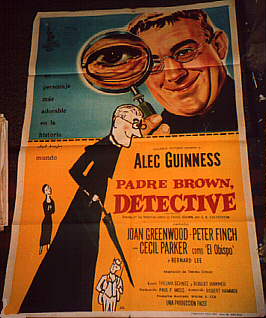
Sir Alec Guinness (Obi Wan Kenobi for the younger folks) played Fr. Brown in a 1950s adaptation of the beloved stories. Guinness' story was told a few months ago in Gilbert Magazine. An actor's study of a character and an author led him to embracing the Catholic Faith.

I have mentioned this before, but as a lifelong Sherlock Holmes fan, I am stupefied by how I never discovered Chesterton and Fr. Brown until my mid - 20s. I strongly encourage all Chestertonians to revisit these tales. It is so rare that a character can be crafted in the detective drama who is so unassuming and improbable, yet still so wonderfully reflect the improbable bumbling of normal life.

Death of Dickens

It is fitting, since this year commemorates the publishing of GK's Charles Dickens one century ago, that we also commemorate the death of Dickens 136 years ago today. Today's entry in Chesterton Day by Day is:
THE hour of absinthe is over. We shall not be much further troubled with the little artists who found Dickens too sane for their sorrows and too clean for their delights. But we have a long way to travel before we get back to what Dickens meant; and the passage is along an English rambling road -- a twisting road such as Mr. Pickwick travelled. But this at least is part of what he meant: that comradeship and serious joy are not interludes in our travel, but that rather our travels are interludes in comradeship and joy, which, through God, shall endure for ever. The inn does not point to the road: the road points to the inn. And all roads point at last to an ultimate inn, where we shall meet Dickens and all his characters. And when we drink again it shall be from the great flagons in the tavern at the end of the world.

Thursday, June 08, 2006

GKC: Papist

G. K. Chesterton stands as a colossal figure in 20th century Catholicism – literally and figuratively.

But just as he was not always the “young man mountain” (as George Bernard Shaw called him), Chesterton was not always Catholic.

He was barely even a Christian.

He was baptized as an infant, but the baptism was more a matter of convention than belief. He was raised, as he later said, in a basically agnostic environment.

Indeed, he declared in Orthodoxy, “I was a pagan at the age of twelve, and a complete agnostic by the age of sixteen.”

Early on, he even wrote anti-Catholic poetry. In one poem, “The Hero” (from when he was about 11 or 12) he wrote:

He had chased all Holland’s navy
Back into the Zuyder Zee
As he smote the Papish tyrant
On the Spaniard’s native sea.

But he also evidenced signs of Catholic/Christian spirituality as a youth. In 1892, for example, he won the Milton Prize at his school with a poem about St. Francis Xavier. He also wrote a poem in praise of Mary, and, foreshadowing one of his later literary achievements, one about St. Francis of Assisi.

A second source of spirituality and latent Christianity was his love of Christmas. This developed in him, he noted, “an affection for the Blessed Virgin and the Holy Family, for Bethlehem and the story of Nazareth.”

That spirituality found support and nourishment though Frances Blogg, whom he began courting in 1896, and married in 1901. She was a devout Anglo-Catholic, and she helped him to grow in his appreciation for Christianity.

“She actually practiced a religion,” Maisie Ward quotes him in her biography of GKC. “This was something utterly unaccountable both to me and the whole fussy culture in which she lived.”

In 1911 in his dedication to The Ballad of the White Horse, he thanked Frances for the gift of faith she’d given him:

Therefore I bring these rhymes to you,
Who brought the cross to me.

He had already become a defender of Catholic teachings by this time. But it was to be 11 years before he became a Catholic. The delay was due in part to not wishing to separate himself from his Anglican wife in any way.

At the same time, though, the more he studied and read and thought, the more he came to the conclusion that only Catholicism offered the completeness of faith.

“The Catholic philosophy is a universal philosophy found to fit anywhere with human nature and the nature of things,” he wrote in The Catholic Church and Conversion.

He noted in the Toronto Daily Star that he had really been Roman Catholic in his orientation for nearly 20 years prior to his conversion, and had been struggling to discern whether Anglo-Catholicism really was a branch of Catholicism that had the authority of Catholicism. He ultimately determined it was not.

“But the point is that the Church of England does not speak strongly. It has no united action. I have no use for a Church which is not a Church militant, which cannot order battle and fall in line and march in the same direction.”

He found himself sitting outside where he felt he belonged. As he wrote to his friend Maurice Baring in 1920:

“I used to think one could be an Anglo-Catholic and really inside it; but if that was (to use an excellent phrase of your own) only a Porch, I do not think I want a Porch, and certainly not a Porch standing some way from the building. A Porch looks silly, standing all by itself in a field.”

By 1922, Frances finally gave her consent. Gilbert was baptized a Roman Catholic September 30, 1922. Frances followed him into the Catholic Church on November 1, 1926.

After his conversion, he was asked repeatedly why he had done it. He game many responses, including this one in the essay, “Why I am a Catholic,“ from Twelve Modern Apostles and Their Creeds:

“The difficulty of explaining `why I am a Catholic’ is that there are ten thousand reasons all amounting to one reason: that Catholicism is true. I could fill all my space with separate sentences each beginning with the words, "It is the only thing that . . ." As, for instance, (1) It is the only thing that really prevents a sin from being a secret. (2) It is the only thing in which the superior cannot be superior; in the sense of supercilious. (3) It is the only thing that frees a man from the degrading slavery of being a child of his age. (4) It is the only thing that talks as if it were the truth; as if it were a real messenger refusing to tamper with a real message. (5) It is the only type of Christianity that really contains every type of man; even the respectable man. (6) It is the only large attempt to change the world from the inside; working through wills and not laws; and so on.”

In The Thing, he notes simply, “Those who know the Catholic practice find it is not only right, but always right when everything else is wrong.”

Indeed, as he concludes “Why I am a Catholic,” the Church is “the trysting place of all the truths in the world.”

In a letter to Baring dated Feb. 13, 1923, he said, “Of course there are a hundred more things to say; indeed the greatest argument for Catholicism is exactly what makes it so hard to argue for it. It is the scale and multiplicity of the forms of truth and help that it has to offer.”

Quite simply, he contends only authentic Catholicism offers the “arsenal” and the authority to battle whatever “potential enemies” to faith the world might offer.

Needless to say, at new of his conversion, Catholic friends were overjoyed, and non-Catholics were dismayed (though the more knowing ones recognized he had long been a Catholic anyway). But he defended his conversion in a series of essays and books.

He contended that many of the objections raised to Catholicism simply misunderstand what the religion is about.

In response to those who argued to Catholicism involved blind obedience and lack of reason and thinking, for example, he counters in he Catholic Church and Conversion, that, “To become a Catholic is not to leave off thinking, but to learn how to think. It is so in exactly the same sense in which to recover from palsy is not to leave off moving but to learn how to move.”

In the New Witness he countered arguments that what the world need is a religion that will “move with the world.” That, he said, is precisely what we do not need.

“We want a Church that will move the world. We want a Church that will move the world. … It is by that test that history will really judge, of any Church, whether it is the real Church or no.”

For Chesterton, that real Church was the Roman Catholic Church. He would spend the rest of his life defending it, and through his writings, the rest of our lives.

Tuesday, June 06, 2006

Chesterton the Journalist

I have troubles referring to GKC as a journalist. When I hear “journalist,” I think "Kolchak.” I’m not the only person who has grappled with the label. Paul Johnson wrote in the Winter 2002 Chesterton Review:

[M]ost of his time was spent in journalism. In one sense, this is curious. Journalists deal with facts, or at least factual lies or half-truths. GKC avoided facts. There are fewer facts in his books, including his history of England, than anyone else’s. Yet his journalism survives just as fairy stories survive, because neither is attached to facts, which grow out of date and are uninteresting. GKC was a highly unprofessional journalist but he believed strongly in the ethics of journalism.

A “highly unprofessional journalist.” That seems apt. It’s not fair to say he wasn’t a journalist, just because he didn’t engage in the muckraking of his era or doesn’t resemble the shoe hounds of today. After all, he was a denizen of that hotbed of journalism, Fleet Street, his biographer Michael Coren noting that “most of the mythology about Gilbert had its origins in Fleet Street,” and that “Fleet Street was his domain, and he was as much a part of it as the El Vino and Cheshire Cheese watering holes which he frequented.”

It might be correct to say that GKC was an op-ed writer. That, after all, is what he wrote: opinion pieces by the truck-full, especially for the Illustrated London News. He landed that weekly column gig in 1905 and would do it for over thirty years, publishing over 1,600 columns. They paid him 350 pounds annually (which, using the calculation explained last week, would equal about $35,000 today). The assignment gave him financial stability and continued access to the leisure that allowed him to create some of the finest books of the early twentieth century.

Even if he isn’t properly considered a journalist, we can be grateful that the journals of his day thought him worthy of the title.

_________________________________________

In a 1991 article for the Midwest Chesterton News, Fr. James Schall shed broader light on the journalism issue, quoting Belloc:

Chesterton was a "journalist ... the chief of that trade," that is, someone who thought that telling the truth to anyone who could read was itself the most worthwhile of enterprises. “The journalist is the man who discovers the truth about important happenings affecting his country in the world even as they happen, and who, having discovered the truth, proclaims it in such a fashion that his fellows shall know it too.”

That passage from Belloc is one my friend William Burleigh at Scripps-Howard would like very much. Chesterton did have the uncanny ability to discover the roots of ultimate things in the happenings of every day events which often ceased to be merely ephemeral through his very words.

But Belloc feared that such writing the truth in the press could not be heard in his land. Belloc compared Chesterton to Samuel Johnson. "Dr. Johnson telling some truth was heard by all the England of his time, all the England which counted, in the sense of that word 'heard' when we use it to mean understood and taken for what he was in full. We have no longer the social machinery for such appreciation." The ability to "hear" the truth is also a function of our wills to want to hear it.

Belloc saw in Chesterton the journalist who could "most convey to his fellow-citizens those things they most needed to know." It was in this "expression of thought" in which Belloc wanted to "continually live." One almost thinks that the only comparable man in the world today is the Holy Father, the one who speaks the truths we most need to know but whose voice is stilled because "we no longer have the social machinery for such appreciation" of what he is saying.

Since is is kind of a creepy date.........

Its not my normal day to post, but since Eric already had a 06/06/06 incident, I feel like I should come on here and make a fitting contribution. A recent issue of Gilbert! featured an interview with the director of Exorcism of Emily Rose, and I was very impressed with his depth and insight. There was far more to this man than one would expect from a "hollywood figure."

Today marks the release date of the remake of The Omen. Exorcism of Emily Rose seems to have gotten some good feedback in Chestertonian circles, and I think that part of the charism that we hold involves engagement with both the high arts, as well as the popular entertainment which shapes the culture.

I really liked the original Omen movie. Gregory Peck always had a tremendous screen presence. Actors like Peck conveyed an authority and a masculinity that has vanished in contemporary filmmaking. The original Omen had few special effects, which left it with a "realistic" feel to it. The story was character driven, with events unfolding through the revealing of the truth about the nature of Damien, and especially Pecks character going from dissmissive, to doubtful, to belief.

The reviews I have read dont leave me much hope, but I am curious to see how a new generation of producers and filmmakers take this.

Chesterton Celebration Ambushed by Devil

It's June 6, 2006, the day of the devil, and Chesterton and Friends has been hit. Over the weekend, I assembled a post about "Chesterton the Journalist." When I tried to retrieve it from my Word software, I couldn't access it. In addition, lots of other features on my computer have been disabled. I've never seen anything like it (I type this from my day job's computer). I have a message into my tech consultant. If he can't fix it, I'll call my priest.

In any event, look for Chesterton the Journalist this evening.

Monday, June 05, 2006

Gilbert in the Countryside

Maisie Ward writes of what an American saw:
"London," said a recently-arrived American, "is the most marvellously fulfilling experience. I went to see Fleet Street this morning, and met G.K. Chesterton face to face. Wrapped in a cloak and standing in the doorway of a pie shop, he was composing a poem, reciting it aloud as he wrote. The most striking thing about the incident was that no one took the slightest notice."
Though Gilbert was very much a man of Fleet Street, soon after his marriage to Frances it was decided that they should abandon their London flat in favour of a more robust and natural domain. And so it was that in 1909 the two of them quit their lodgings at Overstrand Mansions of Battersea and installed themselves at Overroads, Beaconsfield. The similarity of the two places' names is entirely coincidental, though in his typical fashion Gilbert found it both delightful and meaningful.

As to why they chose Beaconsfield:
After we were married, my wife and I lived for about a year in Kensington, the place of my childhood; but I think we both knew that it was not to be the real place for our abode. I remember that we strolled out one day, for a sort of second honeymoon, and went upon a journey into the void, a voyage deliberately objectless. I saw a passing omnibus labelled "Hanwell," and, feeling this to be an appropriate omen, we boarded it and left it somewhere at a stray station, which I entered and asked the man in the ticket office where the next train went to. He uttered a pedantic reply, "Where do you want to go to?" And I uttered the profound and philosophical rejoinder, "Wherever the next train goes to." It seemed that it went to Slough; which may seem to be singular taste, even in a train. However, we went to Slough, and from there set out walking with even less notion of where we were going. And in that fashion we passed through the large and quiet crossroads of a sort of village, and stayed at an inn called The White Hart. We asked the name of the place and were told that it was called Beaconsfield (I mean of course that it was called Beconsfield and not Beaconsfield), and we said to each other, "The is the sort of place where someday we will make our home."
How prophetic that remark would prove to be.

Apart from this romantic discovery, the reasons for moving out "to the country," as it could be called, were practical. The two of them had hopes for a family, and they did not want to raise it in the city. These hopes were tragically dashed by Frances' own phisiological problems, but their failure to sire an heir was not for a lack of effort. What was more, however, life in the city was beginning to become a strain on both of them. Gilbert and Frances, it must be remembered, were still very much lovers, and very much in love. It was hard for Frances to have to share Gilbert with Fleet Street every day, and being there, for him, meant that he always had to be "on," so to speak. They wanted space, quiet, and a garden. They wanted Beaconsfield.

The trend of journalists and cultural types abandoning London to live in the country was not an uncommon one, and the Chestertons' decision to do so was noted by all and sundry, endlessly commented upon, and would remain a subject of controversy even unto their deaths, if you can imagine. Some criticised them for being too far from London to be cultured; others assaulted them for not being *far* enough from London to be *counter-cultural*. Gilbert treated all of this faddishness lightly, of course, and even managed to have some fun with it:
Rival ruralists would quarrel about which had the most completely inconvenient postal service; and there were many jealous heartburnings if one friend found out any uncomfortable situation which the other friend had thoughtlessly overlooked.
For Gilbert, of course, it was not so much the countryside as the country people who made the move really worthwhile. Small towns have a way of forcing the newcomer into a community already formed rather than giving him the advantage of forming his own cliques and fellowships (at least initially), and it was for this reason that Gilbert found it so important to get on well with the town's barbers, doctors, inn and shopkeepers. He saw in them the romance of civilization writ small upon the few; the whole clash of a thousand cultures and a thousand years resounding from out the ruckus of the town meeting hall.

If in Frances Gilbert had found the one thing he had ever wanted, in Beaconsfield he found everything else. His friendships with the locals produced interesting literary and artistic results, though much of the work remained hypothetical or fragmentary. His pictures were cherished prizes for the local children, as were his jokes, puppet plays or even his mere presence. For indeed, though Gilbert and Frances were not blessed with children of their own, their home at Overroads was nonetheless conducted with children in mind, and it became a place of great delight for the local brood. Pageants and parties were also in the works, and it was in this way that Gilbert cemented himself so firmly in the local consciousness. It is from such stuff whence springs the memorable anecdote about his astonishing ability to toss buns into the air and then catch them in his mouth.

It was in Beaconsfield also that Gilbert's friendship with Fr. John O'Connor took root and blossomed into the great and lasting relationship that it would become. Gilbert found O'Connor to be a delightful companion in every regard, for he was literate, urbane, compassionate and wise. He was everything that the disparaged stereotypical priest was not, and it was this paradox that first led Gilbert to consider the prospects of a priest-detective. It is well known that Father Brown was modelled after Fr. O'Connor, anyway, so I will not go into it here. I expect it will be dealt with in the upcoming article about Father Brown himself.

In any event, the modern North American lifestyle does not allow us much in the way of enjoying the pleasures of a home as Gilbert and Frances did, and for that there can be nothing but remorse. Properties are small, and real gardens are rare, if there is even space for them. Living in apartments is becoming a grim necessity. What's worse, of course, is the pollution, the noise, and the cold impersonality that somehow manages to prevail even where quarters are too close for comfort. Reading of Gilbert's idyllic life in the countryside is simultaneously satisfying and troubling to his fans, for his adventures there are certainly delightful and brilliant, but in all of it we find one of the few areas of Gilbert's life that it is difficult - if not impossible - for us to properly emulate. Things have truly changed, and not for the better. His life in Beaconsfield is the sort of life that is no longer a substantial reality, or even much of a memory, but is, rather, almost become a myth. It was to this beautiful, lost world that Belloc's The Four Men was a valediction.

In short, Gilbert's life at Beaconsfield delights us so because it is a lively thing, and full of wonder, but confounds and depresses us because we can never ourselves attain it. In this there is the true essence of tragedy; of a line crossed and obliterated.

For we have looked down to Camelot, and the curse has come upon us.

Sunday, June 04, 2006

Misc. Chesterton

It's Sunday, and we normally don't post on Sundays. But it's the 16-Days of Chesterton, so I went through Michael Coren's biography, Gilbert: The Man Who Was G.K. Chesterton, and pulled out some good lines:

Gilbert could always, would always, be a threat to those who regarded themselves as comfortably entrenched in either the old philosophies or the new ideas.

Joy, happiness, was to Gilbert what conformity was to other theologians; it took on the importance of a virtual sacrament to him. "Man is more himself, man is more manlike," he wrote, "when joy is the fundamental thing in him, and grief the superficial."

There is little doubt that if his cause had been socialism or the pursuit of the permissive age he would now be known and read by a far larger audience.

Gilbert's symbol of hospitality was always sausages and beer.

Gilbert could, and would, write under the influence of alcohol, with no visible difficulties or impairments to his thought and clarity.

Saturday, June 03, 2006

The Chestertonian Life

Over the course of the past week, and over the course of the next week, there has been and will be much talk about how Chesterton lived his life. Though this is an excellent subject, a perhaps more worthy question for his devotees to ask is how they are to live their lives like Chesterton.

In my original post for this project, I suggested that Chesterton stood largely for the triumvirate of faith, sense and family. It would be helpful, I think, to discuss exactly what each of these things implies, for they are so much more than just their names.

Faith

As near to our hearts as faith is (I speak generally, of course; I do not assume that all of our readers are Catholic, or even especially Christian), there is much to be said of it in relation to the Chestertonian ouevre. A golden thread can be found running throughout his entire body of work, and it is a thread of gratitude. Those of you who have read Orthodoxy are well aware of just how important the idea of proper gratitude was to Gilbert, and of how important it, too, should be to us. Gratitude is not merely a courteous gesture to one who has granted us a boon, but also an act of loyalty. Gratitude and loyalty are the cornerstones of faith.

For all of his varied themes, it is easy to see how essentially delighted Gilbert is with most everything about which he has written. "The Battle of Lepanto" is not merely a chronicle of that epoch-making event, but a hymn of thanks, as if to thank God there was a Lepanto, that there was a Don John of Austria, and that there were Turks there to be fought. He has referred to this battle as being the stuff of "the true romance," which is to say, a thing both mythic and real. The parallels to his praise of Christianity for the same reason should be well-known.

In being thankful for the world, and for the stories and people that are its essence, there is a necessary loyalty to these same things that must be maintained. Again we may take Orthodoxy as our primer, here. He speaks of the world as being not just a place where we are stuck by chance and for no particular reason, and which we may as well just leave if it doesn't suit us, but rather as our family's ancestral fortress, with flags flying, battlements armed, and an enemy at the gate. We must be loyal to life, because it is the only thing we can be said to "have" that both matters significantly and is not actually ours. Suicide is the ultimate act of treason.

But there is more to be loyal to than simply the world. One of Gilbert's most famous essays - "A Defence of Rash Vows" - is one of the most important pieces of work we might read to gain an understanding of the principle. For a long time I held what follows to be the most deliciously perfect statement in all of Gilbert's work:
The man who makes a vow makes an appointment with himself at some distant time or place. The danger of it is that himself should not keep the appointment
I have since transferred my idolatry to the beginning of an essay about Fielding's Tom Jones, but there is still much to consider in the line above. The loyalty that binds a man to a course of action that he himself has determined, with consequences that he himself will impose, and the point of which may be largely lost on other people - if not ignored outright - is a very precious thing. Grim Prussian types would perhaps call it the Will, or the Self-Will, or some such lifeless thing. Chestertonians can call it "being a man."

Sense

I use the word "sense" rather than "reason" or even "intelligence" for a number of reasons, most of which are possibly frivolous. For one thing, it is evocative of the idea of "common sense," as it should be, but the minute nature of "faith, sense and family" does not allow for such a lopsided inclusion. What is more, however, I have used the word because I don't mean reason or intelligence. The cruellest monsters of human history have had this trait in abundance; their knowledge was too knowledgable, and their reason too rational.

No, I use the word "sense" because I want to imply that beautiful and delicate marriage between reason and emotion (or sensibility/sensitivity, if you wish to more fully grasp the genesis). And it must be a marriage, after all. No other union could produce such wonderful results, and no two subjects could be simultaneously so meritorious together and so terrible in isolation. Gilbert wrote memorably (Orthodoxy again, I'm afraid) that an excess of reason is the cause of insanity; the madman exists at a center of most exquisite logic, but it is the utterly impregnable nature of his reasoning that makes it worthless. There is no way to argue against the idea that all the world is engaged in some conspiracy against him, or that he really is the secret King of Siam. In the other hand, of course, lies clenched the excess of feeling that makes men foolish rather than cruel or insane; libertines, that is, rather than lunatics. In any event, there is a fine line to be walked between a man who is too weepy to function and a man who sheds no tears, and it takes the balancing of both reason and feeling to do it.

And so, we find "sense." Gilbert's devotion to this miraculous marriage can be found in all sorts of places, and was in particular vital in informing his distributism. Even while the real problems of economics were being rationally addressed, so too were the real victims of economics being addressed as real people, about whom compassion and consideration were necessary for the formation of worthy policy. "Sense" is that curious conclusion that informs the often fantastic results of his more fanciful works, such as his play, The Surprise. Because of this, the moral of a Chesterton story really is moral, and this is highly refreshing.

Family

About the family there is much to be said, and so it may perhaps be unsatisfying that I have little to say about it.

Gilbert's love of family bordered almost on idolatry, though in his case it would be an idolatry of the Holy Family, and the worship is arguably well-deserved. References to the power and primacy of the family are scattered across his works as a farmer might scatter seeds, and with as much of an effect. The family, says he, is the oldest, smallest, and most powerful state. Marriage is that cleaving-together that fulfills the prerogative of the divine creative Fiat, and brings forth man again. Children are the heart and soul of this entire world. For a man cruelly denied a family of his own, Gilbert was certainly well-up on the value thereof.

But at least, for all that, he was surrounded by friends who loved him, and the children of such friends. He was a man old in wisdom and love, and discovered many truths through conjecture that most of the race only grasp through the accident of practice. Speaking as a mere student - and an exceedingly solitary one, at that - I can not hold myself up as able to offer competent commentary on this subject, and it is for this reason that my remarks have been so brief and general. I can only recommend a reading of What's Wrong with the World or Brave New Family to appreciate the full depth of Gilbert's work in this field.

The End?

In closing, then, we may return once more to "A Defence of Rash Vows." Though the essay is a largely jovial one, with many sly turns of language and pleasant expressions, there is to it a very heartfelt exhortation to remember what man once was, and could very easily be again with a little hard work and fortitude. The essay's conclusion is almost a Dies Irae:
All around us is the city of small sins, abounding in backways and retreats, but surely, sooner or later, the towering flame will rise from the harbour announcing that the reign of the cowards is over and a man is burning his ships.
==

Part two of this examination will appear next Saturday, in which I will explain to you just how one might put these principles into practical effect, and the results of such an extravagant experiment.

And of course, be sure to show up on Monday, for our second week of Chestertonian excess. I will be kicking things off with a look at the marvelous history of Gilbert in the countryside on Monday, and the rest of the C&F crew will have material for your consideration as well, of course, including treatments of the phenomenon of Father Brown, Gilbert's Distributism, and his conversion to Roman Catholicism.

Have a lovely weekend.

A GKC biographical anecdote

While visiting Manhattan one evening, G. K. Chesterton was taken to view the bright lights of Broadway.

After staring at the glowing array of product names and marquee advertisements, Chesterton declared, "How beautiful it would be for someone who could not read."

Friday, June 02, 2006

A special reminder

Owing to a hideous day spent cleaning out a woodshop, I will be going to bed early tonight and sleeping in tomorrow. As such, my article on the Chestertonian Life (Day 6 of our Chesterfest) will not appear until the afternoon.

I appreciate your patience.

1914

One of the memories from college which remains with me most vividly today comes from a 20th Century history class I took as an elective. Our instructor told us about a monument to fallen graduates at the French military academy. According to his story, the monument is made up of stone slabs with a year at the top, and the names of fallen graduates carved on face. There is a notable exception, one slab bears a solitary engraving - 1914. That somber, single marking on the stone exists as a testament to the graduating class of 1914 - all of whom died in the Great War.

Gilbert Keith Chesterton's writings of the wartime era have been called Anglo propaganda by critics, who mistakenly place Chesterton on the same level as the other nationalists of his day, forgetting that GKC was against the Boer War. His writings during the war years show a prescient knowledge that the Great War indeed was a war of ideas. With the closing of every coffin lid, the doorway to a new Christendom was slammed shut. Every clod of dirt which buried an entire generation of Europe's youth buried along with them the honor, dignity, and hope of Christian civilization.

Far from being an Anglo apologist, Chesterton I think provides a wonderful image of Just War.
From ILN Nov21 1914 The Current Scene:

"On every sword that is made by man, while the workshops of the world turn out that terrible kind of cutlery, ought to be graven the two mysterious phrases which were on the fairy sword of King Arthur. On one side was written 'Take me', and on the other 'Cast me away.' If no more than this dim fable recalled the doubtful hero fo Camelot, we should know that he defended Christendom against the heather. For the hightest mark of Chirstian civilization is this capacity for feeling that the sword is at once noble and unnatural; and the more unnatural it is, the more noble it is. "

WWI was the first truly industrial war, with aircraft, machine guns, chemical weapons, and all of the fruits of progress turned to battlefield implements.

What emerged from the ashes of the Great War were National Socialism, Communism, and a cloud of self-doubt and lost identity which still covers the West.

Thursday, June 01, 2006

Gilbert and Frances: Always Lovers


G. K. Chesterton barely mentions his wife, Frances, in his autobiography.

That fact might lead someone to conclude that he cared little about her.

That conclusion would be wrong.

He cared about her and her wishes so much that when she asked not to be mentioned at length in the book, he complied.

Her desire to be out of the limelight and his desire to fulfill her wishes are typical of their relationship – a relationship marked by deep love, devotion and mutual respect.

They were lovers, friends, traveling companions, spiritual partners, and playmates who shared nearly 35 years of married life.

Gilbert Chesterton married the former Frances Blogg June 28, 1901, after a nearly 5-year courtship. About the time of their honeymoon, he wrote a poem called “Creation Day” in which he declared:

“Never again with cloudy talk
Shall life be tricked or faith undone,
The world is many and is mad,
But we are sane and we are one.”

Before they married, Frances had had ample warning what life might be like with G. K. who was in many ways just an overgrown boy – albeit a genius. He was absent-minded, unkempt, and terrible with money.

She quickly took charge of the mundane details to free him to write and speak. She paid the bills and tried to carefully dole out the money that he would inevitably lose, spend, or give to beggars.

It was she who suggested the slouch hat and cape that became his trademarks. The get up was not a fashion statement; it was a practical way to deal with his lack of concern for his appearance and how he was dressed. As biographer Maisie Ward pointed out, after a valiant battle to keep him neat and clean, she simply shifted strategies and made him “picturesque.”

It was she who kept his schedule and made sure he got out to give speeches, to keep appointments, or to get to the train on time. The most famous story of his reliance on her in this regard is when he telegraphed her one time saying, “Am at Market Harborough. Where ought I to be?”

And it was her deep faith that helped to bring him to Christianity – and ultimately to Catholicism. In 1911, he dedicated his Ballad of the White Horse to her declaring,

Therefore I bring these rhymes to you,
Who brought the cross to me.

Frances was devoted to her brilliant husband. At one point, she wrote to a priest friend, Father Ignatius Rice, “I am in a perpetual state of wonder at him.”

Chesterton, meanwhile, adored his wife. As Dale Alquist notes in his Common Sense 101: Lessons from G. K. Chesterton, he referred to her as his “bride,” his “queen,”
and his “friend.”

They had sadness and struggles. Early on, there were money woes. They both suffered perpetually from ill health.

And they could have no children. Frances underwent surgery to help with a problem related to this, but without success.

So they filled their homes with the children of friends. Chesterton’s secretary, Dorothy Collins, became almost like a daughter to them.

Fittingly, Chesterton’s last words were directed toward his wife and his “adopted” daughter.

On June 13, 1936, Frances and Dorothy were keeping vigil with the unconscious Gilbert when he suddenly awoke.

He looked at Frances and said, “Hello, my darling.” Then he turned to Dorothy and said, “Hello, my dear.”

He then lapsed into unconsciousness and died the next morning, June 14,

Frances felt his loss. In a letter written in July 1938, she said, “I find it increasingly difficult to keep going. The feeling that he needs me no longer is almost unbearable. How do lovers love without each other? We were always lovers.”

She died on Dec. 12, 1938.

If at death we are indeed met on the other side by those we love, it’s easy to imagine that he was standing there greeting her with, “Hello, my darling.”

During the Delay

We have hit a small delay in our Chesterton celebration. In the meantime, you may want to check out an interesting 2-part series that Rod Bennett has run about a GKC "friend" (as defined loosely on this blog): C.S. Lewis and Pulp Fiction. Entertaining stuff.