Matthew Perry,
Taylor Swift
A site dedicated to G.K. Chesterton, his friends, and the writers he influenced: Belloc, Baring, Lewis, Tolkien, Dawson, Barfield, Knox, Muggeridge, and others.
The American Solidarity Party is a relatively new Christ Democratic party that espouses ideas very much in line with Christian and Catholic teachings - and, of course, Chesterton's ideas.
The party, for example, embraces Distributism.
From the party's principles:
From Aleteia -
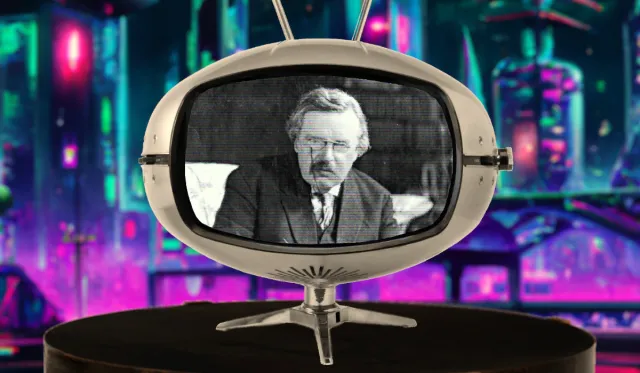
I’m just going to come out and say this. Sometimes, when you’re a writer, you simply have to grit your teeth and make a blunt statement. Prestige television — the high-toned, sophisticated dramas that win all the awards — is boring.
Not all of it, to be sure, but enough that I started to grow suspicious. Something is wrong with modern storytelling. For instance, that show about big city lawyers bending the law in clever ways while trying to justify the guilt of their moral complicity? I made it about halfway through the series and bailed.
And that show about the science teacher who becomes a drug dealer and slowly becomes corrupted? It was like watching paint dry. Or the anti-hero mobster in Jersey who is ruthless with his enemies but has a conflicted, soft side with his family and talks to his therapist about his feelings of guilt, as if that somehow makes him a sympathetic guy? Not interested.
Does this make me a philistine? Probably. Does it mean I have trouble appreciating modern-day art? Almost certainly. Perhaps the issue is entirely within me. Maybe I’m the one with the defective sensibilities. I prefer turning the television off to re-read Lord of the Rings or stories of the saints or old fairy tales — or even re-watch old sitcoms from the 80s.
For a long time, I would force myself to watch prestige television. After all, so many award committees couldn’t be wrong. But as I watched, I couldn’t help but to lose interest. After this happened enough times, I began to ask myself what it is, what particular quality I was failing to find compelling.
G.K. Chesterton, in his book Orthodoxy, suggests the answer. The problem with modern storytelling is that it overwhelmingly focuses on the human ego. Stories now tend be full of anti-heroes, rebels against the system, people with something deeply wrong with them. Most plots go from nowhere to nowhere; no progress is made. The whole point is a psychological deep dive into the allegedly fascinating twists and turns of the human mind, how we morally complicate our decisions before bearing up under the guilt or making ambiguous justifications.

The result of all this interiority is a world in which the anti-hero, the superior or extraordinary person the story focuses on, makes their way through a unique life. There are no dragons to be fought and overcome. There is only endless interior introspection. Each person a hero of their own story. Each hero a suffering Prometheus trying to make meaning in a senseless world.
But, as I tell my parishioners all the time, sin is boring. Moral conflict and self-justification, all the ways we rebel from God and try to take control of our own destinies, rebellion, these things tend to make us feel larger in our own estimation, but they also make the world smaller. To paraphrase Groucho Marx, a world in which my ego is the most fascinating thing is not a world I want to live in.
This is why Chesterton says that the truly exciting stories are those that make us smaller so the world can become larger. If stories aren’t defined by our personal proclivities and willfulness, suddenly the magic enters back into everything. The world becomes an exciting, romantic place. These types of stories are about ordinary people — people like you and me — who encounter an extraordinary universe, who are challenged by it, who genuflect before its beauty, who are in awe of the divine power that created it.
In this way, ordinary people discover grace. We are set upon a heroic journey and discover that something new and extraordinary develops within us.
Chesterton has quipped that there is nothing so extraordinary in this world than an ordinary man and an ordinary woman and their ordinary children. Modern storytelling misses this entirely.
Ordinary people have a far more exciting time than the heroes you see on TV because that which is strange and odd actually strikes them as strange and odd. They find their surroundings cause for fascination and wonder. As Chesterton says, this is the type of person who realizes that it just might be appropriate to fast 40 days just to hear a blackbird sing.

Chesterton harks back to an older form of storytelling – fairy tales. “Fairy tales are the entirely reasonable things,” he writes. Compared to them, everything else rings slightly false. Fairy tales seem to be the stuff of dreams but, in fact, they hold even more truth than a history book. They represent the common wisdom of mankind, which is why fairy tales have an enduring quality. Which of us hasn’t gone back and watched the cartoon fairy tale movies we viewed in our youth? Many of us, I suspect, have introduced these tales to our children.
As a parent, I have read my children fairy tales not because I dismiss my children as childish. On the contrary, I read books like The Little Prince to them every night because I take my children very seriously. I’m introducing them to a world full of virtue and challenges, a world in which God is present, a world in which, if they keep at their heroic journey despite the obstacles, they can slay dragons.
There’s a good reason that storytelling that defaults to an anti-hero is boring, but a tale like Lord of the Rings is the most enduring and popular story of our generation. The anti-hero strives for nothing but self-justification. The hobbits are normal people striving for redemption. To me, the latter is far more exciting. Chesterton agrees. So do a lot of other people, it seems.
https://aleteia.org/2023/09/24/g-k-chesterton-on-why-todays-tv-shows-are-so-boring/?utm_campaign=EM-EN-Newsletter-Daily-&utm_content=Newsletter&utm_medium=email&utm_source=sendgrid&utm_term=20230925
Here are a few quotations from Barfield:
“The obvious is the hardest thing of all to point out to anyone who has genuinely lost sight of it.”
― Worlds Apart
“When the velocity of progress increases beyond a certain point, it becomes indistinguishable from crisis.”
― Night Operation
“True understanding is unattainable without both love and detachment,”
― History in English Words
“Understanding what another human being says to us is always a matter of translation.”
“There is no surer or more illuminating way of reading a man's character, and perhaps a little of his past history, than by observing the contexts in which he prefers to use certain words.”
― History in English Words
“Before the scientific revolution, [man] did not feel himself isolated by his skin from the world outside to quite the same extent that we do. He was integrated, or mortised into it, each different part of him being united to a different part of it by some invisible thread. In his relation to his environment, the man of the middle ages was rather less like an island, rather more like an embryo.”
― Saving the Appearances: A Study in Idolatry
“It was a question of steering Christian dogma between the Scylla of pantheism and the Charybdis of materialism and its logical conclusion, scepticism.”
― History in English Words
Joseph Pearce continues to offer looks at Chesterton, Lewis, and others.
In The Imaginative Conservative he published an article called "Faith & Fantasy: Chesterton, Tolkien, Lewis, Rowling & Other Tellers of Tall Tales"
It begins:
Tall tales are still being told. The light still shines. The torch is still being handed from generation to generation. Thanks be to God, the giver of the light, and thanks be to Chesterton, Tolkien, Lewis, and all other legend-makers and torchbearers of tradition.
Blessed are the legend-makers with their rhyme
of things not found within recorded time.
—J.R. R. Tolkien (From “Mythopoeia”)
This is a festive year for all admirers of the works of J.R.R. Tolkien and C.S. Lewis. This September will mark the fiftieth anniversary of Tolkien’s sailing into the Mystic West, while this November marks the sixtieth anniversary of Lewis’s passing through the stable door and going further up and further in. It would seem appropriate to celebrate these joyous landmarks with an acknowledgment of the legacy of Tolkien and Lewis and of those who influenced them and were influenced by them.
Let’s begin with the connection between “faith and fantasy” which is inseparable from “faith and reason”, as was made evident by Tolkien in his seminal essay “On Fairy-Stories”:
Fantasy is a natural human activity. It certainly does not destroy or even insult Reason; and it does not either blunt the appetite for, nor obscure the perception of, scientific verity. On the contrary. The keener and the clearer is the reason, the better fantasy will it make. If men were ever in a state in which they did not want to know or could not perceive truth (facts or evidence), then Fantasy would languish until they were cured. If they ever get into that state (it would not seem at all impossible), Fantasy will perish, and become Morbid Delusion.
Check out the rest!
Our Sunday Visitor has an article by Russell Shaw about the conversion of C. S. Lewis, "C.S. Lewis and his long journey toward Christianity"
Mapping the spiritual journey of C.S. Lewis doesn’t mean finding that one, special turning point at which he declared himself a believer — that’s clear enough — but tracing the long series of events that led up to it. Fortunately, like St. Augustine writing his Confessions centuries earlier, Lewis himself provides a detailed itinerary of the steps that finally brought him to the point of saying, “I believe.”
Lewis is remembered today as a writer and Christian apologist — arguably the finest of the 20th century. He was not only a prolific writer but remarkably diverse, with an output that included children’s books, scholarly volumes, science fiction, works on Christian doctrine and a moving, intensely personal account of his grief-ridden quarrel with God after his wife’s death.
His books have been adapted for stage, screen and television, and he has been the subject of several biographies. While there is no telling how many people he has reached, the number clearly is in the millions. But his emergence as a Christian writer was long in coming. In “Surprised By Joy,” the autobiographical story of his conversion, he provides a careful, candid explanation of how he “passed from atheism to Christianity.” ...
Check it out.
I just got the May/June 2023 issue, and it is dedicated to C. S. Lewis.
The issue includes numerous articles and review related to Lewis, beginning with the editorial by Joseph Pearce: "The Mere Genius of C. S. Lewis."
Other articles include:
A Literary Communion of Saints: C. S. Lewis and the Power of LiteratureAnd a number of other Lewis-related articles and reviews. I have not read them all yet, but I am looking forward to it.
If you have not discovered StAR yet, and you enjoy intelligent examinations of literature and culture from a Catholic/Christian perspective, I urge you to consider subscribing.
My own contact with Lewis began about the time I first encountered G. K. Chesterton.
As I've noted previously, in the mid 1970's when my faith was wavering I happend to come across some works that righted my spiritual ship: The Confessions of St. Augustine, The Seven Storey Mountain by Thomas Merton, and St. Francis of Assisi by G. K. Chesterton.
Around the same time, though, I also came across the Chronicles of Narnia by Lewis. I read those all in a one week period!
I continued to read Chesterton after than first encounter - but I read even more of Lewis. The science fiction trilogy, Till We have Faces, The Screwtape Letters, Mere Christianity, The Abolition of Man, Surprised by Joy, The Four Loves, A Grief Observed, and severl collections of stories and essay.
I read all those works in a ten-year span. You might say I binged on Lewis!
It is only in the last 20 years that I have been reading enough Chesterton to catch up with the Lewis tally.
Both writers well worth reading.
In a previous post, I mentioned Joseph Pearce's Literature: What Every Catholic Should Know.
Specifically, I noted what books by Chesterton and his friends made Pearce's list of 100 works of literature every Catholic should aspire to read.
It's a pretty comprehensive list. I've read in whole 55 of them. I've read most of The Canterbury Tales, but not all of them, so I did not count that. I've read some of the poems of many of the poets listed, but not all of their poems, so I don't count them. With the Tales and the poets I can say I've read in part six more works he listed.
I have encountered other lists of great works of literature or Catholic works of literature that Catholics should read. Brandon Vogt, for example, has a comprehensive list.
In considering Pearce's list, I have few arguments. It's a good list. Some of the books are hard to find - even in our local library. My personal taste does not run to Jane Austen, so I doubt I'll put a lot of effort into reading more of her books (Mind you, I've taught Pride and Prejudice and even directed a play version of it!). I don't know why he included Shakespeare's The Merry Wives of Windsor - a play I rank among his poorer efforts.
The list does seem very Eurocentric, with a heavy British emphasis, but Pearce is from England, so I'll give him a pass on that.
In the the chapters of the book he does touch on some other writers, but does not add any of their works to the list of 100. There are other writers he never mentions at all..
Among the works I'd add to such a list:
The Sonnets of Shakespeare (yes, a number of his plays are listed, but not his poetry)
Back in 2019, Joseph Pearce published Literature: What Every Catholic Should Know.
He discusses a number of authors in the book, then, in Chapter 25, lists "100 Works of Literature Every Catholic Should Know."
It's a pretty comprehensive chronological list, ranging from The Iliad to Lancelot by Walker Percy. It does not, however, include theological works, hence works like The Everlasting Man did not make the list.
Still, it includes many works by some of our friends.
Hilaire Belloc:
The Path to RomeG. K Chesterton:
The Napoleon of Notting Hill
The Man Who Was Thursday
The Ball and the Cross
The Ballad of the White Horse
Maurice Baring:
C
Cat's Cradle
Robert Peckham
J. R. R. Tolkien
The Hobbit
The Lord of the Rings
C. S. Lewis:
Out of the Silent Planet
Perelandra
That Hideous Strength
Till We Have Faces
The Chronicles of Narnia
Hmm. No Screwtape Letters?
Still, it's a good reading list.
Over the years I've been fortunate to have a number of my clerihews published in Gilbert . The current tally is 50 individual poems. Due to some mix-up, four of those were published a second time.
The last one published was a Robert Burns one in the May/June 2022 issue.
Although I did not attend the Conference last year, I did submit several clerihews for the Clerihew Contest. Alas, they did not make the winners' list, nor have they appeared since in any issue. So unless one of those that I submitted last July make it into print in the future, the tally will likely remain at 50.
Not a bad total.
Oh, I'm still writing clerihews, and will continue to post them here, but I've stopped submitting to the magazine for now.
Here's the published list in alphabetical order:
Achilles - Gilbert Nov/Dec 2017Alexa - Gilbert May/June 2020
Anne Rice - Gilbert Magazine, March/April 2011
As a director, Ed Wood - Gilbert May/June 2020
A somber Marquis de Sade - Gilbert May/June 2017
At Nicaea, St. Nicholas - Gilbert! May/June 2019
Ayn Rand - Gilbert May/June 2020
Charles Bukowski - Gilbert January/February 2017
Condoleeza Rice - Gilbert Magazine, June/July 2007
Dr. Mary Gatter - Gilbert May/June 2017
e (cummings) e - Gilbert Magazine, March/April 2011
Elizabeth Warren - Gilbert May/June 2020
Evangelista Torricelli - Gilbert January/February 2019
Fidel Castro - Gilbert Magazine, April/May 2007
Fred Rogers - Gilbert November/December 2018
Geoffrey Chaucer - Gilbert May/June 2020
G. K. Chesterton - Gilbert Nov/Dec 2017
Herman Melville - Gilbert Magazine, April/May 2007
I don’t know if Rudyard Kipling - Gilbert Magazine, April/May 2007
In his early life Thomas Merton - Gilbert Magazine, March/April 2011
In those woods, Robert Frost- Gilbert Magazine, April/May 2009
Irascible St. Jerome - Gilbert Nov/Dec 2017
Jackson Pollock - Gilbert! May/June 2019
Jean Paul Sartre - Gilbert Magazine, April/May 2007
Lot's wife - Gilbert Magazine, March/April 2011
Methuselah - Gilbert! July/August 2018
Napoleon Bonaparte - Gilbert Nov/Dec 2017
One of the aims of ISIS - Gilbert May/June 2017
One of the aims of ISIS - Gilbert May/June 2020
Paolo Uccello - Gilbert November/December 2018
President James Polk - Gilbert Magazine, May/June 2011
Prolific Stephen King - Gilbert Magazine, March/April 2011
Robert Burns – Gilbert May/June 2022
Rudyard Kipling - Gilbert April/May 2007
Saintly King Henry - Gilbert November/December 2018
Steven Wright - Gilbert May/June 2017
Steven Wright - Gilbert! May/June 2019
St. Dominic - Gilbert November/December 2018
St. Francis of Assisi - Gilbert Magazine, April/May 2007
St. Thomas Aquinas - Gilbert November/December 2018
There was a side of J. R. R. Tolkien - Gilbert Nov/Dec 2017
Titus Oates - Gilbert! May/June 2019
Tron - Gilbert November/December 2018
TV’s Dr. House - Gilbert Magazine, April/May 2007
Vladimir Kosma Zworykin - Gilbert Magazine, March/April 2011
Vladimir Putin - Gilbert (March/April) 2017
When Alexander Pope - Gilbert May/June 2017
When Alexander Pope - Gilbert! May/June 2019
When he was young St. Polycarp - Gilbert May/June 2017
When he was young St. Polycarp - Gilbert! May/June 2019
When talking with Socrates - Gilbert Magazine, January/February 2007
When Siddhartha Gautama - Gilbert Magazine, July/August 2009
Yvonne De Carlo - Gilbert! March/April 2021